
Why Your Funnel Converts the Wrong People (and How to Fix It with Decision Psychology)
As a founder, you might be wondering why your sales funnel is bringing in leads and customers but not the right ones. You then assume that it’s a traffic problem or a design flaw.
However, you may not realize that the underlying issue is a problem with decision-making and systems, which leads to inconsistent conversions. In other words, your funnel might be converting users, but not the type of users you actually want as customers. This led to wasted time on bad-fit leads, requiring you to constantly step in as an approval layer to secure sales.
In this blog, we’ll break down why your funnel is attracting and converting the wrong audience. We’ll use insights from decision psychology to pinpoint what’s missing and show you how to realign your funnel so it consistently attracts high-quality users. You will learn to fix the hidden psychological gaps that are costing you sales, freeing you from being the only one who can close deals.
The Real Problem Isn’t Traffic or Design. It’s Decision Psychology
Consider whether the problem lies in the lack of traffic or in the actions of visitors once they arrive. We’ve observed a scenario known as the “leaky bucket”: when your website or landing page is riddled with flaws such as a confusing layout, unclear messaging, or a lack of trust signals, more traffic simply escapes without converting.
Typically, when this situation occurs, you tend to adjust your colors or layouts, believing that a more visually appealing page will attract better customers. You need to remember that conversion is largely a human behavior issue. According to Harvard Business School research, up to 95% of purchase decisions happen in the subconscious mind. Emotion, not pure logic, drives most customer decisions. In fact, even in B2B markets, a survey found 84% of business buyers base their decisions on emotion (gut feelings, trust, and empathy) over rational analysis.
If your funnel’s messaging and experience don’t tap into those emotional and psychological drivers, you risk two outcomes: either visitors don’t convert at all, or the ones who do convert aren’t truly committed (i.e., the “wrong people” who churn or never buy again).
Start to consider: Without a smart system to qualify and nurture leads, 79% of marketing leads never convert to sales. A funnel that isn’t built around how and why your ideal customers make decisions will convert plenty of wrong users (and leave the right ones unconvinced).
Signs You're Converting the Wrong Audience
Look for these signs, and you can determine that you have a conversion quality problem, not just a conversion rate problem:
1. High Volume, Low Value:
You might be getting leads or sales, but they leave quickly or never upgrade. For example, you run a subscription or membership, and you notice that there are many new sign-ups followed by rapid cancellations. Your funnel may be optimizing for impulse buyers who don’t stick around.
2. You or your sales team must “rescue” conversions:
Do you find yourself personally intervening to close deals that your website or marketing funnel should have handled? If every big client needs a personal call or a custom fix from you, it’s a sign your funnel isn’t persuasive or clear enough to convert the right users. Your business can’t scale if you have to be on every sales call explaining basics that your funnel should clarify.
3. Frequent mismatched inquiries:
You’re getting many inquiries or demo requests, but from people outside your target industry or budget range. This means your funnel messaging is either too broad or attracting users with a different problem than what you actually solve.
4. Focus on freebies or discounts:
You notice that most of your conversions only happen when there’s a giant discount, free trial, or giveaway involved. Such behavior could indicate your funnel is priming people to seek a quick win, not long-term value. These customers may be the wrong fit, drawn in by scarcity tactics or freebies rather than a genuine need.
If one or more of these sounds familiar, it’s time to examine why your funnel is sending the wrong signals.
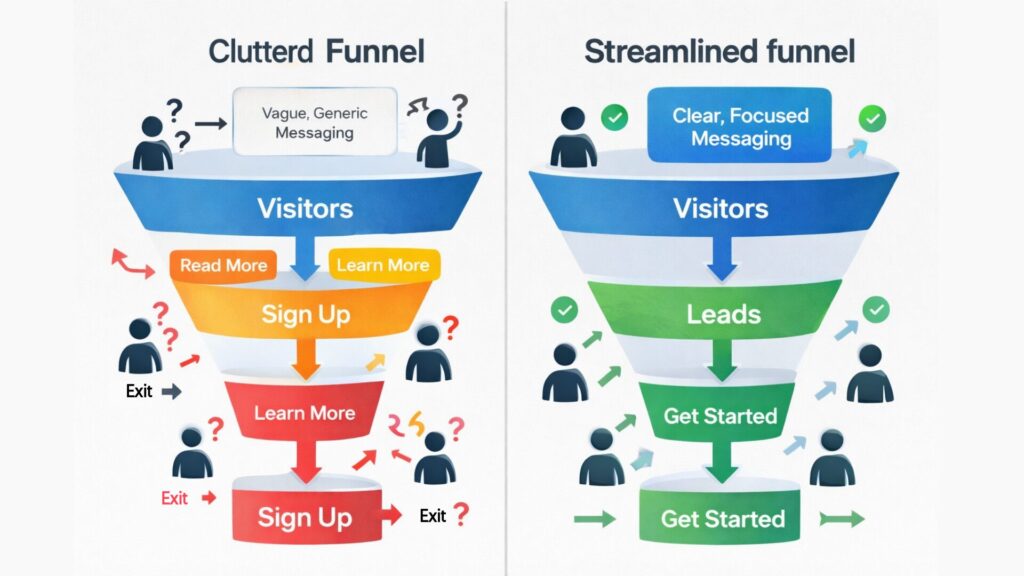
Why Your Funnel Attracts the Wrong People: The Psychology Breakdown
Converting the wrong audience usually comes down to a misalignment in psychology and targeting. Here are some common reasons founders miss, each rooted in decision psychology:
1. You’re Optimizing for Clicks, Not Commitment:
It’s easy to get obsessed with conversion rate and try to remove all friction from your funnel. On the surface, a frictionless funnel means more people complete it.
But beware: if you make it too easy for anyone to convert (e.g., one-click signups, ultra-short forms), you also remove the filters that keep unqualified or low-intent people out. In psychology terms, you want micro-commitments from the user (small steps that prove their interest) before the big ask. If your funnel doesn’t include any micro-conversions (like a quiz, a free resource download, or a custom pricing questionnaire), you might be skipping too quickly to the marriage proposal.
2. Mismatched messaging and intent:
If your ad or headline promises one thing (“Get instant results!”) but your product is actually a long-term solution, you’re seeding the wrong expectations. This mismatch leverages the wrong psychological trigger. You might hook people with curiosity or FOMO, but when they discover the commitment needed, they bail (or become unhappy customers). Be clear about who it’s for and who it’s not for. When your content filters itself, the right people feel “this is for me,” and the wrong people self-select out before they ever fill your pipeline.
3. Neglecting Emotional Drivers:
In reality, your ideal client has fears, desires, and cognitive biases at play. If your funnel doesn’t address those, it either won’t convert them at all or might convert those who respond only to superficial bait.
Think about trust and fear: are you easing the biggest fears your ideal customer has (e.g., “Will this action make me look good to my boss?” or “Will I waste money?”)? If not, you might only be converting folks who aren’t worried about quality (often bad fits). Incorporating psychological triggers can help attract the right people. For instance, using social proof (testimonials, logos of clients) near your CTA will reassure discerning prospects that they’re making a safe choice.
For more on ethical psychological triggers, see our breakdown of 9 psychological triggers in marketing that influence conversions.
4. Founder-Centric Sales Process
Occasionally, the problem arises when your digital system fails to convert without your involvement. As you attempt to distance yourself from the process, the funnel struggles because it lacks the personalized touch and profound understanding of the customer’s decision triggers that you possess.
Essentially, the tribal knowledge in your head hasn’t been translated into the funnel. The wrong people might trickle through because the funnel isn’t asking the nuanced questions or providing the tailored information that you would in person.
To fix this, you need to operationalize your expertise: for example, if you always find yourself addressing the same 5 objections with favorable prospects, make sure those are proactively answered in your funnel content (FAQs, case studies, comparison pages, etc.).
Your goal is to embed the decision-making journey that you guide people through into your funnel so it can convert the right people without you having to handhold every deal.

How to Fix Your Funnel (So It Attracts and Converts Right-Fit Customers)
1. Clearly define your value proposition and target audience.
Your landing page should answer three questions instantly:
- What do you do?
- Who is it for?
- Why should they care?
Use plain language, which your ideal customer uses.
Instead of: “Cloud-based solutions for SMB workflow enhancement”
Try: “We help 5–50 person businesses automate boring paperwork so you save 10 hours a week.”
Call out your audience. “For boutique e-commerce brands” or “Ideal for manufacturing CEOs” acts as a magnet for right-fit prospects.
Trying to appeal to everyone attracts nobody. Tighten your messaging to your niche.
2. Map the customer decision journey.
Think from the perspective of a skeptical, busy CEO. At each stage (awareness, consideration, decision), what questions do they have?
Awareness: Strong headline plus subheader addressing their pain. Add quick social proof to establish authority.
Consideration: Include testimonials or case studies. Provide a comparison of the old way versus the new way. Offer a demo or trial that reduces perceived risk.
Decision: One clear CTA. Make it specific and emphasize what they get, not what they give.
“Get My Free Audit” beats “Submit.”
Every step should flow naturally from the previous one, reducing friction and confusion.
3. Use psychological triggers to attract and qualify.
Social proof and authority: Show relevant client results. Quote testimonials from the same industry as your ideal prospect. Place trust logos near conversion points.
Trust signals answer the fear every decision-maker has: “What if this approach doesn’t work?”
Authentic urgency: If you only take five new clients monthly, say so. “Only 2 spots left for January” motivates action and signals selectivity.
Authentic exclusivity attracts serious buyers. False urgency repels them.
Decision-making biases: Highlight what prospects lose by waiting. “Every week you wait is another $5,000 in lost productivity.”
Simplify options to prevent choice paralysis. One focused landing page beats a homepage with ten paths.
Micro-commitments: Before scheduling a demo, ask 2–3 key questions (budget range, greatest challenge). This process qualifies the user’s intent and provides valuable insights.
People who take time to answer are more serious.
4. Eliminate the friction that frustrates users; add friction that qualifies
Remove universal bad friction:
- Slow loading pages (50% of visitors bounce after 3 seconds)
- Broken mobile design
- Overly complex forms (going from 4 fields to 2 can increase conversions by 120%)
Add strategic friction:
- Quick questionnaires before demo requests
- “How ready are you?” assessment steps
- Exit-intent offers for smaller commitments
Every piece of friction should filter unqualified prospects while making it easier for right-fit people to move forward.
5. Monitor and adjust continuously.
Track what happens after conversions, not just the conversion rate.
Lead-to-customer rate: Of leads coming in, what percentage become paying customers? Compare lead sources to find one that attracts more informed prospects.
Customer feedback: Ask your best customers what stood out in your marketing. Ask churned clients what they expected versus what they got. Fix those gaps.
Micro-conversion tracking: See where drop-offs happen. If people download resources but never book calls, your follow-up needs work.
Session recordings: Use heatmaps to spot where wrong-fit prospects get confused or bounce. Adjust messaging to clarify earlier in the funnel.
Optimize for quality, not quantity. Measure downstream effects like revenue per lead and customer retention.
Final Thought
Fixing a funnel that converts the wrong people has nothing to do with spending more on ads or redesigning your site.
It’s about aligning your conversion process with how real people make decisions.
When you apply decision psychology (clarity, social proof, emotional resonance, and ethical urgency), you attract prospects who think, “This company gets me.”
Building a system that converts the right people frees you from being the bottleneck. Your business generates revenue when you’re not on every call. That’s real scale.
Start with one change this week. Clarify your headline. With each improvement, you build a funnel that converts higher with the right people.
Ready to revamp your funnel? Get started here.
