
A founder spent $8,000 on ads last quarter. This included Google Ads, Meta retargeting, and LinkedIn sponsored posts. At the end of the quarter, he had no idea which one closed his last 12 deals.
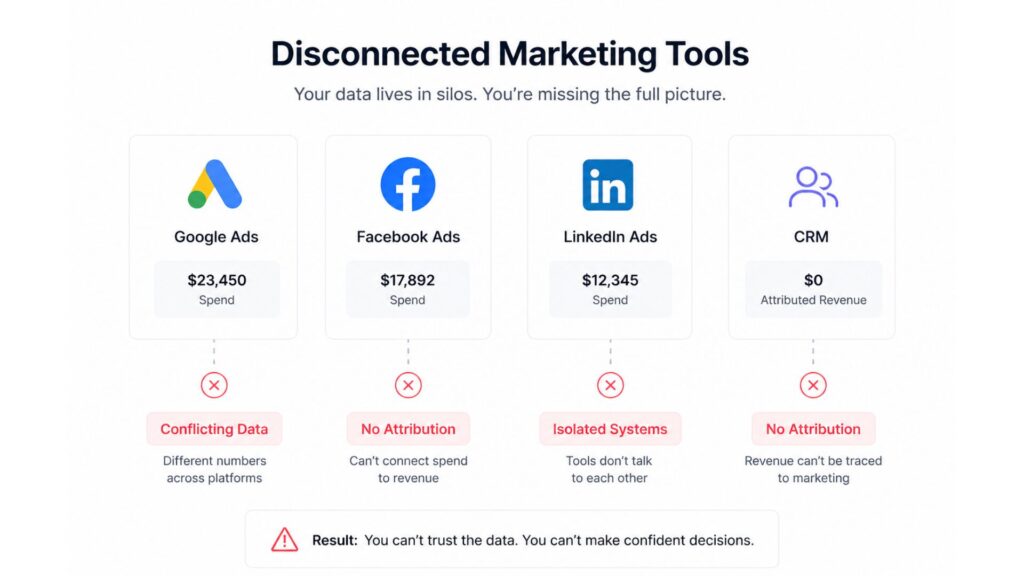
His CRM tracked leads. His ad dashboards showed clicks. Neither system talked to the other. Every budget decision became a guess dressed up as a strategy.
That is not a tracking problem; that is a marketing attribution problem. For scaling startups, it is one of the most expensive gaps to carry.
This blog explains marketing attribution. It covers models for early-stage companies. It explains how to use them without a data team. It also lists tools that are budget-friendly.
By the end, you will know how to stop guessing and divide spending based on what closes deals.

Why Marketing Attribution Breaks in Early-Stage Startups
Marketing attribution identifies which marketing channels contributed to a conversion or closed deal. For startups, it means scaling what works, not what looks good on a dashboard.
Early-stage companies break attribution in four specific ways.
- They rely on last-click by default. Most ad platforms report conversions on a last-click basis. The final touchpoint gets all the credit. The LinkedIn post that introduced the lead gets none. The email nurture sequence that educated them gets none. The webinar that built trust gets none. You end up optimizing for the last step and starving every step that built intent.
- They treat platform data as ground truth. Google Ads reports 40 conversions. Meta claims 38 of those same conversions. Your CRM shows 29 closed deals. All three numbers are real. All three conflict. None of them alone explains what happened. Without a single attribution layer, you’re looking at three different maps of the same area
- They ignore dark social. Many B2B conversions come from channels that don’t pass UTM parameters. These include LinkedIn shares, Slack communities, email forwards, and direct referrals. A founder reads your post, forwards it to a colleague, and that colleague books a call. Your attribution model records it as direct traffic. It was not. Your content fulfilled its purpose without drawing attention.
- They do not reconcile CRM data with ad platform data. Your CRM tracks revenue. Your ad platform tracks clicks. When these two systems never connect, you cannot draw a line from spend to revenue. Channel decisions rely on Customer Acquisition Cost calculations, but they lack half the data.
These four-failure points compound. Fix them, and marketing becomes measurable. Leave them, and you scale blindly.
The Key Marketing Attribution Models for Early-Stage Companies
Marketing attribution models distribute credit for a conversion across touchpoints. Each model tells a different story about your funnel. The right choice depends on your sales cycle, channel mix, and stage.
First-Touch Attribution
Gives 100% of the credit to the first touchpoint a lead interacted with. Useful for understanding where awareness starts. Weak in understanding what closes deals. Best use: measuring top-of-funnel content performance.
Last-Touch Attribution
Gives all the credit to the last touchpoint before conversion. This is the standard in most ad platforms. Easy to set up, but it undervalues every touchpoint that built intent before the close.
Linear Attribution
Distributes credit equally across every touchpoint in the journey. More honest than single-touch models. It’s still unclear. It treats a brand awareness post and a demo confirmation email as equally important.
Time-Decay Attribution
Gives more credit to touchpoints closer to the conversion. Logical for short sales cycles. Less helpful for long B2B cycles. Awareness content from three months ago might have been the initial trigger.
Position-Based (U-Shaped) Attribution
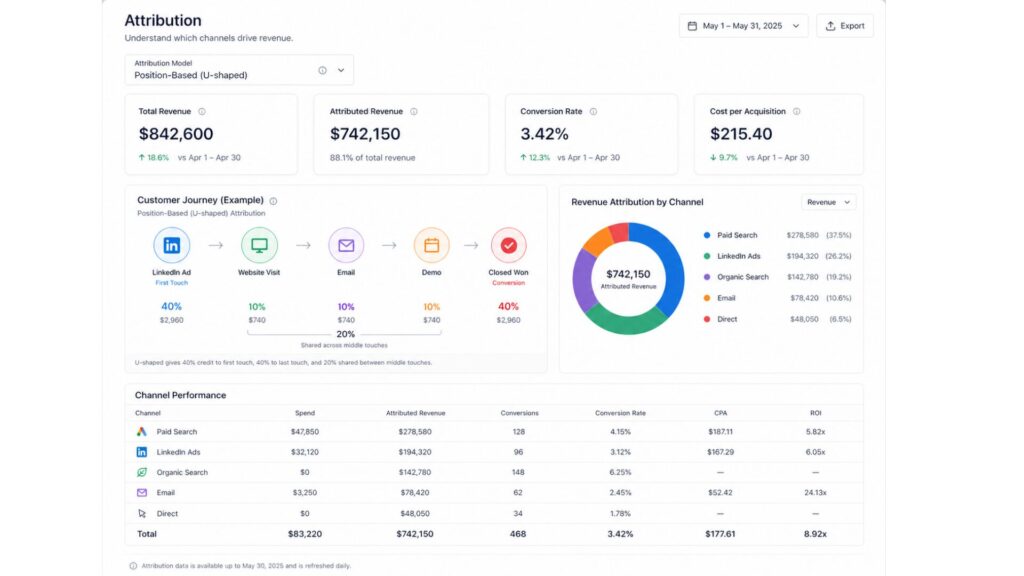
Gives 40% credit to the first touch, 40% to the last touch, and shares 20% among the middle touchpoints. Perfect for B2B founders who want to balance discovery and closing, while nurturing relationships.
Data-Driven Attribution
Uses machine learning to assign credit based on actual conversion patterns. The most accurate model available requires volume: Google Analytics 4 suggests having at least 300 conversions each month. This makes the model more reliable.
How to Measure Marketing Attribution Impact Without a Data Team
Many startups overlook attribution. They think it requires a data engineer, a data warehouse, and a big budget for analytics. It does not.
Here is how a founder-led team can implement attribution.
Step 1: Standardize your UTM parameters
Tag every paid and owned channel link with source, medium, campaign, content, and term. Without consistent tagging, your analytics tool can’t tell the difference between traffic from a LinkedIn post and a LinkedIn ad. Use a UTM builder spreadsheet. Make tagging mandatory before any link goes live. Google’s Campaign URL Builder is free and takes three minutes per link.
Step 2: Set up GA4 with defined conversion events
Google Analytics 4 tracks conversion events natively. Define what counts as a conversion: form submission, demo booking, or checkout completion. Map these events in GA4 and verify they fire correctly. This gives you a first-party data foundation that no platform can override.
Step 3: Connect your CRM and analytics
Your CRM is where revenue lives. Your analytics tool is where behavior lives. Connect them. HubSpot, Pipedrive, and most mid-market CRMs offer GA4 integrations or Zapier connectors. Once connected, you can trace a closed deal back to its original traffic source. That is the core of attribution.
Step 4: Audit dark social
Add a “How did you hear about us?” question to every demo request and discovery call form. This single question captures what no tracking pixel can: word-of-mouth, Slack mentions, referrals, and forwarded emails. Review responses monthly and adjust attribution accordingly.
Step 5: Run a monthly attribution review
Pull three reports: GA4 source/medium, CRM closed-deal source, and ad platform conversions. Compare them. Where they agree, you have confidence. Where they conflict, you have a gap to investigate. This 30-minute review catches more attribution errors than any tool can automate.

How to Implement Multi-Touch Marketing Attribution in Your Startup
Multi-touch attribution assigns credit for a conversion to multiple marketing interactions, not just a single touchpoint. For B2B startups with sales cycles of over two weeks, this is the best way to see what drives the pipeline.
Here is how to implement it without a dedicated analytics infrastructure.
Choose your model before you choose your tool.
Most teams pick a tool and accept whatever model it defaults to. That is backwards. Decide whether you want U-shaped, linear, or time-decay attribution first. Then find a tool that supports it. Choose your model based on your sales cycle and channel mix, not just the tool’s default settings.
Consolidate your data into one place.
Multi-touch attribution requires every touchpoint to be visible in one system. If paid data is in Google Ads, organic data in GA4, and email data in Mailchimp, multi-touch attribution fails. They don’t connect. Use GA4 as the hub. Use UTM parameters as the connective tissue across every channel.
Map your touchpoints before you track them
List every channel a lead touches before converting
- Organic search
- Paid ads
- Email sequences
- LinkedIn content
- Webinar attendance
- Referral
- Direct visit
Each one needs a tracking mechanism. Channels without tracking are invisible in your attribution model. They underperform in budget decisions because they appear to do nothing.
Validate against revenue, not only conversions.
A conversion in GA4 is a form fill. A deal closed in your CRM is revenue. Run attribution against actual revenue numbers. A channel accounts for 40% of your form fills but only 10% of closed revenue. This means it’s not performing as well as the top metric suggests.
Research from HubSpot shows that companies using multi-touch attribution are 15% more likely to report accurate ROI on their marketing spend than those using single-touch models.
Best Marketing Attribution Tools for Startups (No Data Team Required)
hese five tools cover the full range of startup budgets and technical resources. Each is assessed on accuracy, implementation effort, and cost.
Google Analytics 4 (GA4) Cost: Free. The baseline tool for any startup doing marketing attribution. GA4 supports data-driven attribution natively once you hit 300 or more monthly conversions. Below that threshold, use the U-shaped model within its custom attribution settings. It integrates with Google Ads natively and connects to most CRMs via Zapier or direct integration. Required for any attribution stack.
HubSpot Attribution Reports Cost: Starts at $50/month (Starter). If your team already uses HubSpot, its built-in attribution reporting is strong enough for most startups under $5M ARR. It tracks first-touch, last-touch, linear, time-decay, and U-shaped attribution across contacts and deals. Revenue attribution ties directly to closed/won deals. No additional setup required beyond standard HubSpot CRM usage.
Triple Whale Cost: Starts at $100/month. Built for e-commerce and DTC brands. Excels at reconciling data from Meta, TikTok, Google, and Shopify into a single attribution view. If you run paid social as a primary acquisition channel, Triple Whale is the most accurate reconciliation layer at this price point.
Rockerbox Cost: Starts at $500/month. A dedicated marketing attribution platform for startups that have scaled past $1M in ad spend and need cross-channel accuracy beyond what GA4 provides. It handles TV, podcasts, direct mail, and digital channels within a single model. Strong for omnichannel acquisition strategies.
UTM Tracking via Google Sheets (Zero Cost)
For pre-revenue or early-stage companies: a disciplined UTM tagging system tracked in a structured Google Sheet is a legitimate starting point. Pair it with GA4 and a “How did you hear about us?” form field. This costs nothing and, maintained consistently, provides 70% of the attribution insight a paid tool generates.
Comparison at a glance:
| Tool | Best For | Starting cost (approx.) | Attribution Models |
| GA4 (standard) | Startups & SMBs | Free | Data‑driven, last‑click variants; not full U‑shaped/linear/time‑decay natively. |
| HubSpot (attribution) | CRM‑centric SaaS / sales teams | Often $100s+/month (not $50) | Multi‑touch (first‑, U‑, W‑, full‑path equivalent). |
| Triple Whale | Paid‑social–heavy DTC brands | $500–$1,000+/month typical | Cross‑channel, pixel‑based, multi‑touch. |
| Rockerbox | Brands with $1M+ ad spend | ~$500/month | Full‑omnichannel multi‑touch (first‑, last‑, even‑, multi‑touch). |
| Google Sheets + UTM | Pre‑tool / DIY stage | Free | Manual, rules‑based attribution. |
The 4 Most Common Marketing Attribution Mistakes in Fast-Growing Startups
These attribution errors appear in nearly every growth audit. Each is fixable. None requires a data team.
Mistake 1: No UTM discipline.
Links go out without UTM tags. Campaigns launch without source parameters. Organic and paid social register as the same traffic source. Your attribution model runs on incomplete data. Every channel decision becomes suspect.
Fix: Create a UTM naming convention document and make it mandatory before any link is distributed.
Mistake 2: Treating last-click as gospel.
Last-click is the default. It is also the most misleading model for B2B companies with multi-step sales cycles. A founder who spent six weeks consuming your content before booking a demo should not attribute that deal 100% to the final email with the booking link.
Fix: switch to position-based or data-driven attribution and update budget decisions accordingly.
Mistake 3: Ignoring dark social.
When a lead types your URL directly or clicks a link in a forwarded email, most attribution models record it as direct traffic. In B2B, a significant share of high-intent leads come from exactly this path.
Fix: add a “How did you hear about us?” question to every inbound form and weight your dark social channels based on self-reported data.
Mistake 4: Not reconciling CRM data with ad platform data.
Your ad platform will overcount conversions. Every platform claims credit for every conversion it touches. Your CRM records actual revenue. The gap between these two numbers is your attribution error rate.
Fix: run a monthly reconciliation between your CRM closed/won data and your ad platform conversion totals. A gap above 20% signals a systematic error in your attribution model.
Gartner’s Marketing Analytics Report found that 54% of marketing leaders cannot demonstrate the impact of marketing decisions on business outcomes. Attribution gaps are the primary reason.
Want to Go Deeper?
These blogs give you the operational context behind what attribution data reveals:
- Why Your Business Does Not Have a Traffic Problem but a Conversion Problem. You are spending on ads and driving traffic, but revenue is not moving. This blog shows you exactly why your funnel is the problem, not your reach, and what to fix to stop losing leads you already paid for.
- The Cost of Disconnected Tech Stacks: How to Build an Integrated Growth Stack. Every tool you added was supposed to help. Instead, they created silos, duplicate data, and revenue leaks you cannot see. This blog exposes what that disconnection is actually costing you and how to build a stack that works as one system.
- Revenue Infrastructure: Build Predictable B2B Growth. If your revenue depends on who showed up this month, you do not have a growth engine. You have a guessing game. This blog breaks down the infrastructure that turns unpredictable pipeline into consistent, scalable revenue.
FAQ: Marketing Attribution for Startups
What is marketing attribution for startups?
Marketing attribution identifies which marketing channels, campaigns, or touchpoints contributed to a lead converting or a deal closing. For startups, it answers one question: where is your revenue actually coming from?
What is the best marketing attribution model for a SaaS company under $1M?
Position-based (U-shaped) attribution. It credits the first touchpoint that built awareness and the last touchpoint that triggered the conversion, while distributing the remaining credit across the middle interactions. It is accurate enough for early-stage decisions and does not require high conversion volume to function.
What are the key marketing attribution models for early-stage companies?
The five most relevant are: first-touch, last-touch, linear, time-decay, and position-based (U-shaped). Data-driven attribution becomes reliable once a company reaches 300 or more monthly conversions. Most startups with under $2M ARR should use a position-based model as their primary model.
How do I implement multi-touch attribution without a data team?
Use GA4 with consistent UTM tagging across all channels. Connect your CRM to GA4 via native integration or Zapier. Run a monthly reconciliation between closed CRM deals and ad platform conversion reports. Add a “How did you hear about us?” form field to capture dark social. This four-step system requires no data engineer.
What are the best free or affordable attribution tools for startups?
GA4 is free and sufficient for most startups under $3M ARR. HubSpot attribution reporting starts at $50/month and is strong if your CRM is already HubSpot. For startups not yet ready for a paid tool, a disciplined UTM tagging system in Google Sheets combined with GA4 covers 70% of attribution needs.
What is the difference between first-touch and last-touch attribution?
First-touch attribution gives 100% of the conversion credit to the first interaction a lead had with your brand. Last-touch attribution gives 100% of the credit to the final interaction before they converted. Neither is accurate for B2B funnels with multiple touchpoints. Use both as diagnostic lenses, not as primary attribution models.
Why does my CRM show different conversion numbers than my ad platform?
Ad platforms claim credit for any conversion they touched, even when they were one of many touchpoints. CRMs record actual closed revenue, which is a stricter definition of conversion. The gap between the two numbers is your attribution error rate. A gap above 20% indicates a systematic attribution problem that requires reconciliation.
Final Thought
Most startups do not have a spending problem. They have a visibility problem. The budget is there. The channels are running. The leads are coming in. But without marketing attribution, every growth decision runs on the wrong data, and every dollar moved is a guess.
Attribution is not a reporting exercise. It is the foundation of a revenue system. When you know which channels are closing deals, you stop spreading budget thin and start doubling down on what works.
If you are not sure where your revenue is actually coming from, a Free Digital Growth Audit is the fastest way to find out. No pitch. No obligation. A clear picture of what your current attribution setup is costing you in misallocated spend and missed pipeline.
You can also start with our Revenue System Scorecard to benchmark your marketing and attribution infrastructure in under 10 minutes.
The founders who fix attribution first scale faster. Not because they have better marketing. Because they know what their marketing is actually doing.
