
Bolting AI onto a broken revenue system takes a weekend. Fixing the system underneath takes months. Most founders choose the shortcut. They automate messy CRM data, unclear workflows, and vague handoffs. Then they wonder why AI only multiplies the chaos.
An automation readiness audit shows whether your revenue system is ready for AI at all. It reviews your CRM data, workflows, handoffs, and reporting so you do not make the same mistakes.
This post explains what an automation readiness audit is and why messy revenue systems break under AI. You will also see what to fix before you switch anything on.

What Is an Automation Readiness Audit?
An automation readiness audit is a close look at your revenue system. It looks at your CRM data, your workflows, your lead routing, and your reporting. The goal is simple. Find out if your business has the structure automation needs.
An audit like this covers eight areas.
- CRM data quality
- Workflow clarity
- Lead routing
- Sales handoff
- Follow-up rules
- Reporting accuracy
- Tool integration
- Process ownership
Score low in most of these areas, AI will not help you. It will expose you faster.
Why AI Automation Fails in Messy Revenue Systems
AI depends entirely on the system it connects to. Feed it a messy CRM and it scores leads on bad data. Give it unclear follow-up rules and it responds in random ways. Connect it to broken pipeline stages and your reports mislead every decision you make.
AI does not fix unclear systems. It exposes them, at a scale no single employee can match.
Why this matters
A slow manual process fails quietly, one deal at a time. Automate the same process, and it fails loudly and often. The system stays the same. Only the speed changes.

The 6 Signs Your Business Is Not Ready for Automation
Most founders spot at least three of these when they look closely.
Sign 1: Your CRM data is incomplete
Missing lead sources. Duplicate contacts. No owner assigned to half your pipeline. Each one breaks lead scoring before AI even touches it.
Sign 2: Your workflow lives in one person's head
Only one employee knows what happens after a lead comes in. Automation has nothing to copy. Write the process down first.
Sign 3: Your tools do not talk to each other
Your website form, CRM, email tool, and calendar should share data on their own. If someone retypes data by hand, automation inherits the gap.
Sign 4: Your team does not follow the same process
Every rep handles leads differently. Automation has no stable pattern to learn. Consistency has to exist before it gets automated.
Sign 5: Your reporting is not trusted
If you do not trust your own dashboard, automation will not fix it. It will produce wrong numbers faster.
Sign 6: You have no clear owner for each step
Automation still needs someone in charge. No owner means no one notices when the system quietly breaks.
What to Fix Before Adding AI to Your Revenue System
Work through these in order. If you skip steps, the same problems return.
- Clean your CRM data. Remove duplicates. Fix your fields. Set clear stages.
- Map the revenue workflow. Document what happens from first touch to closed deal.
- Define ownership. Every stage needs one clear owner.
- Set rules for lead routing. Decide who gets each lead, when, and why.
- Build follow-up logic. Define timing, message type, and the trigger behind each one.
- Connect your tools. CRM, email, forms, calendar, and dashboards should share data on their own.
- Build reporting you trust. Track the numbers showing where revenue gets stuck.
In audits we run, CRM data quality fails more often than any other area. It ranks ahead of everything else on this list.
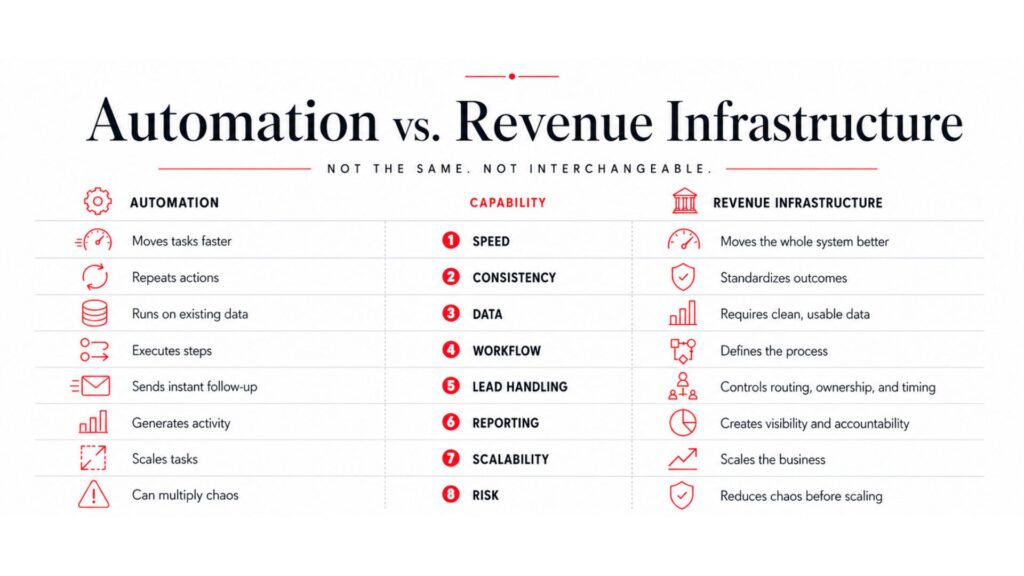
The Difference Between Automation and Revenue Infrastructure
Automation is one layer of a larger system. Revenue infrastructure is the system underneath.
Automation asks which task to speed up. Revenue infrastructure asks whether that task deserves speed at all.
Automation replaces effort. Revenue infrastructure replaces guesswork. Founders who fix infrastructure first build automation that compounds. Founders who automate first build chaos that compounds instead.
What an AI-Ready Revenue System Looks Like
An AI-ready revenue system shares a few clear traits:
- Clean CRM data with no duplicate or orphaned records
- Clearly defined lead stages that match how you sell
- Routing based on real rules, not guesswork
- Follow-up rules with clear timing
- Tools that share data with no manual work
- Dashboards your leadership team trusts
- One clear owner assigned to every stage
- Human review built in where judgment still matters
The goal is not to automate everything in your business. The goal is to automate the right parts of an already clean system.
Why This Matters for Founders Scaling Past One Million
Messy workflows feel manageable at a small scale. One founder can hold the whole process in memory alone.
Add more leads, more clients, and more team members, and the cracks widen fast. McKinsey tested 25 factors linked to AI results. Workflow redesign showed the strongest effect on real financial impact. Yet only about one in five companies using AI report redesigning their workflows at all. Most businesses still layer AI on top of the same broken process.
The cost of skipping the audit shows up in a few places:
- Slower follow-up on leads ready to buy
- Missed opportunities buried in bad CRM data
- Reporting nobody on the leadership team fully trusts
- A sales process that depends on one or two people
- AI repeating every mistake already baked into the data
Poor CRM data is not a minor operational issue. HubSpot research shows dirty data quietly drains revenue across sales and marketing. The problem grows once AI tools start reading the same data.
How to Run a Simple Automation Readiness Audit
Score each area from one to five before you touch a single automation tool.
| Area | Question |
| CRM data | Is the data clean enough to trust |
| Workflow | Is each step clearly mapped |
| Ownership | Does every step have an owner |
| Handoff | Are leads passed without delay or confusion |
| Reporting | Does the dashboard show what is really happening |
| Tools | Are the core tools connected |
| Follow-up | Are timing and message rules clear |
If most areas score under three, start with cleanup, not AI. Fix the foundation first. Automate second.
Want to Go Deeper?
These three posts go further into the systems behind this audit.
- How to Set Up a CRM That Actually Closes Deals — A 5-step CRM setup framework for founders scaling past $500K, covering stages, lead scoring, and automation.
- The Cost of Disconnected Tech Stacks — Why tools that do not talk to each other quietly block scaling past $1M ARR, plus a 5-step fix.
- Digital Growth Audit: How to Audit Your Business in 90 Minutes — The exact 6-area audit Creativz runs before every engagement, with benchmarks and a scoring system.
Final Thought
AI is not the shortcut around a broken system. It is the amplifier sitting on top of whatever you already have. A clean revenue system moves faster with AI attached to it. A messy one breaks in more places, more often. Audit the system first. Automate what deserves to be automated.
Want to see where your revenue system stands before you automate it. Book a Digital Growth Audit and find the gaps first. Curious how your CRM, workflows, and reporting score right now. Request your Revenue System Scorecard.

Creativz.io
Creativz.io is a digital growth consulting firm that builds revenue infrastructure for B2B founders scaling from $500K to $10M ARR. The team architects conversion systems, CRM pipelines, lead-nurture automation, and analytics infrastructure that turn website traffic into predictable revenue. Creativz has worked across construction, SaaS, fintech, B2B services, and logistics, with a focus on systems that scale without scaling headcount.
