
Founder dependency is not about working too hard. It is about your business being structurally unable to move without you.
That distinction matters. Burnout is a symptom. Founder dependency is the diagnosis.
When every pricing decision, sales call, operations approval, and client escalation still routes through you, the business does not have systems. It has one person holding everything together.
This article explains why founder dependency forms, where it actually lives inside a scaling company, and what a real fix looks like.

What Founder Dependency Actually Means
Founder dependency is the condition where a business relies on the founder’s personal judgment, relationships, or memory to function. When that person is unavailable, the business stalls, slows, or fails to deliver.
This is not about effort or capability. Many highly capable founders are deeply dependent on bottlenecks. The problem is structural, not personal.
Why This Matters
Investopedia identifies this as key-person risk: in many small businesses, the owner keeps the books, manages employees, and handles key customers. Without them, the business can come to a stop. That risk compounds with every new client, new hire, and new revenue target.
How It Differs From Founder Burnout
Burnout is a state. Dependency is a structure.
A founder can recover from burnout and return to the same bottleneck system. Fixing the system is what actually changes the trajectory. The two problems overlap, but treating only the symptom leaves the cause intact.
Why Founder Dependency Gets Worse as You Grow
Growth amplifies the problem. Harvard Business Review’s research on the Founder’s Dilemma, based on an analysis of 212 American startups, found that long-tenured, highly successful founder-CEOs are unusually rare. The reason: what works at $500K in revenue creates friction at $ 5 M in revenue. The founder who handled everything early on becomes the ceiling that stops the business from reaching the next level.
Every new client increases reliance on the founder’s judgment. Every new hire adds more questions routed to the founder. The system that created early success becomes the constraint that limits future scale.
The 5 Visible Signs of Founder Dependency
These are not productivity problems. They are structural signals.
- Pricing decisions require founder approval, even for standard deals
- Sales calls stall when the founder is not on them
- Client escalations go directly to the founder by default
- New hires ask the founder for decisions that documented processes should cover
- The founder checks in on execution because no dashboard shows it
McKinsey research on organizational health found that 72% of senior executives reported that bad strategic decisions were at least as common as good ones in their organizations. The root cause: accountability was unclear, decisions escalated upward, and authority was never pushed close enough to the work.
Sound familiar?
The presence of these symptoms does not mean your team is weak. It means decision rights, escalation rules, and operating playbooks were never built. The founder filled those gaps with personal judgment. That worked at an earlier stage. Now it is the friction.
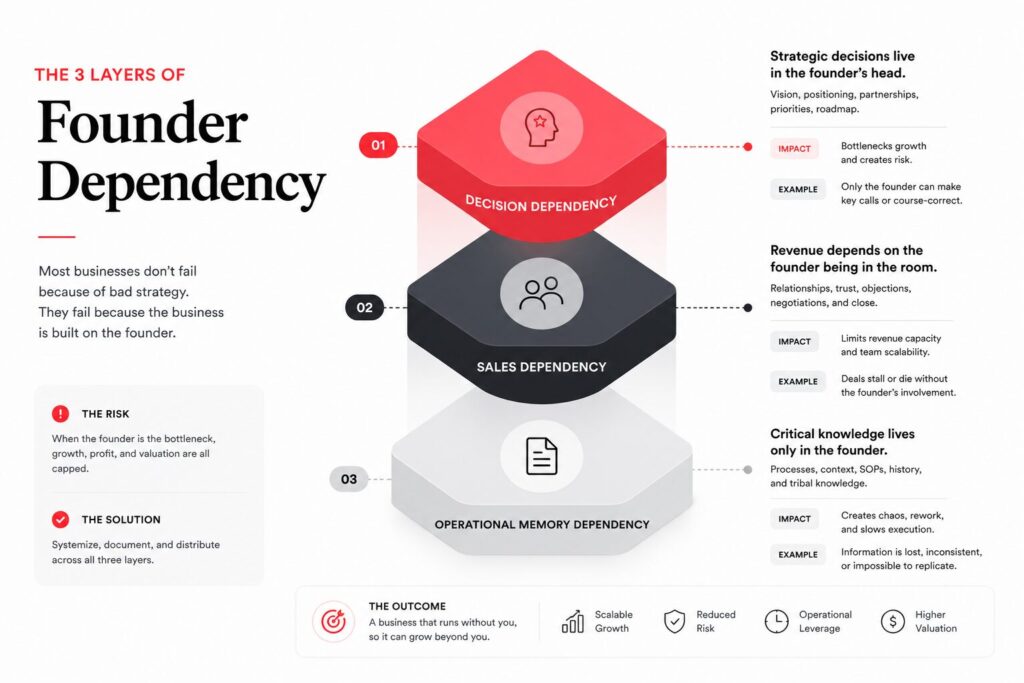
The 3 Layers Where Founder Dependency Lives
Most advice about founder dependency treats it as a single problem. It is not. It lives in three separate system
Layer 1: Decision Dependency
The first layer is decision-making. If pricing, client approvals, hiring choices, and offer design still require founder input, the company does not have delegated decision rights. It has assistants orbiting a bottleneck.
HBR’s research on organizational decision-making is direct: decisions are the coin of the realm. Companies lose ground when the right decisions are not made quickly and executed consistently. Every hour a pricing decision waits for founder review is an hour of friction your competitor does not have.
The fix is not a mindset shift to delegation. It is a written framework that specifies which decisions the team can make without approval, which require escalation, and what criteria govern each category.

Layer 2: Sales Dependency
The second layer is revenue. Founder-led sales work early. The founder knows the product, has the relationships, and can handle every objection. But the business does not know what the founder knows.
HBR’s research on the Sales Learning Curve argues that companies ramp sales capacity too quickly before the organization has learned how buyers actually acquire and use the offering. Founder-led sales often persist not from habit, but because the commercial process was never codified. The knowledge lives in the founder’s head, not in a playbook or CRM pipeline.
Fixing this layer means documenting objection handling, building a CRM pipeline that reflects the actual deal stages, and training the sales team on what the founder naturally does. The goal is to transfer commercial knowledge into a repeatable system.
Layer 3: Operational Memory Dependency
The third layer is the hardest to see. Operational memory dependency occurs when daily execution depends on what the founder remembers, notices, or catches.
There is no SOP for it. No dashboard tracks it. The founder just knows. And because they know, the team does not need to.
Asana’s 2023 Anatomy of Work study of 9,615 global knowledge workers found that leaders were losing 3.6 hours per week to unnecessary meetings, using 10 apps per day, and working in environments where 62% of the workday was spent on repetitive or low-leverage tasks. This is not inefficiency. This is what operational memory dependency looks like at scale.
The fix is documentation and automation. Every recurring process that depends on the founder’s attention needs a written owner, a trigger, and a completion signal that does not require the founder’s review.
The Difference Between Founder Dependency and Normal Founder Involvement
Not all founder involvement is founder dependency. Some decisions belong with the founder. Understanding the difference is what separates smart delegation from abdication.
| Founder Dependency (Fix This) | Healthy Founder Involvement (Keep This) |
| Approving every invoice under $5,000 | Setting pricing strategy for new markets |
| Being on every sales call to close deals | Defining ideal client criteria and offer positioning |
| Answering operational questions from direct reports | Making major hiring decisions at the leadership level |
| Reviewing every client email before it is sent | Owning key client relationships at the executive level |
| Tracking delivery through personal check-ins | Setting OKRs and reviewing performance dashboards |
McKinsey’s decision taxonomy is useful here. The firm separates big-bet decisions (founder territory), cross-cutting decisions (need clear handoff protocols), and delegated decisions (should move close to the work with explicit authority). The goal is not the founder’s disappearance. It is routing the right decision to the right level.
What Fixing Founder Dependency Actually Looks Like in 90 Days
This is not a six-month transformation program. The foundation can be built in one quarter if the work is focused.
Weeks 1 to 3: Identify Where You Are the Bottleneck
Start with an honest audit. Map every recurring decision, approval, or escalation that currently routes to you. Do not guess. Pull your calendar, your inbox, and your Slack for the past two weeks.
For each item, ask: Does this genuinely require my judgment, or does it route to me because no one else has the authority or the information to handle it?
The second category is your action list.
Weeks 4 to 6: Codify the Three Decision Layers
Write a plain-English operating playbook for cross-cutting decisions. The playbook covers who owns each decision category, which criteria apply, the escalation threshold, and who gets notified when an exception is triggered.
For sales, document what the founder does on calls. Turn it into a qualification framework, an objection guide, and a CRM pipeline that mirrors real deal stages.
For operations, build a dashboard that shows daily delivery status without requiring founder check-ins. If the team cannot answer the question, the metric does not exist in the system.
Weeks 7 to 9: Automate the Repeating Work
Once the processes are documented, automate the repetitive tasks. Lead follow-up sequences, invoice approvals under threshold, CRM pipeline stage updates, and reporting pulls are all candidates.
Automation built on top of a documented process is leveraged. Automation built on top of undocumented judgment is fragile. Get the documentation right first.
Weeks 10 to 12: Hand Off With Scorecards and Escalation Rules
Push authority close to the work with a defined escalation threshold. The team handles everything under that line. Above it, they escalate with context, not just the problem.
A weekly dashboard review replaces the founder’s informal awareness. The metric becomes the signal, not the founder’s gut.
The Revenue Cost of Staying in the Bottleneck
This is not a quality-of-life problem. It is a revenue problem.
A business doing $5M per year with 30% operational inefficiency is losing $1.5M annually. Not to competitors. Not too bad products. To friction, manual work, and broken handoffs that no one has fixed because the founder is too busy doing the work to stop and redesign it.
Decision fatigue is real and measurable. By the time a founder reaches high-leverage strategic decisions, they have already spent their best thinking on approvals and escalations that the system should have handled. The quality of decisions degrades. So does the quality of output.
There is also the compounding effect. As Charles Goddet, CEO of Predictable Profits, observes, when you are in the founder trap, you cannot work your way out of it, hire your way out of it, or make more money to get out of it. The structure must change.
Founder Dependency: Frequently Asked Questions
How do I know if my business is too dependent on me?
If the business slows, stalls, or loses deals when you are unavailable for a week, the dependency is structural. Run a two-week audit of every decision and approval that reached you. If more than half of them did not require your personal judgment, you have a systems problem, not a delegation problem.
Is founder dependency the same as founder burnout?
No. Burnout is an outcome. Dependency is the structure that produces it. Recovering from burnout and returning to the same bottleneck system will produce the same result. The structure must change.
How do I delegate without losing quality control?
Write the criteria you use to make decisions. Turn your judgment into a framework. Then give the team authority to apply that framework within defined boundaries. Quality control comes from clear standards and visible metrics, not from personal approval on every output.
Can a founder-led sales scale?
Founder-led sales is the right model in early stages when the commercial process is still being learned. It becomes a constraint when the founder’s knowledge has not been transferred into a playbook, CRM pipeline, or objection guide. The goal is not to remove the founder from sales. It is to make the sales process legible and repeatable without the founder on every call.
What systems reduce owner dependency?
Three systems matter most: a decision rights framework that defines authority levels, a CRM pipeline that makes sales progress visible without check-ins, and an operational dashboard that shows delivery status in real time. Automation sits atop all three.
Final Thought
Founder dependency is not evidence of a weak team or a bad founder. It is evidence of a business that grew faster than its operating architecture could support.
The founders who break through are not the ones who work harder or hire more people. They are the ones who build the decision rights, sales infrastructure, and operational systems that let the business carry more without routing everything through one person.
The bottleneck is solvable. But it requires looking at the structure, not just the schedule.
Ready to find your biggest revenue leak?
The Creativz.io Digital Growth Audit maps your full revenue system in one week. We identify where founder dependency is costing you the most and what to build first.

Creativz.io
Creativz.io is a digital growth consulting firm that builds revenue infrastructure for B2B founders scaling from $500K to $10M ARR. The team architects conversion systems, CRM pipelines, lead-nurture automation, and analytics infrastructure that turn website traffic into predictable revenue. Creativz has worked across construction, SaaS, fintech, B2B services, and logistics, with a focus on systems that scale without scaling headcount.
