
The Revenue Infrastructure Stack: How Founders Build Predictable Growth Without More Traffic
Modern buyers are well-informed. Most visitors arrive after reading reviews, comparing options, and shortlisting a few brands. However, many founders still focus on increasing traffic and adjusting ad budgets and headlines in hopes of better results. When these tactics fail, frustration grows, and workloads increase. Missed emails, neglected follow-ups, and stagnant metrics signal underlying issues.
The core issue is not traffic but inadequate systems**.** Without infrastructure connecting landing pages, follow-up, data, and automation, new visitors generate noise rather than revenue. Building the right structure is more reliable than seeking traffic spikes.
This guide introduces a six-layer revenue infrastructure model and outlines how to begin.

The Hidden Problems Behind “More Leads”
Founders often mistake high visitor numbers for success. In reality, weak systems can turn strong intent into missed opportunities and burnout. Consider the following facts:
- Lead generation is a persistent challenge. Surveys indicate that 61 percent of marketers see it as their main hurdle, and 79 percent of leads never convert to sales. Increasing traffic to a flawed process only increases inefficiency. This is why many sites redesign repeatedly without results, a cycle we break down into 5 reasons your website isn’t converting.
- The personal cost of unstructured growth is significant. Start-up life is demanding; 72 percent of founders report mental health challenges such as anxiety and burnout. A 2025 survey found that only 6 percent of founders reported no mental health issues in the previous year. When revenue relies on constant personal effort instead of repeatable systems, burnout is likely.
- Effective conversions require multiple interactions. RAIN Group research shows it takes an average of eight touchpoints to secure an initial meeting. Single-touch optimizations, such as changing a headline, rarely produce significant results.
- Timely responses are critical. Responding to a lead within 5 minutes makes you 100 times more likely to connect and 21 times more likely to qualify than waiting 30 minutes. Delayed replies often result in lost opportunities to competitors that move faster.
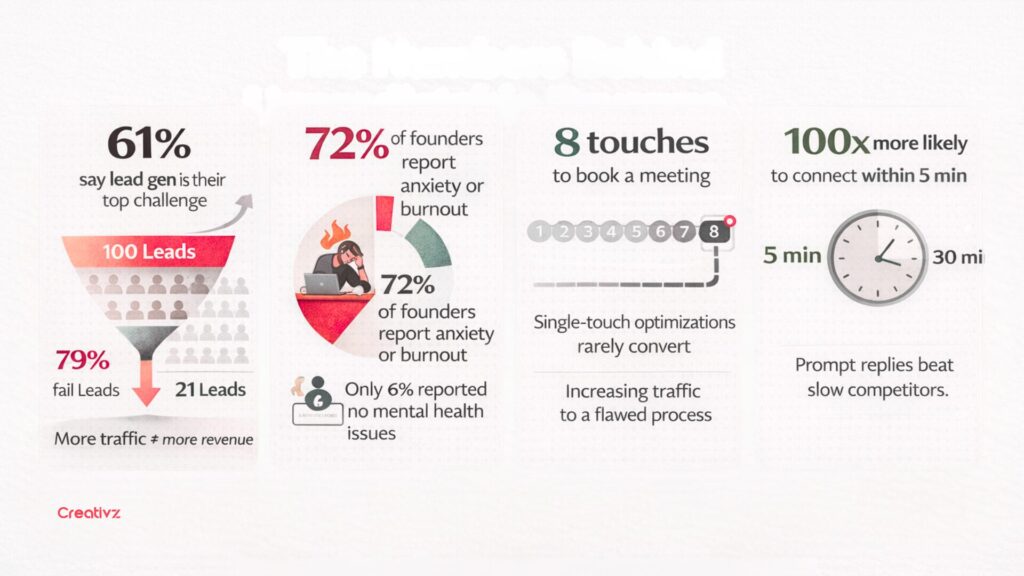
These statistics highlight a systems issue, not a traffic problem. If sales depend on personal follow-up or busy months seem random, a foundational overhaul is needed.
What Revenue Infrastructure Actually Means
Revenue infrastructure is not about servers or code. It is the connected system that turns demand into revenue across landing pages, data, automation, tracking, and decision logic.
It ensures interest does not stall after a form fill, demo request, or search click. Rather than relying on manual follow-ups or isolated tools, revenue infrastructure creates a clear path from first touch to closed deal and renewal. Every important conversation runs through it.
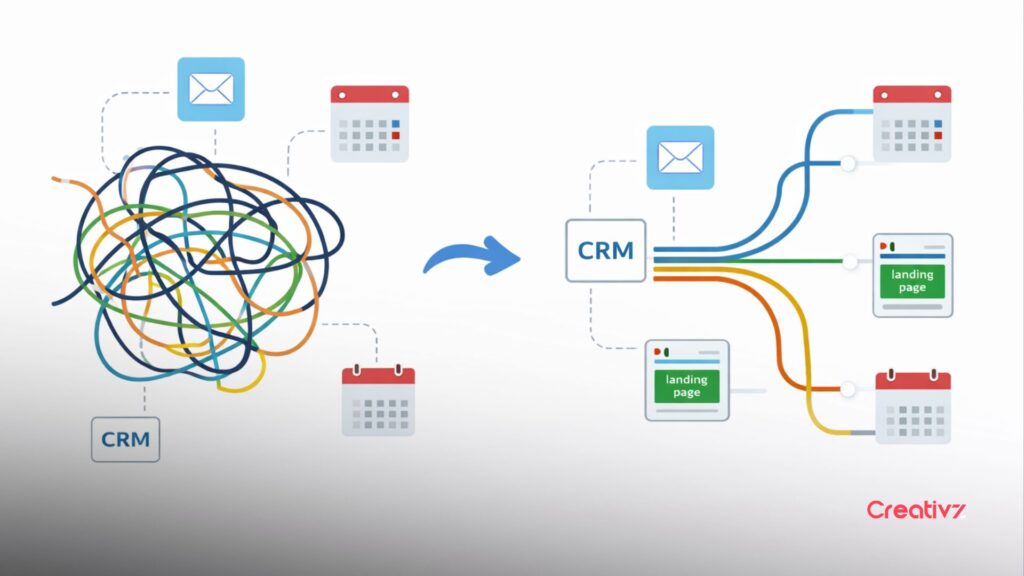
Without this structure, traffic creates activity but not momentum. Leads accumulate, follow-ups are missed, and data is scattered across tools. Growth relies on constant effort rather than a repeatable system.
Why AI Search Accelerates the Need
This system is now essential because the buyer journey has changed.
McKinsey’s 2025 research shows that roughly half of Google searches now surface AI-generated summaries, and about half of consumers intentionally use AI-powered search tools to make purchasing decisions. McKinsey also estimates that brands unprepared for this shift could see declines of 20–50% in traditional search traffic.
This means discovery, qualification, and shortlisting often occur before someone visits your site, within AI summaries, chat interfaces, forums, and third-party content. By the time a buyer arrives, they are already informed and closer to a decision.
AI search compresses the journey into fewer visible steps. Buyers arrive with intent and little patience for friction. They evaluate you based on external signals such as reviews, mentions, clarity of positioning, and consistency between what AI presents and what your site delivers.
Revenue infrastructure enables this process. It ensures you capture intent quickly, follow up with relevance, qualify leads intelligently, and measure real revenue impact, not just clicks or form fills. In an AI-driven buying environment, strong systems do more than support growth; they determine who converts and who is filtered out.

The Six Layers of a Revenue Infrastructure Stack for Predictable Growth
Predictable revenue comes from a comprehensive system, not just a funnel. The following six layers work together to convert demand into revenue.
1. Demand Capture
This layer is the initial point of contact with your business. To capture demand effectively:
Align intent with dedicated landing pages. General homepages convert poorly. Targeted landing pages matched to specific ads or keywords can significantly increase conversions, especially when they follow a proven structure, such as clear value propositions, focused CTAs, and trust signals (elements outlined in 7 essentials every high-converting landing page needs). Ensure headlines reflect your offer, simplify choices, and provide a single call to action.
For paid traffic, using a homepage instead of a purpose-built landing page often wastes budget, as our breakdown of homepage vs. landing page explains.
Use trust signals. Testimonials, case studies, and guarantees reduce uncertainty. Even if AI search highlights your business, social proof on your landing page reassures visitors that they are in the right place.
Offer micro-wins. Provide resources such as checklists, webinars, or calculators in exchange for contact information. These early actions are micro-conversions. Small signals that reveal where a buyer is in their decision process long before a sale.
Early opt-ins build momentum for the multi-touch journey. For example, offer an “AI readiness checklist” to help visitors assess their preparedness for AI-powered search.
2. Decision Framing
After capturing attention, guide visitors toward the right decision:
- Clarify the problem and solution. Use messaging that identifies the challenge and positions your offer as the logical next step. Neuroscience research suggests that up to 95 percent of consumer decision-making is subconscious, influenced by emotions and heuristics. This is why many funnels attract interest but repel buyers. A mismatch we explore is why funnels convert the wrong people. Address fears, aspirations, and desired outcomes rather than focusing solely on features.
- Provide proof and reassurance. Support your claims with testimonials, case studies, and statistics. Use clear language and familiar visuals to build trust. Clearly outline the steps that follow an action, such as the process from a demo request to the initial call.
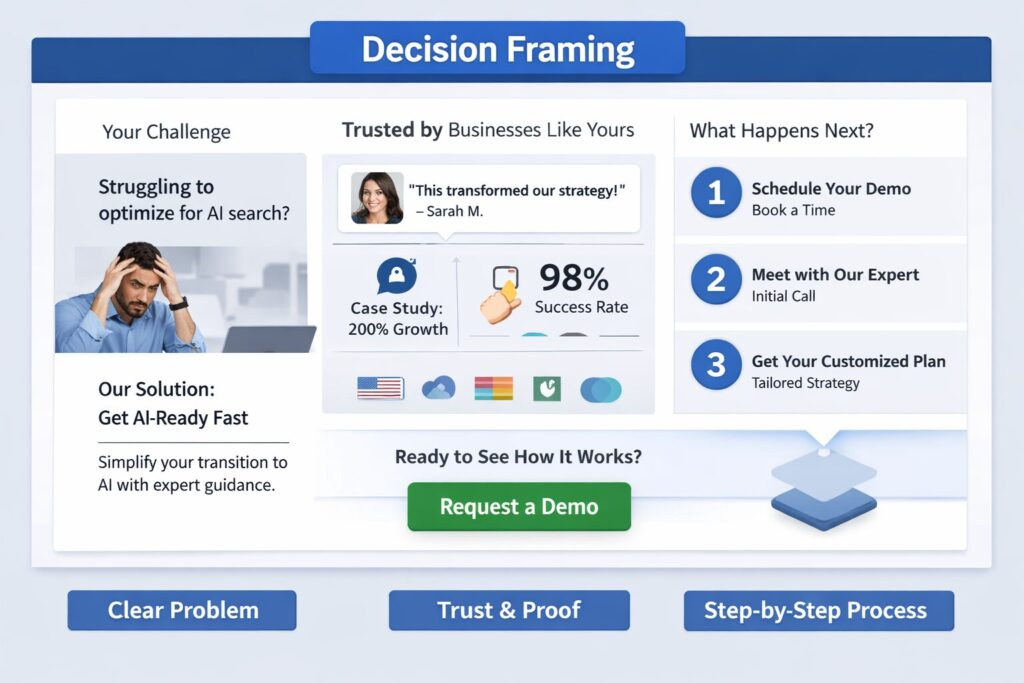
- Frame choices to prevent analysis paralysis. Prospects arriving from AI summaries or referral links expect clarity. Present your primary offer as the most straightforward option.
3. Lead Qualification
Quality leads matter more than quantity. Qualify leads effectively by:
Tracking behavioral signals. Monitor micro‑conversions such as video views, content downloads, and webinar attendance to gauge intent. Assign weights to actions; for example, a demo request might be worth 10 points, a webinar attendance five points, and an e‑book download three points. Leads accumulating scores above a threshold graduate to sales outreach.
In practice, this means a lead who watches a product video, attends a webinar, and requests a demo is prioritized automatically, while casual readers stay in nurture without clogging sales time.
Sort by fit and engagement. Combine behavioral scores with firmographic data such as industry, company size, and role to prioritize prospects who are both interested and qualified. High-scoring leads receive personalized follow-up, while lower scores enter nurturing sequences.
Think in sequences. Multiple interactions are required to convert leads. Plan a series of touches, such as email, calls, and LinkedIn messages, rather than single outreach attempts. This is especially important for AI-driven inbound traffic, where buyers arrive informed but uncommitted (we address this in “Why AI search leads don’t convert to stable revenue”).
Apollo’s research recommends eight touches over ten days, but adjust timing and channels to fit your audience.
4. Follow‑Up Automation
Speed and relevance are essential:
Respond within minutes. Use automated scheduling tools or chatbots to acknowledge inquiries instantly and route them appropriately.
Automate with context. Automation should deliver the right message at the right time based on user behavior. When done correctly, it removes founders from repetitive follow-ups while improving consistency, a shift we detail in how smart automation frees founders and boosts predictable revenue.
For example, downloading a guide can trigger an educational email series, while a demo request can trigger calendar invites. Personalize communications using CRM data to demonstrate understanding of each lead’s needs. Use multi-channel sequences. Combine email, SMS, calls, and direct mail. For example, an eight-touch, ten-day sequence could include:
- Day 1: email introduction with resources
- Day 2: no outreach
- Day 3: morning email and afternoon call
- Day 4-5: morning call with voicemail and afternoon SMS
- Day 6-7: email and call
- Day 8-10: email and call offering to answer questions.
Adjust frequency and channels based on performance.
5. Revenue Visibility
Improvement requires effective measurement. Traffic and form fills are vanity metrics unless they are linked to revenue. To gain visibility:
Track full-funnel metrics. Monitor lifetime value (LTV), customer acquisition cost (CAC), time to conversion, and lead-to-customer rates. Since most leads do not convert, focusing on the wrong metrics can obscure underlying issues.
Build unified dashboards. Integrate data from your CRM, marketing automation, analytics platforms, and billing systems. When all stakeholders access consistent data, bottlenecks are easier to identify. Manual data collection or reporting from disconnected tools indicates your operations are not ready to scale. One of the clearest indicators is outlined in the 5 signs your business operations can’t scale.
For instance, if your CRM shows strong lead volume but your billing system shows flat revenue, the issue isn’t demand; it’s breakdowns between stages.
Analyze cohorts and segments. Compare conversion rates across channels, campaigns, and personas. Use these insights to allocate resources and refine targeting. For example, if webinar registrants convert at twice the rate of ebook downloaders, prioritize live events.
6. Feedback & Optimization Loops
Infrastructure requires ongoing improvement:
- Collect feedback at every stage. Use surveys, interviews, and heatmaps to identify friction points. Ask leads why they did not book a call or abandoned a cart.
- Conduct experiments. A/B test headlines, forms, offers, and sequences. Document hypotheses and outcomes. As AI search brings more qualified visitors, small improvements in your conversion flow can have a significant impact.
- Close the loop. Incorporate insights into your content strategy, lead scoring, and automation rules. If a blog post or webinar generates high-quality leads, feature it in your outreach. If AI summaries mention specific features, ensure your landing pages highlight them as well.
How to Spot Weak Infrastructure
If you are unsure whether you have a revenue infrastructure issue, look for these symptoms:
- Sales only happen when you personally follow up. Without systems, revenue stops when you take a day off.
- No one knows which leads to the call. Without qualification rules and scores, your team picks at random, and hot prospects cool off.
- Good months feel like luck. Revenue spikes only when a launch goes viral or you send a flurry of manual emails.
- Traffic and stress increase, but revenue does not. Spending more on ads or content without automation only adds to your workload.
- Dashboards do not reflect reality. If reports show high lead volume but revenue remains unchanged, your data may be disconnected or incomplete.
Recognizing these signs is the first step. For additional self-diagnostic questions, refer to our guide on business operations that cannot scale.

Where to Start
Building the entire stack takes time. Start with small steps:
- Focus on one flow. For many teams, this starts with the demo request or primary lead form, the point where speed and follow-up matter most. Pick the landing page with the most traffic. Map the journey from opt-in to your main conversion (e.g., a demo call). Identify friction points and set up an automated follow‑up that triggers within five minutes of each critical action.
- Choose a revenue‑linked metric. Track lead‑to‑customer conversion rate or average sales cycle length. Run experiments aimed at improving that number. Ignore vanity metrics like page views or email opens until your core conversion improves.
- Implement one follow‑up system. Create a simple email or SMS sequence triggered by the most important action (demo request, purchase, or cart abandonment). Personalize messages with data collected during opt-in. For example, if they indicated interest in AI search, send them the AI readiness checklist and invite them to a webinar on generative engine optimization.
Once that first layer works, add the next. Introduce decision‑framing content, refine lead scoring, expand automation across channels, and build unified dashboards. Each additional layer compounds the results.
Final Thought
Your product, marketing, and hustle create demand. A revenue infrastructure stack turns that demand into predictable growth. As AI shortens buyer journeys and decision-making moves upstream, brands with strong systems will be the ones that scale.
If this resonates, don’t wait for the next traffic spike to fix your foundation.
