
Tools and any other software are abundant and easy to access for us. Specially that technology is evolving and AI is helping us reach more heights in terms of scaling our business. As founder, you’ve invested in CRMs, marketing platforms, AI apps and dashboards. You have more software than ever, yet daily operations still feel fragile. Leads wait. Follow-ups rely on your memory. You’re checking Slack, email, and your CRM just to decide what to do next.
The problem isn’t your effort or the tools you’re using. It’s the absence of a cohesive system. Companies are now diving headfirst into AI automation as it shifts from a “nice-to-have” experiment to the core engine of modern business. Yet using automation without proper structure can create more noise than clarity.
In this blog, we will unpack how you can use smart automation (not just more tools) to build predictable revenue and regain control.

Identifying High‑Impact Tasks to Automate
Not everything needs automation, but you should never handle recurring bottlenecks manually. Focus on daily tasks that have a direct impact on revenue. Data from Martal’s 2026 lead generation report shows that 61% of marketers cite generating quality leads as their biggest challenge, and 79% of leads never convert because they weren’t nurtured or qualified. The problem isn’t the sheer number of leads; it’s the quality of those leads and the subsequent actions taken.
Lead Qualification & Routing
Qualifying leads manually wastes time and gives inconsistent results. When someone downloads a resource or fills out a form, automation can determine intent (e.g., job title, company size, engagement signals) and route them to the right person. This reduces sales friction and ensures marketing isn’t judged solely on vanity metrics. To dive deeper into optimizing your top‑of‑funnel messaging, read our post on Why Your Funnel Converts the Wrong People (and How to Fix It with Decision Psychology).
Post‑Conversion Follow‑Up & Nurturing
A staggering 79% of leads never convert because they aren’t nurtured properly. Smart workflows have the power to kick off personalized emails, SMS messages, and retargeting campaigns, each one designed to resonate with individual actions. If someone views a webinar but doesn’t book a call, an automated sequence could follow up with relevant case studies. If you’re still doing follow-ups the old-school way, revisit our insights on 6 Steps to Turn Visitors into Customers for tactical guidance.
Sales Handoffs & CRM Updates
Separation of information is a common cause of stalled negotiations. AI agents and automated workflows are capable of logging activities, advancing deal stages, and alerting stakeholders, all without any human input. As one guide puts it, founders acquire leverage when agents “own outcomes and keep workflows moving without supervision.” This setup ensures that actions proceed without interruption, and your involvement is limited to moments when a decision needs to be made.
Reporting & Visibility
Dashboards often overwhelm founders, drowning them in data that provides minimal actionable insight. Automate the gathering of crucial metrics. The collection includes things like how many leads become opportunities, the speed of the sales pipeline, and customer retention rates. Then, present these figures in a weekly summary. Automating high-impact tasks allows you to concentrate on trends instead of constantly monitoring updates. Our post on 5 Signs Your Business Operations Can’t Scale highlights common operational red flags and how to address them.
Integrating AI and Automation Tools into Workflows
Installing software is a straightforward task. However, overseeing its operations presents a distinct set of challenges. A recent examination of AI’s impact on business operations highlights a common problem: many companies are bogged down by the need for human intervention in their processes. This process includes tasks like compiling reports, forwarding emails, and waiting for approvals, all of which are still heavily reliant on human effort, according to hazentech.com. AI’s footprint is expanding rapidly; a recent survey found that 88% of companies now employ AI regularly in at least one area. However, a significant number of these initiatives falter.
To avoid “tool overload,” think about system design:
- Centralize data – Adopt a CRM or customer data platform as your single source of truth. Ensure all marketing, sales, and support interactions sync there automatically.
- Define triggers and ownership – Map out what should happen when someone books a demo, downloads a guide, or becomes inactive. Automation should send updates to specific team members and stop when human judgment is needed.
- Start with simple flows – Solve one gap at a time. For example, automate meeting reminders before layering on lead scoring.
- Test and iterate – Evaluate your sequences monthly. Where are leads still getting stuck? Where does your team intervene unnecessarily?
For a detailed breakdown of how to design AI‑powered workflows, read Email Marketing in 2026: Why Full‑Funnel Automation Beats Random Emails, which shows how automated nurture sequences increase conversions.
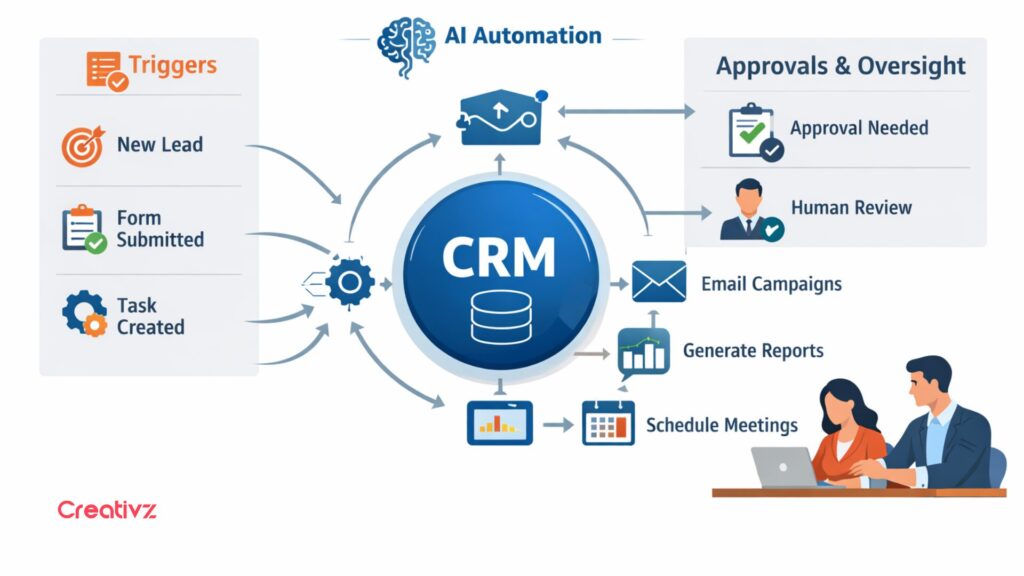
Maintaining a Human Touch
Automation raises a common fear: losing personal connection. The goal is not to replace critical thinking or your brand voice; it’s to remove repetitive tasks so you can show up when it counts. As a Startup Daily feature notes, many founders embrace AI not to work faster but to create breathing space and mental capacity.
For example, the founder of a consultancy found herself drowning in manual admin work until she delegated repetitive tasks to a generative AI assistant. Once the AI drafted follow‑up emails and structured session notes in her voice, she could refocus on client relationships.
This personalized approach will be critical in 2026. By using AI to handle scheduling, note-taking, and basic content creation, you can devote more energy to deep conversations and strategic decisions. If you’re worried about automated emails sounding generic, check out What Are Micro Conversions for ideas on personalizing each touchpoint.
Preventing Founder Burnout and Building Scalability
Automation goes beyond mere efficiency; it’s also a matter of your well-being. The Sifted Founder Mental Health survey showed that 94% of founders reported mental health issues, and 54% said they had experienced complete burnout in the past year. Many founders are skeptical of automation, a feeling that comes from their experiences with systems that don’t fully work. Even when things seem finished, someone still needs to review, prompt, and correct. As time goes on, this upkeep evolves into another responsibility.
Well‑designed AI agents behave like infrastructure. They read data, act within boundaries, update records, and stop. By delegating follow-through, the founder’s cognitive load drops, and leadership attention can shift from chasing tasks to making decisions. Automation, in essence, creates freedom, not just increased activity.

If you’re feeling the weight of manual operations, revisit our article Why Your Business Doesn’t Have a Traffic Problem but a Conversion Problem—it explains how operational inefficiencies drag down results even when marketing is on point.
Final Thoughts: Systems Over Tools
2026 is the year where more technology is showing than ever, yet you still feel fatigue. The solution isn’t another app, but a system that ties your tools together and automates what shouldn’t require your attention.
AI adoption is accelerating because it offers a competitive edge and most organizations implement it to improve efficiency. However, AI alone doesn’t solve poor workflows. Use smart automation to qualify and route leads, nurture prospects, update your CRM, and surface the metrics that matter.
Finally, remember that automation should replace manual effort, not strategic judgment. When you use technology to remove execution drag, you get back the two things founders value most: predictable revenue and time.
Ready to see where your systems are leaking and how automation could free you? Book a call with our experts and we’ll review your workflows together.
Let’s transform your tech stack from a collection of tools into a scalable system.
