
Most founders look for growth problems in the wrong places.
Ad spend gets audited. The sales team gets reviewed, and the offer gets questioned. But one of the most expensive drags on revenue sits quietly in the background, never appearing on a P&L. Slow business decision-making systems cost growing companies more than bad marketing ever will.
When a business scales from $1M to $5M, it adds complexity. More tools, more people, more channels, and more approvals come into play. The same instincts that worked at $500K become the bottleneck at $5M. Leadership teams spend hours waiting on reports that should take seconds. Sales teams follow up days after a lead goes cold. Campaign budgets stay frozen because no one has the data to act.
That friction is not a management problem. It is a systems problem.
In this blog, we break down why slow business decision-making systems are among the most expensive problems for a scaling company and what high-growth operators build to fix them.

Why Growth Slows as Complexity Increases in Business Decision-Making Systems
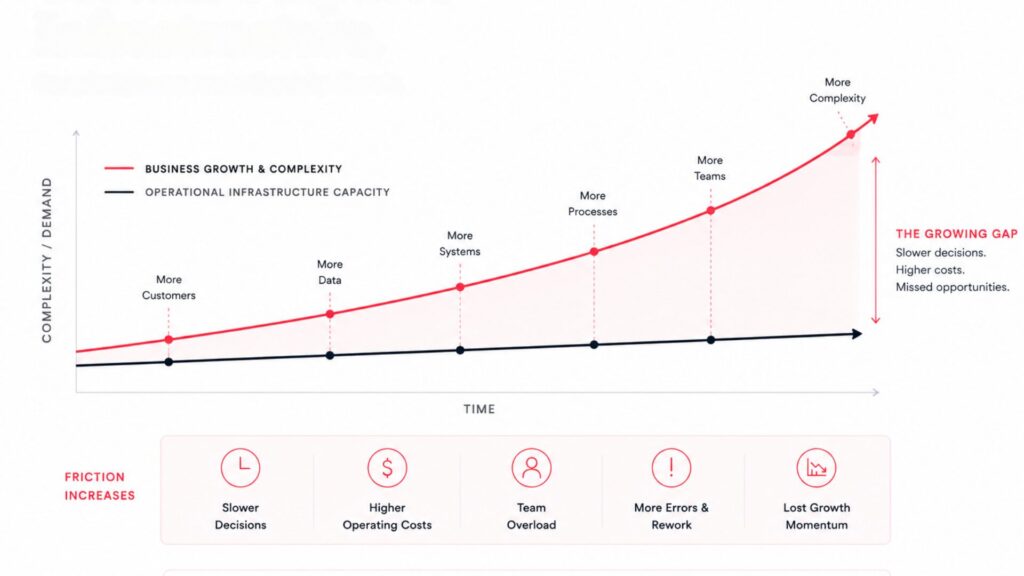
Scaling a business feels like adding capacity. More hires, more tools, more processes. In reality, every addition also adds friction, and decision-making slows because the infrastructure was never built to handle the volume.
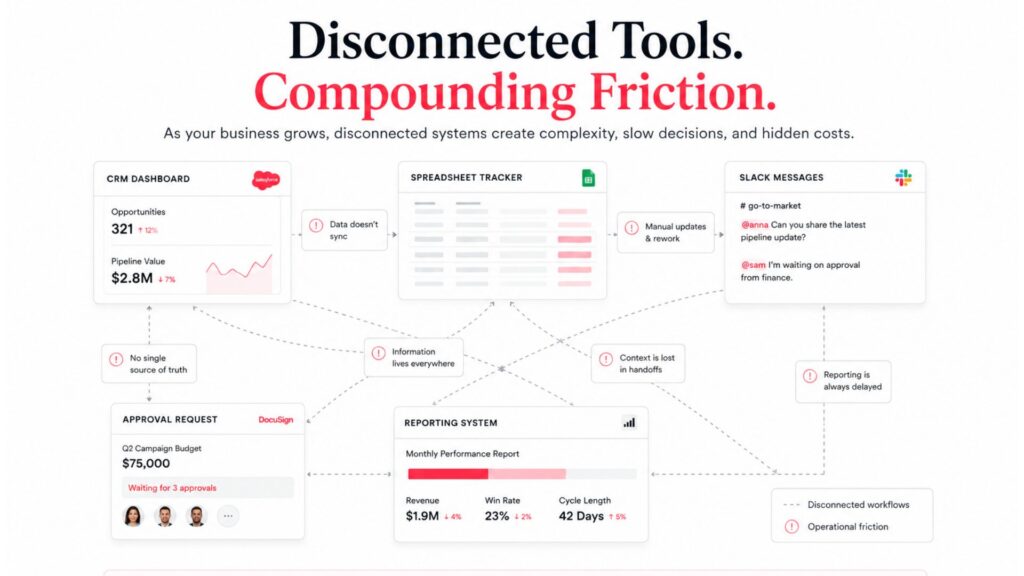
Here is what that friction looks like in practice:
- A CRM that does not sync with the ad platform, so lead attribution is always manual
- A reporting setup built on spreadsheets that someone updates twice a week
- Approval chains that require a founder’s sign-off on decisions that should be automated
- Sales and marketing are operating on different data with no single source of truth
- Dashboards that show last week’s numbers instead of what is happening right now
None of these problems feels critical on its own. Together, however, they compound. The company moves more slowly than it should at every level, and teams make decisions on stale data. As a result, founders become the bottleneck because no system exists to route information clearly.
According to McKinsey’s research on organizational agility, companies with high decision-making speed are twice as likely to report above-average financial performance. For founders specifically, that means speed of execution is a structural advantage, and it starts with the systems underneath.
The Real Cost of Slow Business Decision-Making Systems
Operational drag is easy to dismiss because it does not appear as a line item. The cost is real, though, and it shows up in revenue rather than in the operations report.

Delayed Lead Follow-Up
Research from InsideSales.com (now XANT) found that the odds of qualifying a lead drop by over 80 percent if you wait longer than five minutes to respond. When leads arrive and sit in a queue because there is no system to route, score, and trigger an immediate response, most scaling businesses end up replying hours later. That gap is not a sales problem. In fact, it is a routing and automation failure.
Frozen Campaign Budgets
When reporting is manual and delayed, marketers cannot optimize in real time. Underperforming campaigns continue to spend because no one has clear visibility into which channels are producing revenue versus which are producing noise. As a result, a $30,000 monthly ad budget running on two-week-old data is functionally operating blind.
Unclear Pipeline Visibility
Founders and sales leaders make pipeline decisions based on incomplete information. Deals appear closer than they are because the CRM data is not updated. Revenue forecasts become guesswork, and hiring decisions get made on projections that do not reflect what is actually moving.
Reactive Rather Than Proactive Operations
When systems do not surface information automatically, leadership spends time investigating rather than deciding. Every week turns into a cycle of status updates, check-in calls, and manual reports pulling data that should already be visible. Instead of acting on insight, teams spend hours producing it.
Slow decisions are not a leadership failure. They are an infrastructure failure.
The Infrastructure Problem Behind Slow Business Decision-Making Systems
Most founders assume slow decision-making is a people or culture problem. The belief is that the team needs to move faster or that leadership needs to delegate more. But when you trace the problem back to its root, it almost always leads to the same place: disconnected infrastructure.
The four infrastructure failures that slow decisions the most:
- Siloed data. Sales data lives in one tool. Marketing data lives in another. Finance operates on spreadsheets. As a consequence, no one has a unified view of what is happening.
- Manual reporting. When data must be pulled, formatted, and distributed manually, it is always out of date by the time it reaches a decision-maker.
- Disconnected workflows. When tools do not communicate with each other, people become the integration layer. They copy data between systems, send manual notifications, and manage handoffs that should be automated.
- No automation layer. Without workflow automation, every process requires human initiation. Approval requests, lead assignments, follow-up sequences, and reporting cycles all wait on someone to trigger them.
The result is a business where execution speed is capped by the slowest human in the chain. That ceiling gets lower as complexity increases because every new hire, tool, and channel adds another variable to an already fragile system.
Why the Gap Widens at Scale
Early-stage businesses tolerate manual systems because volume is low. As revenue grows, however, the same manual process that handled 50 leads per month struggles at 500. Gartner’s research on data-driven decision-making shows why mature analytics infrastructure matters: organizations that use data more effectively make better decisions and outperform less data-driven peers.
So the infrastructure problem is not just a present-day drag. It is also a compounding liability. Every quarter spent on manual systems is a quarter where the ceiling gets lower.
What High-Growth Companies Do Differently With Business Decision-Making Systems
The businesses that scale past $5M without losing operational control share a common trait. Rather than adding headcount to absorb complexity, they build infrastructure designed to accelerate decisions, not just record them.
Centralized Dashboards
High-growth operators run their businesses from a single source of truth. One dashboard pulls data from the CRM, ad platforms, email tools, and financial systems. As a result, leadership sees the number they need without sending a Slack message or waiting for a report.
Integrated Reporting
Instead of exporting CSVs and building spreadsheet reports manually, the data flows automatically. When a lead converts, the CRM updates. When a campaign hits a target cost per acquisition, the system flags it. When a deal moves to a new stage, the pipeline report reflects it instantly.
Automated Workflows
Routine decisions get systemized. Lead routing, follow-up triggers, approval thresholds, and onboarding sequences run without manual input. Consequently, the team focuses on judgment calls rather than administrative steps.
CRM Alignment Across Teams
Sales, marketing, and operations work from the same data. A lead captured on an ad platform flows into the CRM, is automatically scored, routed to the right rep, and triggers a follow-up sequence. No one copies data between tools. No lead falls through a gap.
Real-Time Visibility
Decisions happen faster when the data is current. Real-time dashboards mean a founder can approve a budget shift in five minutes instead of waiting two days for a compiled report. Similarly, a sales leader can identify a stalled deal in the morning rather than finding out on a Friday call.
The fastest-growing companies do not have better instincts. They have faster infrastructure.
The Competitive Advantage of Faster Business Decision-Making Systems
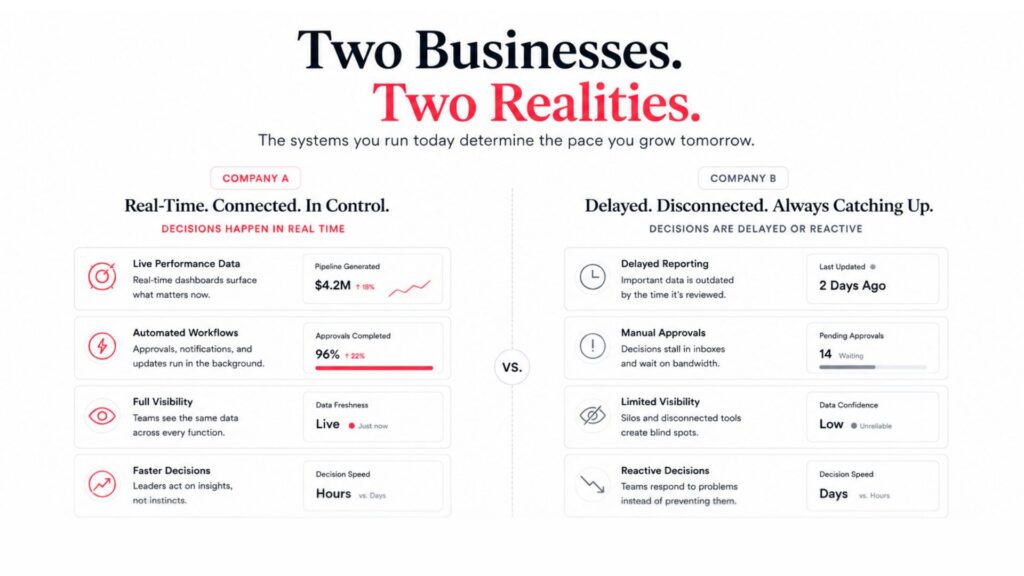
Businesses no longer compete only on product quality or marketing spend. Increasingly, they compete on execution speed. Two companies with similar offers, pricing, and markets will diverge based on which can act on information faster.
Consider the difference at the campaign level. A business with real-time visibility adjusts its ad spend when performance starts slipping. Meanwhile, the competitor waits until the monthly review. That gap compounds over twelve months into a meaningful revenue difference.
At the sales level, the contrast is just as stark. Automated lead routing means a prospect hears back within 5 minutes. By comparison, a manual process follows up the next morning, and by then the conversation has often moved. Speed of response is not just a courtesy. It is a conversion variable.
At the operations level, integrated reporting allows a hiring decision in week two of the quarter. Without that infrastructure, week two gets spent gathering data to understand whether a hire is even warranted. By the time the decision is made, the quarter has moved on.
Operational speed is a compounding advantage. The gap between a well-systematized business and a manual one widens every quarter.
Importantly, this is not a technology problem. Most of the tools already exist. HubSpot, Salesforce, Zapier, Make, and Looker are available at any budget level. The gap is architecture: how those tools connect, what they feed into, and how data flows from action to insight to decision.
That architecture is what separates a business that reacts to its numbers from one that runs on them.
Want to Go Deeper?
These posts cover the infrastructure decisions that compound over time:
- Lead Scoring for Startups: How to Prioritize the Right Prospects — Learn how a structured lead scoring system routes your best prospects to the right rep faster, so your team stops chasing the wrong deals.
- Sales Playbook for Startups: Building a Repeatable Revenue System — A repeatable sales playbook removes founder dependency from the pipeline and gives your team a clear path from first touch to closed deal.
- Why Founders Must Own Their Audience — Rented reach on platforms your business does not control is a growth liability. This post breaks down how to build an owned audience that scales with the business.
Frequently Asked Questions About Business Decision-Making Systems
Why is decision-making important for business growth?
Decision-making speed determines how quickly a business can respond to market signals, optimize operations, and capture opportunities. Slow decisions mean delayed responses to underperforming campaigns, missed sales windows, and reactive hiring. Businesses that build systems to accelerate decisions grow faster because they act on information before competitors do.
What slows decision-making in growing businesses?
The most common causes are disconnected tools that do not share data, manual reporting that produces outdated information, unclear decision ownership, and founders who remain in every approval chain. As a business scales, these friction points compound, creating operational drag that limits growth.
How do disconnected systems impact operations?
When systems do not integrate, people become the bridge between them. Data gets copied manually, reports are assembled by hand, and handoffs depend on someone remembering to complete them. This introduces delays, errors, and inconsistency. A disconnected tech stack is one of the primary reasons follow-up slows, reporting lags, and pipeline visibility breaks down.
What tools improve operational visibility?
A CRM with automated pipeline tracking is the foundation. Layering in marketing automation, attribution dashboards, and workflow automation tools creates a system where information flows automatically from action to insight. The specific tools matter less than how they connect. Integration architecture determines visibility, not any single platform.
Why do businesses need real-time reporting systems?
Decisions made on two-week-old data are blind decisions. Real-time reporting allows operators to identify problems early, optimize spend in the current cycle, and catch stalled deals before they close cold. The faster data surfaces, the faster action follows.
How can automation improve business efficiency?
Automation removes humans from routine decisions, allowing them to focus on judgment-dependent ones. Lead routing, follow-up sequences, approval triggers, and reporting cycles all run without manual initiation. The result is consistent execution at any volume, with fewer errors and faster response times than manual processes allow.
Final Thought
Growth does not slow because of bad marketing. It slows because the infrastructure underneath the business was never built to handle operational complexity at scale.
If your business decisions rely on spreadsheets, delayed reports, or manual updates, that infrastructure may already be limiting your next stage of growth. The revenue is there. The team is capable. Even so, slow systems cap how fast you can act on both.
The companies that break through $5M and beyond do not wait until the problems become visible. They build the architecture before the ceiling arrives.
If you want to know where your business decision-making systems are creating drag, a Free Digital Growth Audit is the starting point. We map your full revenue infrastructure, identify the highest-impact bottlenecks, and build a clear picture of what to fix first.
Not sure where your systems stand? Take the Revenue System Scorecard It contains questions across six categories, which will give you a clear score across Lead Generation, CRM Health, Automation, Analytics, and more.
