
$185 million in fines.
A sales incentive system produced this number at Wells Fargo in September 2016.
Employees hit their targets. Regulators found more than two million deposit and credit card accounts opened without clear customer consent. The bank had already fired 5,300 people.
No technology failed, and no forecast came in wrong.
The scoreboard worked, and every number on it moved in the right direction.
Then the business absorbed a decade of repair.
Read the story as a design problem, not a morality tale. Targets measured the wrong event and nothing in the system caught the gap.

The Sales Incentive System Worked Exactly As Designed
Wells Fargo built its reputation on cross-selling. More products per household meant more revenue per customer. Acquisition costs stayed low. Investors watched the ratio. Analysts quoted it on earnings calls.
The internal goal became eight products per household. Staff knew the push as “Gr-eight.”
Branch pressure was public well before the fines. The Los Angeles Times reported on it in 2013. Regulators acted three years later.
Here is the September 2016 record:
- A $100 million penalty from the Consumer Financial Protection Bureau, the largest the agency had issued
- $35 million to the Office of the Comptroller of the Currency
- $50 million to the City and County of Los Angeles
- More than two million accounts opened without clear consent, by the bank’s own analysis
- 5,300 employees fired during the internal review
Later reviews raised the account estimate above three million.
In 2020, the Department of Justice named the cause in plain words. Wells Fargo pushed employees toward unrealistic sales goals. Thousands of them opened accounts under false pretenses or without consent. Some faked records or misused customer identities. The bank paid $3 billion. It also entered a three-year deferred prosecution agreement.
Penalties were not the largest cost.
In 2018, the Federal Reserve capped the bank’s total assets at $1.95 trillion. The cap held until governance improved. Seven years passed. Rivals gathered deposits through a historic boom while Wells Fargo sat still.
The Federal Reserve lifted the cap in June 2025. Its 2018 enforcement action closed in March 2026. Remediation ran close to a decade.
A metric ran for a few years. The repair took ten.
What a Sales Incentive System Counts Becomes What Your Team Produces
A sales incentive system is the set of targets, metrics, and payouts deciding how your team earns. It covers what you count, who reports it, who verifies it, and when money moves.
Researchers flagged this pattern long before the fine landed.
In 2009, four academics published “Goals Gone Wild” through Harvard Business School and the Academy of Management Perspectives. They listed the side effects of aggressive goal setting. Narrow focus. Unethical behavior. Distorted risk taking. Damaged culture.
Their paper arrived seven years ahead of the enforcement order. The mechanism is simple. Every metric measures one of two things: action, account opened, demo booked, proposal sent, or call logged.
Actions are easy to count. They are also easy to produce on demand. Outcomes are harder to count and far harder to fake.
Products per household counted actions. One customer held eight unused products. Another held eight useful ones. The scoreboard called both a win.
Attach money to an action and the action arrives. Everything after it becomes optional.
Why these matters
Your dashboard reads as a set of instructions. Whatever it counts, your team produces more of by Friday. Pick the event with care. People optimize it faster than most founders expect.
Founders Build the Same Sales Incentive System at Smaller Scale
A bank with 200,000 staff feels distant from a company with five people in sales.
Structurally, they match.
You set a target. You attach money to it. The person who paid the number also reports it. Nobody checks the report against outside evidence.
At $3 million in revenue, the pattern shows up in familiar places.
- Deals marked closed-won before the contract is signed
- Discounts issued near quarter-end to reach quota
- Pipeline stages advanced to look healthy in the Monday review
- Demos booked with unqualified prospects to hit an activity target
- Leads marked as contacted after one unanswered email
- Renewals counted at signature rather than at payment
Run the math on a five-person team. Each rep books ten demos a month to clear an activity target. Two of those ten come from accounts with no budget and no timeline. Your team burns ten hours a month on calls with no path to a deal. The activity report shows a green month.
None of this requires dishonest people. Each example comes from someone following the scoreboard in front of them. Reward the behavior long enough, and it stops feeling like a shortcut. It becomes the job.
Wells Fargo had internal audit, compliance, a risk function, and a board. A founder has a Friday dashboard and a sales lead reporting upward.
Smaller companies carry less protection, not more.
Four Failure Points Inside a Sales Incentive System
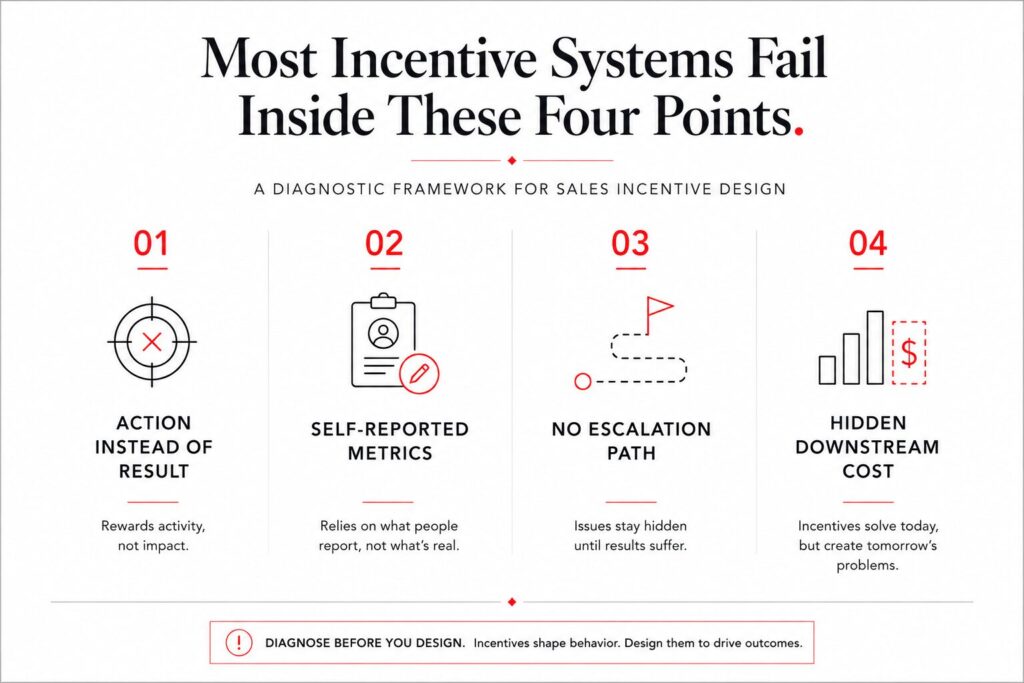
The metric counts an action, not a result
Ask one question about any number you pay for. Does the number still move when the customer receives nothing of value? A yes means you are paying for effort.
The person paid reports the number
Self-reported metrics drift. Interpretation drives the drift, not dishonesty. A qualified lead becomes whatever qualifies at 4pm on the final day of the month.
Bad news has no route upward
Wells Fargo staff raised the pressure on supervisors. Expectations held firm. Every plan needs a working path for one sentence: this target is out of reach. Somebody with authority has to hear it in time.
The cost of the miss lands somewhere invisible
Unwanted accounts hit customers first. The balance sheet felt it years later. Inside a service business, the cost is hidden in churn, refunds, and delivery load. Your sales team doesn’t see any of it in their own report.
How to Rebuild a Sales Incentive System Around Outcomes
Instead of: paying commission on deals closed
Try: paying part of it on revenue collected and retained at 90 days
Why: collection and retention resist manufacturing
Instead of: treating activity as performance
Try: treating activity as a leading indicator, reviewed weekly and never paid
Why: activity predicts results without equaling them
Instead of: accepting self-reported pipeline stages
Try: requiring one piece of evidence for each stage change
Why: evidence removes opinion from the forecast
Instead of: annual quota resets
Try: quarterly reviews with a written record of the behavior each target produced
Why: a broken target caught in 90 days costs less than one caught in three years
One rule sits above all four. Anyone who reports a missed target early keeps their standing. Punish the messenger and you buy silence at full price.
Rollout matters as much as design. Give written notice. Show the math on a real deal from last quarter. Then let the team model their own pay under the new plan before it starts.
Sales Incentive System Design for Med Spas and Consult Bookings
The same structure breaks down within aesthetics clinics, on a smaller scale and at a faster pace.
Front desk staff and patient coordinators often earn on consults booked. Booking is an action. Attendance and treatment are outcomes.
Set a booking target with no attendance measure, and you get a full calendar with an empty treatment room.
Creativz ran a secret-shopping review of med spa digital response across Arizona in 2026. The study examined reply behaviour on public channels. It did not assess clinical quality. Two patterns repeated. Replies arrived slowly. Many quoted a price and stopped there.
Neither pattern appears on a “leads responded to” report. Both appear in the schedule three weeks later.
Better measures to pay inside a clinic:
- Consults attended rather than consults booked
- Treatments performed within 30 days of the consult
- Rebooking rate before the patient leaves the building
- Recovery rate on cancellations and no-shows
Speed still belongs on the wall. Pair it with what happened after the reply.
Why these matters
A clinic with strong demand still loses revenue when the reward stops at the booking. The calendar fills. The treatment room sits idle. Nobody sees the gap until payroll arrives.
Sales Incentive System Audit
Pull your current comp plan and one quarter of closed revenue. Work through five questions in order. Budget an hour.

Metric definition
- Which event triggers payment?
- Is the event an action or a result?
- What does the customer receive at the moment it occurs?
- Would the number still move if a customer were unhappy?
Verification
- Who reports the number?
- What evidence confirms the report?
- Which fields stay editable by the person paid on them?
- How long passes between the claim and the check?
Escalation
- Where does someone report an unreachable target?
- What happened the last time someone did?
- Does anyone test targets against real capacity before the quarter starts?
Payout timing
- Does payment land before delivery, before collection, or after retention?
- What happens to commission after a refund or an early cancellation?
- Does the plan reward a client who leaves in month two?
Review cadence
- When did the plan last change?
- Which behavior shifted after the revision?
- What behavior appeared and surprised you?
The audit returns one answer. Your comp plan describes your real strategy, whatever the strategy deck says.
Want to Go Deeper on Sales Incentive System Design
Final Thought on Sales Incentive System Design
Wells Fargo did not fail at execution. Staff executed the plan with unusual discipline.
Design was the failure. The plan measured the wrong event. No independent check sat behind the number.
Your comp plan drives behavior harder than your strategy document, your values page, or your quarterly all-hands. People produce whatever the scoreboard rewards. They produce it fast.
Creativz maps the path between a target, the behavior it creates, and the revenue it returns. We find where a number gets counted, who verifies it, and what the business absorbs when it is wrong.
Book a Free Digital Growth Audit to review one comp plan against one quarter of closed revenue.
For a faster self-check, the Revenue System Scorecard gives a starting read on where measurement breaks first.

Creativz.io
Creativz.io is a digital growth consulting firm that builds revenue infrastructure for B2B founders scaling from $500K to $10M ARR. The team architects conversion systems, CRM pipelines, lead-nurture automation, and analytics infrastructure that turn website traffic into predictable revenue. Creativz has worked across construction, SaaS, fintech, B2B services, and logistics, with a focus on systems that scale without scaling headcount.
