
Many founders find scaling a business difficult after passing $1M in revenue. The usual suspects get blamed: not enough leads, weak marketing, or an underperforming sales team.
We recently worked with a client whose company doubled revenue in 2 years, but scaling stalled after she reached $1M in revenue. Her team spent hours manually transferring data and resolving technical issues instead of focusing on growth a common outcome when business systems aren’t integrated.
For B2B companies generating between $550K and $10M, this scenario is extremely common. As companies grow, they add tools for sales, marketing, support, finance, and analytics. Over time, these systems stop working together.
Teams begin entering the same information in multiple places, key data falls through the cracks, and leadership struggles to get a clear view of the business. Instead of supporting growth, disconnected systems quietly begin to block scaling business operations.
In this blog, you’ll learn why disconnected systems prevent scaling a business, how to spot the warning signs, and how to build a tech stack that supports your next stage of growth.

Why Scaling a Business Gets Harder After $1M
At first, systems are simple. Founders track customer details in a spreadsheet, use one platform for marketing, and handle finances with basic accounting software.
As the business grows, things get more complicated. New tools are added to solve new problems:
- Marketing automation platforms
- Sales CRMs
- Helpdesk systems
- Analytics dashboards
- Project management tools
- Invoicing software
Adding each new tool feels like progress. But over time, the business relies on many separate systems that do not work together. The team ends up spending more time managing these tools than actually growing the company.
This is the point where scaling becomes difficult.
If your operations are already showing strain, 5 Signs Your Business Operations Cannot Scale is a useful starting point for diagnosis.
Why Scaling Businesses Run Into System Problems
Scaling challenges rarely come from a lack of tools. Most growing companies already have more software than they need—the problem is how these systems interact.
When departments choose their own tools, the technology stack becomes fragmented. Each team works in its own silo, and the systems don’t talk to each other.
Without intentional business systems integration, these tools operate in isolation. As the company grows, this fragmentation creates friction that slows down decision-making, automation, and collaboration.
This is when scaling businesses face a deeper infrastructure problem: a disconnected tech stack.
What Is a Disconnected Tech Stack in a Scaling Business?
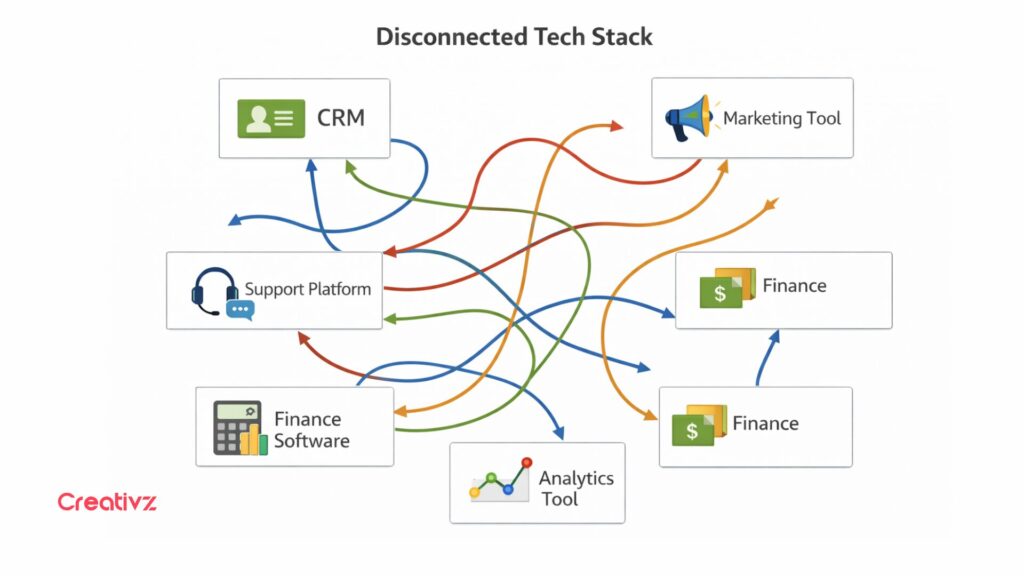
A disconnected tech stack means your software tools cannot automatically share data or workflows. Each system holds valuable information, but that data stays stuck in its own platform.
For a growing B2B company, this typically looks like:
- A CRM that does not sync with the marketing platform
- Customer support tickets are stored in a separate helpdesk with no link to sales data
- Invoices and payments are tracked in a system that finance manages alone
- Analytics reports that never automatically reach leadership dashboards.
Each department ends up with a different view of the customer. Without one reliable source of truth, the business runs on fragmented data. Over time, these small gaps cause problems throughout the company.
Warning Signs Your Systems Are Blocking Scaling
| Warning Sign | What It Signals | Business Impact |
|---|---|---|
| Teams copy data manually between platforms | No automated data flow between systems | Hours lost weekly to low-value admin work |
| Multiple spreadsheets used to reconcile reports | No unified source of truth | Leadership decisions based on unreliable data |
| Duplicate customer records across systems | Systems operate in silos | Inconsistent customer experience, errors in outreach |
| Marketing built on outdated customer data | CRM and marketing tools are not synced | Campaigns miss the mark, wasted ad spend |
| Automation tools fail to trigger reliably | Data needed for triggers is incomplete or siloed | Growth ceiling hits faster than expected |
How Disconnected Systems Slow Down Scaling Business Operations
1. Teams Lose Time Switching Between Tools
Employees constantly switch between platforms to finish tasks that should be simple. Research from Harvard Business Review shows that knowledge workers switch between applications hundreds of times per day, losing hours of productive work each week due to constant context switching. These interruptions add up across departments, lowering focus and productivity everywhere.
2. Data Becomes Unreliable
When information is spread across different systems, reports often do not match. Leaders waste time trying to match up numbers instead of making decisions. As trust in reports declines, people start relying on gut instinct rather than data.
3. Customer Experience Suffers
Without shared data, teams lack context. A customer who spoke to support last week is asked the same questions again by sales. That friction erodes trust and weakens retention, which directly affects revenue.
4. Automation Becomes Impossible
Automation initiatives depend heavily on integrated data systems. Research from MuleSoft’s Connectivity Benchmark Report shows that integration challenges remain one of the biggest barriers preventing organizations from successfully implementing automation and digital transformation initiatives.
These inefficiencies compound as you scale. For a practical look at how this affects your revenue engine, read How to Build Predictable Revenue with a Revenue Infrastructure Stack.

Why SaaS Sprawl Happens in Scaling Companies
What Is SaaS Sprawl?
SaaS sprawl happens when companies acquire software subscriptions faster than they can manage, integrate, or govern them. Each tool is usually purchased with good intentions—often to solve a specific operational problem. But without central oversight or system architecture, the technology stack quickly expands beyond what any one person can track or maintain.
This is especially common in scaling businesses where different departments independently adopt tools for marketing, sales, operations, and finance.
The Operational Consequences of SaaS Sprawl
The consequences of SaaS sprawl are significant. Research on SaaS management shows that companies frequently pay for software licenses that go unused when tools are adopted faster than they can be governed. (Vendr SaaS Buying Trends Report)
- Unused licenses are draining budgets every month.
- Duplicated functionality across tools performing the same tasks
- Growing integration complexity as new tools must connect to existing systems (As companies add tools, integration complexity increases, a challenge highlighted in research from MuleSoft’s Connectivity Benchmark Report.)
- Rising IT management costs as the number of platforms expands.
Beyond financial waste, SaaS sprawl creates operational confusion.
Teams become unsure which system to rely on. Processes may be documented in one platform but executed in another. Over time, shadow IT emerges as departments adopt software outside official systems to get their work done.
Why SaaS Sprawl Is Common in Scaling Businesses
As companies scale, the pressure to move quickly often leads teams to adopt new tools independently.
Marketing selects its own automation platform. Sales implements a CRM. Operations introduces project management tools. Finance uses a separate reporting platform.
Without a unified architecture connecting these systems, the technology environment becomes fragmented.
Today, companies rely on dozens of SaaS applications to run their operations. The Zylo SaaS Management Index reports that organizations manage a rapidly growing number of SaaS tools across departments as businesses scale.
Without deliberate tech stack consolidation, these numbers continue to grow—making scaling the business increasingly difficult.
Why AI and Automation Fail in Disconnected Scaling Businesses
Many founders are now investing in AI and automation to help their businesses grow faster. But these tools only work well when they have access to complete and consistent data.
If customer information is fragmented across systems:
- Marketing AI cannot personalize campaigns without a full customer history.
- Predictive sales tools cannot score leads when pipeline data is incomplete.
- Automation workflows cannot trigger actions when the required data lives in a separate platform.
If your business systems are not integrated, AI becomes just another disconnected tool instead of helping the business grow.
AI cannot fix a broken system. It requires connected infrastructure and unified data to deliver meaningful results. Research on enterprise AI adoption consistently shows that AI initiatives struggle when business systems operate in disconnected data silos.
If you are investing in AI-driven acquisition, Why AI Search Leads Do Not Convert to Stable Revenue explains why fragmented backend systems are often the root cause of poor AI performance.
Related: How Small Businesses Can Use Generative Engine Optimization to Convert AI Search Traffic
What a Connected System Looks Like in a Scaling Business?
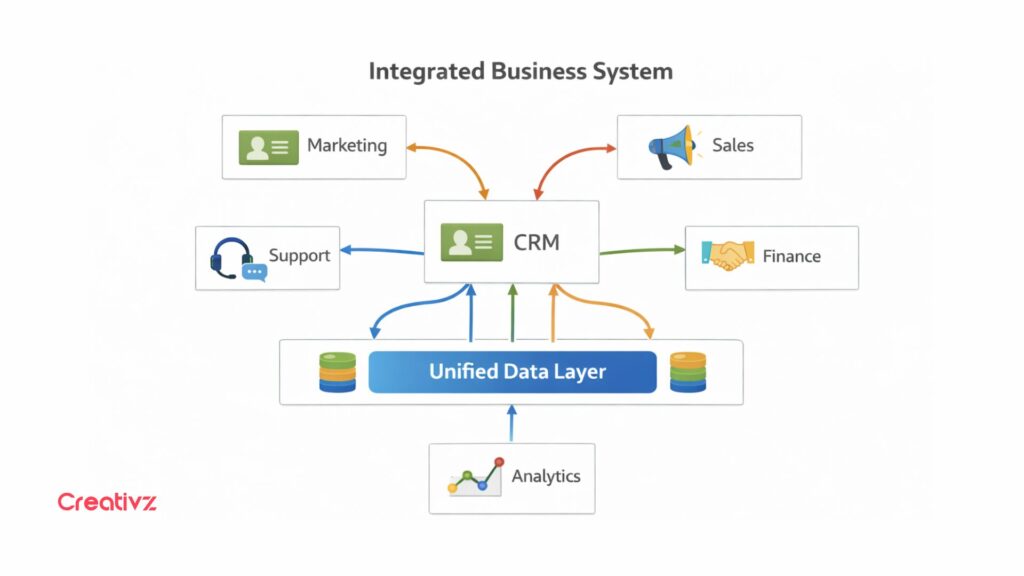
The solution is not to remove every tool from your stack. It is building a connected system architecture where every platform works together.
An integrated growth system means:
- Data flows automatically between tools without manual exports or imports.
- Teams operate from a single, shared source of truth.
- Reporting is accurate and updated in real time.
- Automation runs across departments, not just within individual tools.
- Leadership sees revenue, marketing performance, and operational metrics in one view.
Instead of using separate platforms, your business runs on a coordinated technology system built for growth. This is why consolidating your tech stack gives you an advantage. Rather than adding more tools, you focus on simplifying and connecting the ones that matter most.
For founders scaling their revenue engine, How Smart Automation Frees Founders and Boosts Predictable Revenue in 2026 shows what this looks like in practice.
How Scaling Businesses Consolidate Their Tech Stack (5-Step Framework)
Companies that successfully scale their operations follow a structured process. Here is the framework:
Step 1: Audit Every Tool in Your Stack
Start by identifying all software platforms used across all departments. For each tool, document:
- What it does and which team owns it
- How frequently is it actually used?
- What data it captures and where that data goes
- Which other systems does it connect to, and how
This audit quickly reveals extra tools and unused subscriptions. Most founders are surprised by what they find. They often discover multiple CRMs across departments, marketing platforms no one uses, unused licenses costing money each month, or tools doing the same job without anyone noticing. The audit usually confirms the feeling that some systems are underused, overlapping, or completely forgotten.
Step 2: Eliminate Redundant Systems
Get rid of tools that do the same thing. Many companies have several platforms for similar tasks because different teams chose them independently. Choose one tool for each job and cancel the others. The money you save can help pay for the integration work you need next.
Step 3: Establish a Core System of Record
Every business needs a central platform where critical data lives. For most B2B companies, this is a CRM or ERP. All other tools connect to this core platform to maintain consistent data across the organization.
When picking a core system, focus on things like scalability—can it handle your future growth?—integration options, and whether your team will actually use it every day. Choosing a platform that fits these needs sets you up for smooth, long-term growth.
Having a single source of truth makes automation and AI more reliable. Without it, you are building on a shaky foundation.
Step 4: Integrate Remaining Tools
Use integration platforms or built-in connectors to automatically move information between systems. This removes the need for manual data transfers and lets you automate tasks across departments.
At this stage, workflows that previously required human coordination begin to run autonomously.
If email is part of your automation layer, Email Marketing in 2026: Why Full-Funnel Automation Beats Random Emails explains how to connect it properly to your growth system.
Step 5: Continuously Optimize the Stack
Your technology stack should change as your business grows. Check your tools every quarter to ensure they still help you reach your goals and integrate well with the rest of your systems.
For a smoother review, use a simple checklist each quarter:
- Is this tool still essential for your current business goals?
- How frequently is it actually used by your team?
- Does the tool integrate seamlessly with your core systems?
- Are there any overlapping functions with other platforms?
- Are there unused licenses or features you are paying for?
- Has any department adopted shadow tools outside official systems?
- Are there new integration needs or process gaps since your last review?
By reviewing your stack regularly with this checklist, you can avoid SaaS sprawl and keep your tech setup simple as your business grows.
Companies that maintain disciplined tech governance avoid falling back into SaaS sprawl.
Lorem ipsum dolor sit amet, consectetur adipiscing elit. Ut elit tellus, luctus nec ullamcorper mattis, pulvinar dapibus leo.
What Happens When Scaling Businesses Connect Their Systems
Companies that consolidate disconnected tech stacks consistently report measurable improvements:
| Area | Before Consolidation | After Consolidation |
|---|---|---|
| Reporting speed | Hours of manual reconciliation | Real-time dashboards |
| Software costs | Baseline | Average 30% reduction |
| Productivity | Baseline | Up to 25% improvement |
| Integration maintenance | High ongoing effort | 74% decrease (MuleSoft data) |
| AI and automation | Limited by data gaps | Reliable, real-time outputs |
| Customer experience | Fragmented, inconsistent | Unified, context-aware |
Beyond the cost savings, the biggest benefit is strategic. Leaders can make decisions faster, and reporting time often drops by 40 percent after consolidation. Growth projects run more smoothly—many companies see sales cycles shorten by up to 25 percent when systems are connected. Sometimes, conversion rates go up by 15 to 20 percent just by removing data silos and missed handoffs. As a result, the business gets easier to run as it grows.
Fragmented systems affect more than just your internal operations. When data does not move between marketing, sales, and support tools, your conversion funnel loses leads at every step.
- Marketing campaigns target prospects based on incomplete data.
- Sales follow-up is delayed because the lead context is missing.
- Post-sale experience is inconsistent because support lacks purchase history.
- Retargeting and nurture sequences fire on stale signals
The result is a funnel that consistently underperforms its potential, no matter how much traffic or how many leads you get.
If your funnel is the immediate priority, start with Why Your Business Does Not Have a Traffic Problem but a Conversion Problem. It breaks down how system gaps translate directly to lost revenue.
Also worth reading: Why Your Funnel Converts the Wrong People (And How to Fix It with Decision Psychology)
How to Tell if Your Business Cannot Scale Because of Disconnected Systems
If scaling your business feels increasingly difficult, disconnected systems may be the cause.
Watch for these signs:
- Employees copying data manually between tools
- Reports that require multiple spreadsheets to compile
- Duplicate customer records across systems
- Automation workflows are failing regularly
- Teams relying on shadow spreadsheets outside official platforms
These signals suggest the business is operating on a fragmented infrastructure.
And fragmentation becomes more expensive as the company grows.
Further Reading for Scaling Founders
If specific areas of your growth system need attention alongside consolidation, these posts go deeper:
- Conversion gaps: 5 Reasons Your Website Is Not Converting (And How to Fix Them)
- Revenue infrastructure: How to Build Predictable Revenue with a Revenue Infrastructure Stack
- Automation strategy: How Smart Automation Frees Founders and Boosts Predictable Revenue in 2026
- Operations diagnosis: 5 Signs Your Business Operations Cannot Scale
- Full-funnel email: Email Marketing in 2026: Why Full-Funnel Automation Beats Random Emails
- Conversion optimization: What Is Conversion Rate Optimization (CRO)? And Why Most Businesses Get It Wrong
- AI search strategy: How Small Businesses Can Use Generative Engine Optimization to Convert AI Search Traffic
Final Thought
Many founders try to solve scaling problems by improving marketing, hiring more salespeople, or adjusting individual processes. But the real constraint is often deeper: the systems connecting the business together.
When those systems are fragmented, scaling becomes slow, expensive, and unpredictable.
If running your business feels harder as it grows, the problem might not be your strategy, but your systems. Creativz helps B2B founders build scalable, connected growth systems that remove fragmentation and support steady growth. If you want to move from disconnected tools to an integrated system, that is what we do.
Ready to get started? Book a free consultation with our team to talk about your scaling challenges:
