
The easiest way to see this is to look at a simple, everyday buying situation.
You message two companies. One replies in five minutes. The other gets back to you the next day.
Who gets the deal?
You already know the answer. But most businesses are still optimizing their ad creative while their leads go cold.
The impact of lead response time is one of the most underrated levers in B2B sales. It beats better copy. It beats a stronger offer. It beats a redesigned funnel. Speed is the differentiator most founders overlook because it lives in the ops layer, not the marketing layer.
This post breaks down why and what to do about it.

Why Speed Beats Strategy in Today's Buying Environment
To understand why response time matters so much, you have to look at how people actually buy today. The rules of attention and comparison have changed, and speed now beats almost every other advantage.
Buyers today do not wait. They open three tabs, fill out two forms, and send one LinkedIn message, all in the same session. The first company to respond gets the conversation. The rest get ignored.
This is not a theory. Decades of on-demand everything have shaped this buyer behavior.
A Harvard Business Review study found that companies contacting leads within one hour are seven times more likely to have a meaningful conversation with a decision-maker than those who wait just one hour longer. Wait 24 hours, and that number drops to 60 times less likely.
Three dynamics drive this:
- Buyers compare simultaneously. Your prospect is not choosing between you and your competitor sequentially. They are evaluating both at the same time. First response wins the attention.
- Attention is short and context-dependent. A buyer who filled out your form is in buying mode right now. That window closes fast. By tomorrow, they will be back in execution mode, and your email will feel like an interruption.
- First responder advantage is real. The rep who responds first sets the tone for the relationship. They frame the problem. They anchor the solution. Whoever comes second is playing catch-up from the start.

The Hidden Cost of Slow Follow-Ups on Lead Response Time Impact
Once you see how modern buyers behave, the real problem becomes clear: every minute of delay quietly drains the return on your marketing.
Slow response time doesn’t just lose individual deals—it erodes the return on every dollar you spend on ads, content, and SEO.
Here is what that actually costs:
- Lost deals. Leads that filled out your form were interested. They did not ghost you. You lost them through inaction.
- Cold leads. If you don’t respond to a warm lead for 12 hours, it becomes a cold lead. You now need a re-engagement sequence for someone who was already ready to talk.
- Wasted ad spend. If your cost per lead is $80 and your response rate is slow, you are not paying $80 per lead. You are paying $80 per missed opportunity.
According to InsideSales research, 35 to 50 percent of deals go to the vendor that responds first. That is not a small edge. That is a structural advantage built into the sales process itself.
The math is brutal: if your close rate is 20% and you are losing 35% of opportunities to slow response, you are operating at roughly 65% of your potential revenue. No campaign optimization closes that gap.
Most businesses assume slow growth is a traffic problem. It rarely is. The real issue lives closer to conversion in the way your system handles responses. The leads are there—but without a system to catch them at the moment of action, your funnel does its job, and the revenue still walks out the door.
What Happens Between Click and Contact (Where Deals Are Lost)
All of that lost revenue has a very specific origin: the dead space between when a lead raises their hand and when someone actually responds.
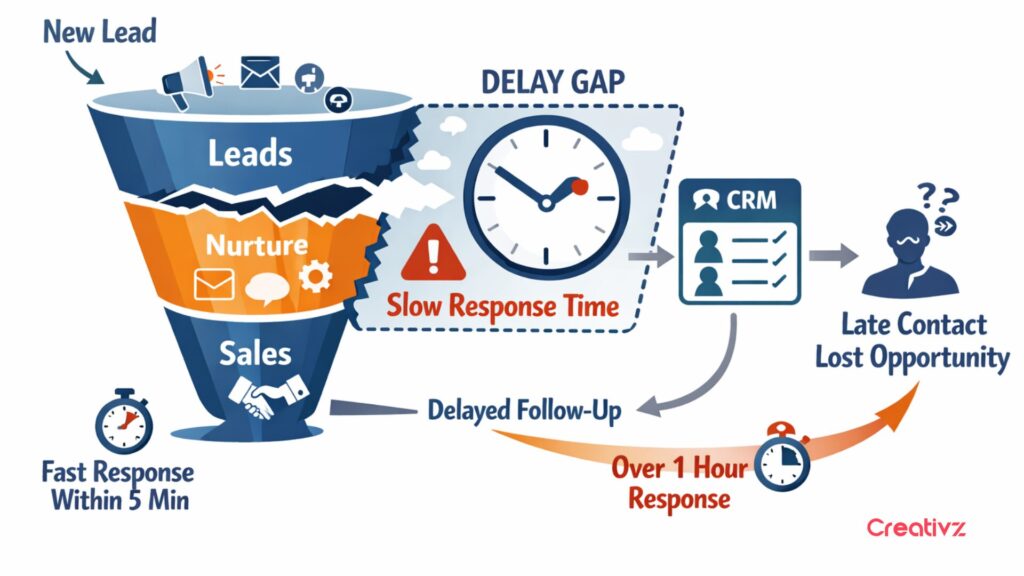
Most businesses have a gap between the moment a lead signals interest and the moment a human responds. That gap is where deals die.
Here is what that gap usually looks like:
- Your forms dump leads into a spreadsheet or CRM with no alert.. Someone checks it at the end of the day.
- No automated first touch. The lead hears nothing for hours. Their enthusiasm cools.
- Sales rep delays. They are in meetings, on calls, or simply did not see the notification.
- Wrong routing. The lead goes to a general inbox. Nobody owns it. Nobody responds.
This is not a people problem. It is a systems problem. Your team intends to follow up fast. The infrastructure that makes it happen automatically just isn’t there.
The problem is not your team’s effort. It is the gap between form submission and the moment your team even knows a lead exists.
This gap also sits directly inside your funnel. A well-built funnel brings people to the point of action. If nothing catches them at that moment, the funnel does its job, and the revenue still walks out the door.
What a Fast Lead Response System Actually Looks Like
If the problem is baked into your system, the solution has to be as well. That starts with defining what a truly fast response setup looks like.
A fast-response system isn’t about hiring more reps or demanding that people work faster. It is about building infrastructure that removes human delay from the critical first window.
Here is what that system includes:
1. Instant Lead Capture With Real-Time Alerts
The moment a form is filled, a lead is created in your CRM, and the right person gets a notification. Not an email digest. An instant push notification, Slack message, or SMS. The rep knows within 60 seconds.
2. Automated First Touch
Before any human responds, the system sends a personalized acknowledgment. Not a generic autoresponder. A message that confirms receipt, sets expectations, and delivers immediate value, like a relevant case study or audit result.
This is exactly where full-funnel email automation earns its place. earns its place. The first automated message isn’t marketing—it’s part of your response infrastructure.
3. Lead Routing to the Right Person
The lead does not sit in a shared inbox. It routes to a specific rep based on geography, company size, or product interest. Ownership is immediate and unambiguous.
4. Escalation Triggers
If the assigned rep does not respond within a defined window, the system escalates. The lead gets a follow-up. The manager gets an alert. Nothing falls through.
5. Unified Pipeline View
Every lead, every response time, and every follow‑up are visible in one dashboard. You can see exactly where response time is breaking down and fix it surgically.
This is the system that changes lead response time impact from a metric you hope to improve into a process you control.
How to Reduce Response Time Without Hiring More People
At this point, many founders assume the only answer is more sales reps. In practice, smart automation does far more for a fraction of the cost.
Automation does.
- CRM triggers. Configure your CRM to fire a notification the instant a lead enters the pipeline. HubSpot, Salesforce, and Pipedrive all support this natively.
- Automated email sequences. Build a first-touch email that goes out within two minutes of form submission. Include the lead’s name, a specific reference to what they submitted, and a clear next step.
- Zapier or Make workflows. Connect your lead capture form directly to your rep’s Slack or SMS. Zero manual steps.
- Calendar booking links. Include a direct booking link in the first automated message. Reduce friction to zero. The lead can book without waiting for a human to suggest times.
This is also the argument for smart automation as a growth lever, not just an efficiency play. When your response system runs automatically, your team spends its time on conversations that matter, not chasing notifications.
None of this requires a developer or a complex tech stack. You can set most of this up in an afternoon with the tools you already have. The gap isn’t capability. Its configuration.
From Speed to Revenue: Why Lead Response Time Impact Drives Conversion Rates
All of this infrastructure work isn’t just about feeling more organized. It directly changes how many deals you close.
Response time does not just determine who gets the first conversation. It shapes the entire sales dynamic that follows.
When you respond fast:
- The lead is still in context. They remember exactly why they filled out the form, so the conversation starts warmer.
- You signal operational quality. Buyers thinking about handing you their business are watching how you operate. A fast response tells them you have your act together.
- You build momentum early. The first 24 hours of a sales relationship set the tone, and a fast response creates forward momentum that carries through the entire cycle.
- Your close rates go up—often significantly. Research shows that responding within five minutes can increase conversion rates by up to 400% compared to a 10‑minute delay.
Slow response, on the other hand, communicates the opposite. It signals disorganization. It creates friction. It gives the first-responder competitor time to build trust while you are still drafting your initial email.
If you have already optimized your landing pages and are still seeing low conversion, the issue is likely not the page. It is what happens after the click. Response time is the last mile of your conversion system.

The Real Problem is Not Your Marketing. It is Your System.
When you follow the impact of response time all the way through the funnel, a pattern emerges.
Most founders chasing growth are focused on the wrong variable. They are A/B testing ad headlines while leads from last Tuesday are still sitting in an unread CRM queue.
The first company to respond often wins, not the best one.
That is not a knock on quality or strategy. Great marketing still matters. But great marketing feeding a slow follow-up system is a waste. You are filling a bucket with a hole in it.
The fix is not more budget. It is closing the gap between lead capture and first contact. That is a systems problem. And systems problems have systems solutions.
If your business is showing signs that your operations cannot scale, slow response time is almost always one of the root causes. It is not isolated to sales. It runs through every function that touches the customer.
Want to Go Deeper?
These posts cover the systems that sit around your response infrastructure:
Final Thought
Speed is not a personality trait. It is not something your team can just decide to do better. It is the output of a well-built system.
If you do not know your current average response time, that is the first thing to find out. If it is over five minutes, you are losing deals to competitors who are faster, not smarter.
We run a Free Digital Growth Audit that maps your entire lead-to-response process and identifies exactly where you are losing deals to slow follow-up. No pitch. Just a clear picture of what is broken and what to fix.
