
Why Founders Should Stop Depending on Big Social Platforms and Start Owning Their Audience
If you’re a founder of a SaaS startup or a small‑to‑medium business (SMB), you’ve probably felt that social media doesn’t hit the same anymore.
3 algorithm changes in 18 months. Ad costs up 35%. Organic reach has dropped to under 2% for most business pages.
And yet the usual advice sounds unchanged: post more, test more, jump on the next trend.
Here’s the uncomfortable truth: Social platforms still work as discovery tools, but they don’t work as the foundation of a business. The founders who are building compounding, predictable growth are not chasing algorithms. They are building audiences they own: email lists, newsletters, communities, and direct channels. In which no platform can cut off their reach overnight.
It isn’t one algorithm update: it’s a shift in the entire environment.
What Changed on Social Platforms And Why It's Not Going Back
In 2026, generative AI content and fake interactions flood the very platforms that power our news and entertainment. Over 50% of Americans get their news from social networks, yet those feeds are increasingly filled with AI-generated slop, ads for nonexistent products, and content that blends real and fake.
This “potpourri of real and fake” has led to an experience that’s more asocial than social. Half of the country is more concerned than excited about AI in daily life, and even journalists using generative AI professionally are deeply worried about its impacts.
Researchers note that social media is now the least trusted source for product and brand recommendations. Customers are aware that many influencers receive payment, and they suspect some may not even be genuine. Meta’s own projections indicate that around 10% of its revenue comes from ads for scams and banned goods, amounting to billions of scam ads shown to users. It’s no wonder that trust, the fuel of any community, is eroding.
The results for founders: you can build a following of 50,000 people on Instagram and still struggle to sell because the audience never trusted the channel enough to act on what they saw there.
Why Owned Audience Strategy Beats Paid Reach in 2026
Amid noisy feeds and AI‑generated content, people are gravitating toward authentic voices and smaller communities. Predictions for 2026 point to the rise of micro‑influencers and nano‑influencers (creators with 10k or fewer followers). These creators have tight‑knit communities and approachable styles, the antidote to skepticism of polished ads.
Their content feels genuine, which is why followers trust them. Engagement is higher too: nano‑influencers see roughly 2.7% engagement on Instagram, about 50% higher than micro‑influencers and far above macro-influencers.
Closely tied to the micro‑influencer trend is the boom in user‑generated content (UGC). Rather than relying on slick brand videos, marketers are leaning on real customer reviews, unboxing videos, and genuine product demos. Surveys show that 78% of marketers worldwide rate UGC as important to their social strategy, with more than a third calling it “extremely important.” UGC simply comes off as more honest than heavily edited brand content, and when influencers amplify it, the authenticity loop is powerful.
For founders, this means your audience values relatability over perfection. Sharing behind‑the‑scenes glimpses of product development, team stories, and customer testimonials resonates more than polished ads. Encouraging customers to create and share their experiences builds credibility and fosters a community around your brand.
The Real Problem: Attention Without Infrastructure
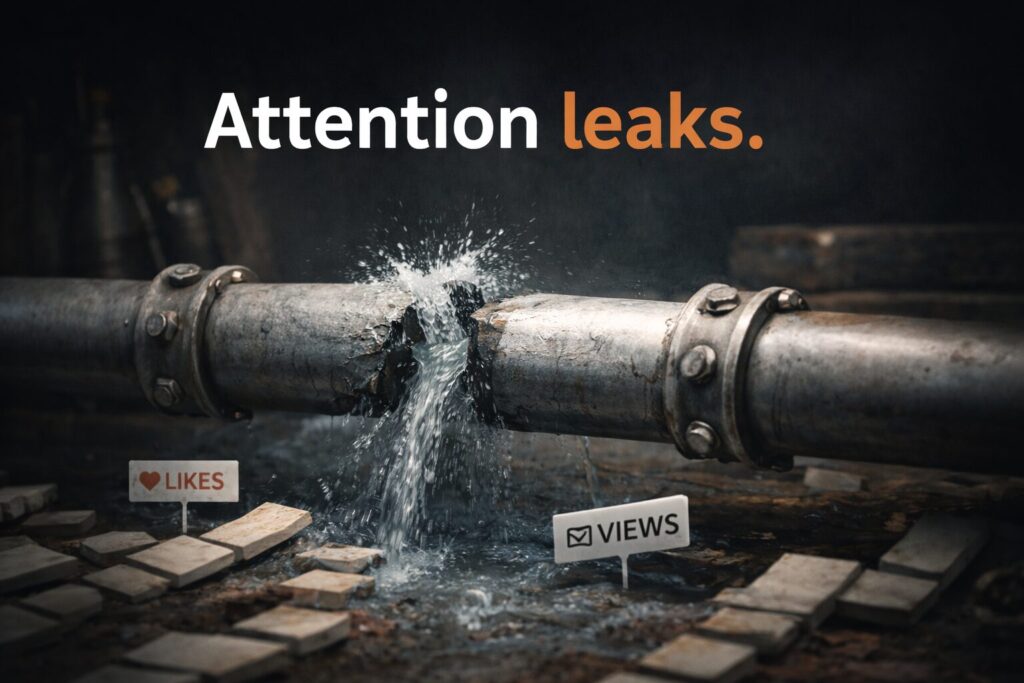
Social platforms are excellent discovery tools but poor at ownership. When you rely on them entirely, four things break:
- Discovery without ownership. You get views but no retained audience. Nothing compounds because the moment you stop posting, the relationship pauses.
- Engagement without qualification. Likes and comments do not tell you who is ready to book a demo or start a trial. High engagement and zero pipeline are more common than most founders admit.
- Traffic without conversion infrastructure. Clicks land on pages that do not capture intent or trigger follow-up. The lead arrives and disappears because there is no system to catch them.
- Visibility without continuity. The algorithm decides who sees you. Your best prospects may never see your message because the platform’s priorities changed that week.
Many businesses don’t actually have a traffic problem; they have nowhere for traffic to go. If you’ve been experimenting with Generative Engine Optimization to convert AI search traffic, you’ve already felt this shift: leads from AI search arrive pre‑qualified, and if you don’t own the experience after the click, they disappear.
Why Owned Social Platforms Produce More Predictable Revenue
The chaos of 2025 (soaring ad costs, algorithm shake‑ups, and AI hype) forced marketers to look ahead. Experts predict 2026 will be about securing your foundations and shifting from noise to value. The trend for this year is clear: shift from rented attention to owned channels. Brands are tired of sinking budgets into social platforms they do not control
Emails, SMS, and owned web experiences provide that control. When ad platforms become unpredictable and Google CPCs surge, complementing paid channels with owned channels provides far more stability. Focusing on growing your email list protects against rising ad costs and pay‑to‑play algorithms. In fact, marketers see email as their most effective channel, ahead of social media and paid search.
The numbers back this up:
- Average email ROI: $36 for every $1 spent (3,600 % ROI). Some industries achieve $38 per $1 spent or higher.
- Automated workflows generate 30× higher returns than one‑off campaigns.
- 52% of consumers purchase directly from an email they receive.
When you own your channels, you control the journey from first touch to customer conversion: you can nurture relationships via email newsletters, segment your list by interest, and automate follow‑ups when someone downloads a guide or fills out a contact form.
How to Build an Owned Audience System That Compounds
Moving away from platform dependency does not mean abandoning social media. It means building the infrastructure behind it so every piece of content you create routes attention somewhere it compounds.
Build conversion-focused pages that capture intent
Create clear paths from interest to conversation
A contact form should trigger a follow-up email within 5 minutes. A content download should tag the subscriber and add them to a nurture sequence. A demo request should immediately trigger an assignment to the right rep and a personalized first-touch email.
These are not complicated automations. They are the baseline infrastructure that separates founders who compound their audience from those who restart from zero every week.
Build your email list before you need it
Automate the follow-up so nothing falls through

What Platform Dependency Actually Costs a Scaling Founder
- A platform changes its algorithm. Overnight, your reach drops 60%. The audience you spent two years building becomes unreachable without paid promotion.
- Your ad account gets flagged or suspended. This happens more often than founders talk about. One policy change, and your primary acquisition channel is gone.
- You try to sell, and nothing converts. High follower counts and low sales rates are the clearest signs that the audience was never yours. It was the platform’s.
- You stop posting for two weeks. The pipeline dries up because the relationship depends entirely on your content output, not a system that runs without you.
Frequently Asked Questions
Why must founders own their audience?
What is an owned audience strategy?
How do I build an owned audience as a SaaS founder?
What is the difference between a social media following and an owned audience?
Is email marketing still effective for B2B founders in 2026?
Final Thought
Social media didn’t stop working overnight; it just stopped being dependable. The real risk isn’t low reach or bad algorithms; it’s building your business on someone else’s platform.
More founders are quietly realizing this. They’re tired of chasing trends and rebuilding momentum every week. Owning your audience doesn’t mean abandoning platforms; it means giving attention to where it lands. It means inviting your followers into your own space: your website, your newsletter, your community. Where relationships continue and growth compounds.
If this message resonates with you, you don’t need to rush or buy anything. Start by thinking differently about what drives your business growth. When you’re ready for more clarity and practical ideas, feel free to talk to us.
We’re always happy to share what’s working and learn from fellow founders.
