
You are hitting $20K+/month often and notice something unsettling: growth slows down or becomes harder to manage, even though leads keep coming in.
Even if you’re investing heavily in your ads or SEO, the number of visitors is increasing without any noticeable increase in revenue. The issue probably isn’t traffic. It’s what happens after the click.
As your business scales, buyer behavior also changes. Prospects now move faster, patience drops, and decision windows reduce.
Landing pages that once worked start failing quietly. Forms sit unsubmitted, follow-ups rely on manual work, and you find yourself stepping in to “rescue” deals. Generic pages aren’t broken in obvious ways; they simply leak momentum. The result is inconsistent revenue despite demand.

This post reframes landing pages as systems, not static brochures. We’ll explore:
- why landing page conversion optimization and post‑click optimization are critical at scale.
- how automation supports that system, and where most existing advice falls short.
By the end, you’ll be able to spot hidden leaks and build a page that routes intent, triggers follow‑ups automatically, and preserves momentum.
The hidden bottleneck: post‑click experience
Conversion rate optimization (CRO) is more than just a catchphrase; it guarantees the efficient use of the traffic you invest in. Optimizing conversion rates helps you get more value from the same number of visitors. This means you spend your marketing budget more efficiently, reduce the cost of acquiring customers, and improve the user experience. But there’s more that goes beyond the landing page to cover the whole journey. This process includes everything from the initial impression to the thank-you page and the next follow-up.
When growth slows, it’s often because:
- Leads move faster. Decision windows shrink, and people won’t wait for manual responses. They expect your immediate next step.
- Patience drops. A slow page, unclear headline, or long form causes them to bounce. The average visitor decides whether to stay within three seconds; a 1‑second delay can drop mobile conversions by 20%. (For more on timing and page speed, see our conversion blueprint.)
- Generic pages leak momentum. Without a clear value proposition or automated follow‑up, high‑intent leads slip away. Over 70% of shopping carts are abandoned due to unclear or risky purchase paths, according to research from Baymard.
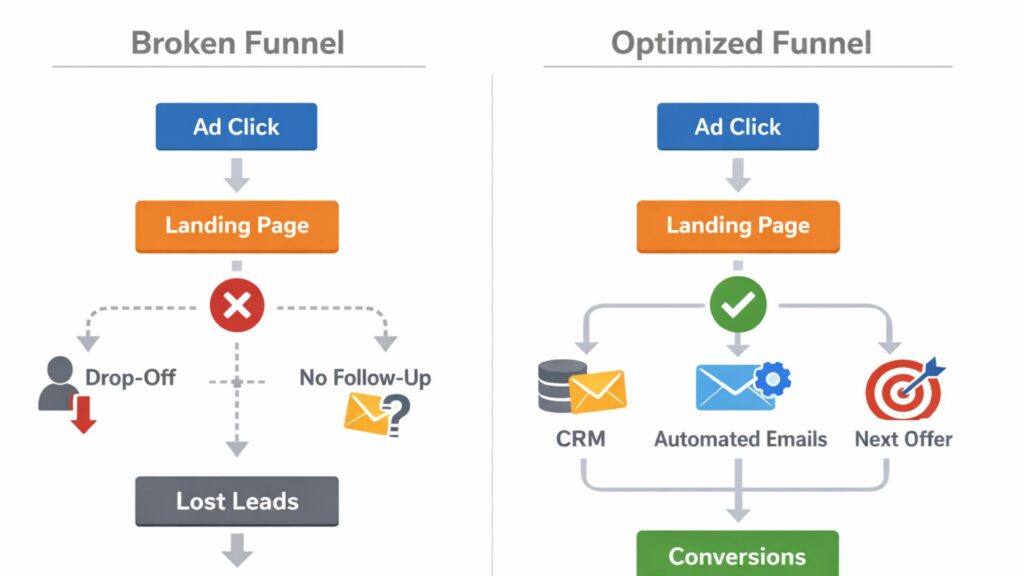
Post-click optimization aims to maintain momentum. When someone clicks an ad, every second counts. If they’re forced to think, wait, or navigate irrelevant pages, you’ve lost them. A high‑converting landing page guides them from interest to action seamlessly, collecting intent signals and triggering the right follow‑up—without you stepping in.

Landing pages are systems, not pages.
You may hear many people say, “Just focus on headlines, colors, and calls to action.” Those elements matter, but they’re part of a larger system. Conversion marketing coordinates four levers:
1. Audience & intent
Who is visiting, and what are they trying to achieve?
2. Value proposition & offer
Why should they act now? What promise and proof make the action worthwhile?
3. Experience & friction removal
Are pages swift, clear, and trustworthy? Are forms short and mobile‑friendly? Reducing form fields from 11 to 4 can increase completions by 120% (see our conversion blueprint for examples).
4. Measurement & feedback loops
Do you track clean events and run experiments to see what works? PPC Hero describes CRO as a repetitive cycle of isolating friction points, designing a treatment, and testing it.
When these levers work together, your page becomes a decision engine. Instead of simply collecting emails, the system routes visitor intent: high-value visitors receive a demo booking link, curious browsers are provided with a guide, and repeat customers are offered a loyalty incentive. Follow-ups are triggered automatically, personalized emails, SMS or retargeting, based on the visitor’s actions.
Why post-click optimization matters now
Advertising expenses have climbed while conversion rates have slipped. Contentsquare’s digital experience benchmarks found cost per visit up 9 % year over year and conversions down 6.1 %. That means every click must convert more efficiently. Meanwhile, brands using AI-powered personalization are now considered essential, as independent research reveals a 16-point increase in conversions compared to basic efforts, a topic also covered in the same report. In this environment, generic pages aren’t just wasteful; they’re expensive.
Advanced post‑click systems help you adapt:
- Personalization & segmentation
Use first‑party data (pages viewed, products browsed, engagement signals) to build 4–6 cohorts. For each cohort, personalize one element—headline, proof module, recommendation carousel, or CTA—and measure the impact. Small changes aligned with intent lead to outsized gains.
- Micro‑conversions
Most visitors aren’t ready for a stern “Buy now.” Give them a smaller “yes”: save to wishlist, download a calculator, or request a free audit. Micro-conversions build momentum and permission to follow up. For inspiration, explore our guide on micro conversions.
- Modular design & clear flows
Make three answers visible above the fold: What is this? Why care now? How do I act? Use modular blocks (benefits, proof, risk reversal, FAQs) so you can recombine pages for different intents without rebuilding.
- Trust & social proof
Conversions stall when uncertainty rises. Put testimonials, case outcomes, and guarantees next to the CTA; show safety nets early (free returns, warranties, and secure payment badges).
Filling the gaps: what existing advice misses
Many resources cover the basics of landing page optimization, such as clear headlines, strong offers, and trust signals. They explain design fundamentals, psychological triggers, and ways to reduce friction. Some also challenge the idea that simply increasing traffic will solve conversion problems. While these core principles are important, they do not address the broader system-level challenges.
Beginner CRO tips don’t address the unique challenges faced by founders scaling beyond $20K/month.
- Dynamic segmentation and personalization are crucial aspects to consider
Most posts talk about “knowing your audience,” but they rarely explain how to build cohorts from first-party signals and adjust page elements in real time. Advanced personalization can yield a 16‑point conversion lift, yet few guides show you how to operationalize it.
- Automation after the click
- Many articles conclude their discussion after the form submission. In reality, what happens next determines revenue: automated lead qualification, routing to the right rep, and personalized follow‑ups via email/SMS. Our post on smart automation hints at this, but your landing page must integrate with those workflows from the start.
- The balance between system design and tool overload is crucial
It’s tempting to bolt on pop‑ups and chat widgets. Yet acquisition costs are rising while conversions are slipping. Without a coherent system, more tools create noise, not clarity. Focus on routing intent and triggering the next best action instead of adding features for their own sake.
- Analytics and feedback loops
Beginners often ignore measurement or rely solely on top‑of‑funnel metrics. CRO is a cycle: isolate friction, design a treatment, and test it. Build dashboards that track micro‑conversions, cohort performance, and time‑to‑value. Use A/B tests on high‑traffic pages and sequential tests when traffic is thin.
By addressing these gaps, you move from “optimizing a page” to engineering a post‑click system that scales with your business.
Building your post‑click system: practical steps
Ready to turn your landing page into a conversion engine? Here’s a blueprint that pulls it all together:
1. Map the visitor journey and segment intent
Before redesigning anything, map out where visitors come from and what they do on your site. Use heatmaps and analytics (Hotjar, Crazy Egg, GA4) to identify drop‑off points and gather first‑party signals. Group visitors into cohorts (e.g., new visitors who viewed a product but didn’t opt in; repeat buyers dormant for 60 days).
2. Clarify the promise above the fold
In the first three seconds, answer What is this? Who is it for? Why should I care? Use a benefit‑driven headline and a single call to action (CTA). Mobile traffic now drives ~60 % of visits, so keep your above‑the‑fold content clear and thumb‑friendly. Our high‑converting landing page guide dives deeper into above‑the‑fold clarity.
3. Design modular pages that route intent
Build your landing page with interchangeable blocks: problem description, offer, proof, FAQs, risk reversal, and CTA. Show or hide blocks based on visitor intent and cohort. For example, high‑intent visitors see case studies and a “Book my free audit” button; low‑intent visitors see a guide download and social proof.
4. Implement micro-conversion ladders
Don’t ask everyone to buy immediately. Offer low‑commitment actions such as quizzes, calculators, or downloads. Each micro-conversion collects data and signals intent, which triggers the next step. These smaller “yeses” create momentum and qualify leads.
5. Automate lead qualification and follow‑up
Connect your forms to a CRM or marketing automation platform. Set rules that route leads based on company size, job title, or engagement signals. Trigger personalized email/SMS sequences that deliver case studies or booking links. This eliminates manual obstacles and guarantees that no lead is overlooked. For deeper guidance, see our post on How Smart Automation Frees Founders and Boosts Predictable Revenue.
6. Test, measure, and iterate
Every change should be a hypothesis. Run A/B tests on headlines, offers, and CTAs; use sequential tests when traffic is low. Track micro‑conversions, time‑to‑value, and cohort‑level performance. Document winners as reusable patterns so you can scale them across channels.
Final Thought
Post‑click optimization isn’t about adding more tools or copying trendy designs. It’s about building systems that preserve momentum, route intent, and trigger follow‑ups so your team doesn’t have to. When you treat your landing page as a system, not just a page, you solve the real problem: inconsistent conversions that demand your constant attention.
If your growth has plateaued despite steady traffic, take a serious look at what happens after the click. Map your visitor journeys, segment your audience, and build micro-conversion ladders. Then integrate automation to qualify and nurture leads while you sleep. Growth becomes predictable only when systems replace manual effort.
Are you curious about the areas where your funnel is lacking efficiency?
