
First-Party Data Strategy: How to Build a Cookieless Growth System in 2026
There are two ways to run a kitchen.
You can source your own ingredients, control quality, and cook on your schedule. Or you can depend on a supplier who changes prices without warning, restricts access without explanation, and can cut you off at any time.
Most businesses rely on third-party data for digital growth—tracking visitors with third-party cookies, buying audiences from platforms, and depending on identifiers they never owned.
That model is breaking. Not because of one “cookieless deadline.” Because the infrastructure itself is structurally constrained.
In 2026, Safari blocks third-party cookies by default. Firefox disables cross-site tracking cookies by default. Apple requires explicit opt-in for cross-app tracking under App Tracking Transparency. Google retired its Privacy Sandbox APIs in October 2025. And roughly 29.5% of internet users block ads at some point.
The result: your measurement inputs are incomplete. Your pipeline data is unreliable. Your cost per acquisition is climbing for no obvious reason.
But here is what most blogs get wrong. This is not a cookie problem. This is a problem with the broken system. And a first-party data strategy is not the answer to the disappearance of cookies. It is the foundation of a revenue system that should already be in place.
This blog breaks down what that system looks like, why your growth stalls without it, and how to build it the right way. Let’s start by clarifying the core concepts you need to understand.

What Is a First-Party Data Strategy and Why Do Most Businesses Get It Wrong?
Before fixing the system, you need to be clear on what you are actually building. Most founders misdefine this from the start.
First-party data is information you collect directly from your audience through your own channels: website behavior, form submissions, CRM activity, email engagement, purchase history, product usage, and support interactions. You own the collection. The relationship is direct. Nobody can take it from you.
Two related terms matter for your strategy:
- Zero-party data is information customers intentionally and proactively share with you. Preferences, intent signals and how they want to be recognized. Forrester Research coined the term to separate data given willingly from data inferred through behavior. Think onboarding surveys, preference centers, quiz funnels.
- Third-party data is collected by someone else and sold to you. It depends on cross-site tracking, which browsers and privacy frameworks now restrict. Truthset research found that third-party ad targeting data is inaccurate up to 51% of the time, with accuracy ranging from 32 to 69% across providers.
Here is the bigger misconception most founders carry into this conversation:
Cookies are not a data strategy. Cookies are a storage mechanism. A cookie working today does not mean your revenue system is healthy.
Most founders we audit have a CRM, a website, ad platforms, and an email tool. They call that a first-party data strategy. What they have is four disconnected systems, each generating its own version of the truth.
That disconnect is what the rest of this blog addresses. To diagnose the problem, let’s examine the most common first-party data pitfalls.
Why Your First-Party Data Strategy Is Failing: The Broken System Hiding in Plain Sight
Once you understand what first-party data actually is, the next question is obvious: why does growth stay unpredictable even when the tools are there?
The answer is almost never the tools. It is the architecture connecting them.
According to IDC research, companies lose 20-30% of their revenue annually due to inefficiencies caused by data silos. For a business doing $5M in revenue, that is up to $1.5M leaking through the cracks every year without appearing on a single P&L line item.
Gartner research puts the annual cost of bad data at $12.9 million for the average organization. A survey of 720 sales reps found they spend nearly 65% of their time on non-selling activity, largely because data does not flow between systems.
Salesforce’s research offers the sharpest figure: only 1 in 4 marketers is satisfied with how they use data to power customer moments. That means 75% of teams feel the exact friction you feel. They have tools. The tools just don’t talk to each other.
Here is what a broken first-party data system looks like in practice:
- Your ad platform reports 40 leads. Your CRM shows 12.
- Email sequences fire to contacts who have already closed, churned, or were never qualified.
- A high-intent lead submits a form and hears nothing for 48 hours because the routing broke.
- Sales and marketing work from different data sets. Every pipeline call becomes a debate about which number is right.
This is not a tracking problem. This is a revenue architecture problem. Buying more tools makes it worse. Companies already use an average of 100 software applications, according to Okta. More tools mean more handoffs. More handoffs mean more gaps.
The fastest-growing companies are not those with more tools. They are systems in which every tool shares the same data.
Knowing the system is broken is step one. Understanding the revenue cost of leaving it broken is what forces action. Let’s explore those costs now.

The Revenue Cost of Running Without a First-Party Data Strategy
Broken data systems do not just create reporting headaches. They directly erode revenue in ways that are measurable, predictable, and preventable.
The MIT Lead Response Management Study is one of the clearest examples. The odds of contacting a lead drop 100 times when response time moves from 5 minutes to 30 minutes. The odds of qualifying that lead drop 21 times over the same window.
That is not a salesperson’s problem. That is a system failure. The form was submitted. The CRM did not trigger. The notification never fired. The sequence never started. No human knew. The lead went cold while your team was busy.
Four revenue consequences follow directly from a missing or broken first-party data strategy:
- Bad targeting raises your CAC. Your ad platform does not know what your CRM knows. It keeps spending to reach people who have already converted, churned, or were never a fit. BCG research shows that brands using first-party data achieve 5 to 8 times the ROI on marketing spend compared to those relying on third-party signals.
- Lost leads drain the pipeline. High-intent prospects go cold because no automation picks them up. Companies with disconnected CRMs experience conversion rates up to 20% lower than those with integrated CRMs.
- An inconsistent pipeline makes forecasting impossible. You cannot trace the path from traffic to a closed deal. 53% of US B2B marketers say at least 10% of their leads are disqualified by sales due to poor data quality, according to Demand Metric.
- Rising costs with declining returns. McKinsey reports businesses using first-party data effectively reduce marketing spend by up to 20% while increasing revenue by up to 15%. The gap between integrated and fragmented operations compounds every quarter.
When you don’t own your data, you don’t control your growth. You rent your results from platforms that change their rules without asking.
This is the cost of inaction. The next question is: what does a functional first-party data strategy actually look like, and what it takes to build on it. Let’s turn to that now.
What a First-Party Data Strategy Actually Looks Like Inside a Revenue System
Most blogs answer this question with a list of tools. That is not the answer.
A first-party data strategy is not a collection project or a tech stack checklist. It is a connected revenue system in which data flows from the first touchpoint to the close, and every team works from the same source of truth.
The IAB’s State of Data research highlights the architecture serious operators invest in: website analytics tools, customer data platforms, identity solutions, consent management platforms, tag management, and privacy tools. These technology layers work together as a single integrated system, not isolated purchases.m.
Here is how those layers map to revenue:
- Capture. Every touchpoint that produces a signal. Forms, onboarding flows, chat, product behavior and purchase events. If it is not captured with consent and routed correctly, it does not exist.
- Store. A single source of truth in your CRM or CDP. Not your ad platform’s leads tab. Not a spreadsheet. Everything else is a source that feeds into it.
- Enrich. Layer behavioral scoring, firmographic data, and intent signals. Google’s Enhanced Conversions lets you send hashed first-party data from lead forms at conversion time, so attribution gets cleaner without relying on cookies.
- Trigger. Automated workflows that fire based on real behavior. A lead score threshold hits, and a sequence starts. A contact goes cold, a re-engagement fires. No manual intervention.
- Convert. Sales work off live, accurate data. Outreach is timed to intent. Every action is traceable from the original source to the closed deal.
Each layer makes the next one smarter. That is what separates having data from having a revenue system.
Now, here is what that system looks like when you build it specifically for a founder-led B2B business.

How to Build a First-Party Data Strategy Using the Creativz Digital Growth Stack
After auditing dozens of founder-led businesses doing $500K to $10M, one pattern appears every time. The tools are there. The system is not. Data sits in silos, automations fire blindly, and leadership makes decisions from three dashboards that all say different things.
The Creativz Digital Growth Stack is the five-layer system we use to fix it. Each layer builds on the one before it. You cannot skip to layer four and expect layer one to work itself out.
Layer 1: Revenue Capture Infrastructure
Map every capture point: forms, demo requests, onboarding steps, email signups, product events, support tickets. Audits that are connected, broken, and duplicated. Most businesses discover that 40-60% of their capture points are not connected to anything downstream. That is where leads disappear before sales ever see them.
Layer 2: Unified CRM Architecture
Normalize all capture points into one CRM-based system of record. One. Every contact has a complete, clean, timestamped history. Sales and marketing work from the same data. No more pipeline debates. No more “which number is right” conversations. One source of truth for every revenue decision.
Layer 3: Consent-Aware Data Collection
If you operate in the EU or the UK, consent is mandatory. Google’s Consent Mode framework requires consent signals to pass before measurement fires. The UK’s ICO is explicit: cookie rules apply even when data is technically anonymous. Consent-aware collection is not a compliance checkbox. It is what keeps your data system legally defensible as you scale internationally.
Layer 4: Behavioral Segmentation Engine
Segment based on what contacts actually did. Pricing page visits, specific email clicks, time-in-product, and feature usage. Behavioral signals predict conversion far better than demographic assumptions. This is the layer where your data stops producing reports and starts producing decisions.
Layer 5: First-Party Activation
Your first-party data becomes your activation lever. Google’s Customer Match lets you upload customer data with consent and reach those contacts across Google properties. Meta has a parallel mechanism. The point is not platform dependency. It is that your list, built on real relationships with real consent, works regardless of what any algorithm does next.
Here is what this looks like for a real business.
A B2B founder doing $2M per year runs Google Ads, HubSpot, and an email tool. On paper, the stack looks complete. In practice, the ad platform does not know when a deal closes. HubSpot fires nurture sequences to leads who have already been disqualified. The email tool runs on a contact list that is three months out of date. CAC went up 40% in six months, and nobody can explain why.
A Digital Growth Audit identifies the leaks. We rebuild across all five layers. The ad algorithm starts optimizing for buyers, not clicks. Sequences only fire to active, qualified contacts. Sales sees real behavioral data before every call. Within 90 days, CAC drops, pipeline velocity improves, and the founder can finally point to which campaigns drove closed revenue.
Same traffic. Same team. Different system.
Once the system is built, the real advantage kicks in: data starts driving decisions instead of just sitting in dashboards.
How a First-Party Data Strategy Turns Raw Data into Revenue Decisions
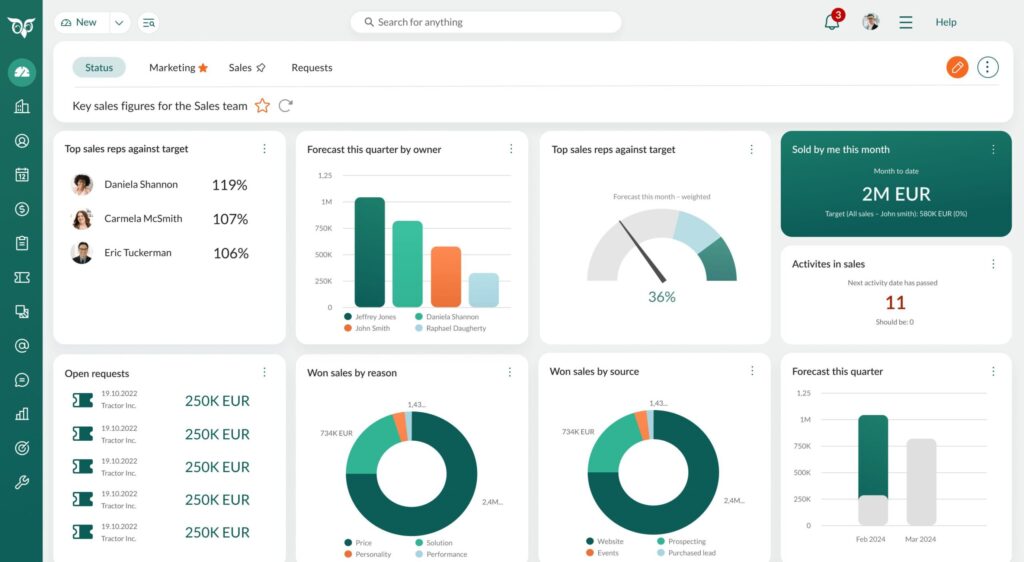
Building the system is the hard part. What happens after is the part that founders underestimate.
Most founders already have dashboards. Most founders still argue about which number is right. That is because each dashboard reflects only the slice of reality its tool can see. Salesforce confirms it: only one in four marketers is satisfied with how they use data to power customer moments.
When the five layers of the Digital Growth Stack are connected, and your first-party data strategy is running properly, three things change immediately:
- Data becomes actionable in real time. A lead views your pricing page twice. HubSpot updates its score. A sales alert fires. The sequence adjusts. No human intervention. The system runs the play automatically based on behavior, not assumptions.
- Attribution finally reflects reality. You stop measuring channel performance in isolation. You start measuring revenue contribution across the full journey from first ad click to closed deal. Marketing knows which campaigns produce buyers, not just form fills.
- Scale stops requiring headcount. The system runs the same playbook for every lead, regardless of volume. Growth no longer means hiring more people to manage manual processes. The infrastructure handles the load.
This is what Gartner defines as the RevOps mandate: integrating people, processes, and technology to collect data across the revenue process, enable data-led decision-making, and automate workflows. It is a business operating system, not a marketing project.
There is one more piece of this that most founders only discover when it is too late: what happens when you skip this and keep depending on platforms instead.
Why a First-Party Data Strategy Is Your Protection Against Platform Dependency
Every business that scaled primarily through paid platforms hits the same wall. It works. Then it gets expensive. Then it becomes unpredictable. That is not a bad luck problem. It is the natural result of building growth on borrowed identifiers and rented audiences.
Platform dependency costs you in four specific ways, and each one compounds the others:
- Rising CAC with no explanation. Signal loss from privacy changes means platforms optimize on less data, leading to worse targeting and higher cost per acquisition. EY research shows companies lose 1 to 5% of EBITDA annually to revenue leakage tied directly to disconnected systems and signal gaps. You pay more and get less, and the gap widens every quarter.
- Zero fallback when rules change. Apple’s App Tracking Transparency came in overnight. Google retired its Privacy Sandbox APIs in October 2025 after publisher testing showed a 30% decline in revenue. Platform rules change on their timeline. Your first-party data does not change. It is the only asset in this equation that you control.
- Attribution collapse kills decision-making. When platform-reported numbers disagree with your CRM, budget allocation becomes guesswork. A one-week delay in campaign optimization can reduce monthly revenue growth by 2-3%. Over a year, that is hundreds of thousands in unrealized potential.
- Audiences that evaporate with ad spend. The audience you built inside a platform belongs to that platform. Cut the spend, and you lose the reach. A first-party list is yours regardless of policy. That is the durable asset. The relationship, not the platform rental.
Platform dependency is a governance problem before it is a marketing problem. You cannot build predictable revenue on infrastructure you do not control.
Everything above connects to one decision: do you own your data system, or do you rent access to someone else’s?

Want to Go Deeper on First-Party Data Strategy?
The Cost of Disconnected Tech Stacks: How to Build an Integrated Growth Stack
A deep breakdown of why scaling businesses hit a wall after $1M in revenue, how disconnected systems create invisible revenue leaks, and the exact integration approach to fix it. If the broken system section of this blog resonated, this is the next read.
Revenue Infrastructure: Build Predictable B2B Growth
Covers the five layers of revenue infrastructure that connect people, processes, data, and technology into one system. Includes a phase-by-phase execution roadmap and the data on what mature revenue infrastructure actually produces in revenue growth and pipeline accuracy.
The platform dependency argument from this blog, extended. Covers why social reach is becoming structurally unreliable in 2026, why audience ownership is the only durable growth asset, and how to build a system that keeps compounding even when you stop paying platforms.
Final Thought
Most businesses treat a first-party data strategy as a marketing project. It is not. It is a revenue infrastructure decision.
The founders who grow predictably over the next three years are the ones building connected systems where data flows from first touch to closed deal without friction, manual work, or guesswork.
The ones who don’t are still arguing about which dashboard to trust.
When you don’t own your data, you don’t control your growth. The durable asset is not your platform audience. It is the connected revenue system you built around real relationships.
If your pipeline feels inconsistent, your attribution is broken, or your tools generate data that nobody acts on, the problem is not your traffic. It is your system.
A Digital Growth Audit from Creativz maps every gap between your current data infrastructure and a system that drives a qualified pipeline. We find the revenue leaks, show you exactly what is broken, and build a clear path to predictable growth.
