
Your team is not lazy. Your processes are broken.
Revenue growth has stalled. Leads come in but go quiet. Follow-ups happen when someone remembers. The founder spends three hours a week manually moving data between tools that should be able to communicate with each other.
This is not a workload problem. It is a workflow problem.
Most businesses at the $500K to $10M mark are not short on effort. They are short on systems. And every day they operate without autonomous workflows, the gap between them and the businesses that do so widens.
In this blog, you’ll learn what autonomous workflows really are, where manual operations tend to break and cost revenue, and the specific steps to build systems that function without constant human input. To understand the gap, let’s first examine why workflows often falter before scaling.

Why Most Business Workflows Break Before They Scale
The way most B2B operations actually run looks something like this. A lead emails in. Someone logs it in the CRM. Another person pings the sales team. Two days pass. By the time anyone follows up, the buyer has moved on.
That is not an isolated failure. It is the default state for most businesses without connected workflow automation. And it compounds fast.
Three things cause most workflow breakdowns:
- Manual handoffs. Every time a human has to move information from one place to another, there is a delay, an error risk, and a dependency on someone being available.
- Tool fragmentation. Slack for communication, a separate CRM, a different email platform, spreadsheets for tracking. Each tool works in isolation. None of them produces a complete picture.
- Slow response time. HubSpot data shows that 30-50% of leads go cold due to follow-up delays. Most businesses are responding within hours. The window is minutes.
The result is invisible revenue leaks. Not dramatic failures. Slow, consistent losses that are nearly impossible to see until you measure them.
If your business stops moving when your team stops working, you do not have a growth system. You have a group of people holding everything together manually.
What Autonomous Workflows Actually Mean (No Hype)
Autonomous workflows are not a software category. They are not a single AI tool. They are not a bot answering customer service emails.
An autonomous workflow is a connected system that moves from trigger to action to outcome without requiring a human to initiate each step.
The clearest way to explain it is with a real example most founders recognize.
The manual version
Lead submits a form. Someone checks the inbox that evening. They log the lead in the CRM. They send a generic reply the next morning. The sales team gets notified in a Slack message that gets buried. Three days pass. The lead has already booked a call with a competitor.
The autonomous version
Lead submits a form. Within 60 seconds, they receive a personalized acknowledgment. The lead is automatically scored and routed to the right person based on company size and intent signal. A branched email sequence starts immediately and is tailored to their use case. The sales team receives a notification with full context. The call gets booked the same day. Every step is tracked in the CRM and attributed to the source.
Same lead. Different system. The second version requires no memory-dependent actions.
This is what the 5 signs your business operations cannot scale point to. The ceiling is not talent. It is infrastructure.
Trigger. Action. Outcome. No manual steps in between. That is an autonomous workflow.
The Shift From Tools to Autonomous Workflows
Most founders already have tools. Their issue is having tools, not systems.
A tool does one job. A system connects multiple jobs into a flow. Zapier alone is a tool. Zapier connects your form to your CRM, your email platform, and your analytics dashboard.
Here is what that difference looks like in practice:
| Manual (Old Way) | Autonomous (New Way) |
| Manual follow-ups | Automated sequences triggered by behavior |
| Disconnected tools | Integrated systems with live data flow |
| Reactive decisions | Real-time dashboards and predictive signals |
| People-dependent workflows | System-driven workflows that run 24/7 |
| Hours to respond to leads | Minutes, with automated acknowledgment |
| Guesswork on what is working | Attribution tied to closed revenue |
McKinsey research shows that companies with connected automated business systems grow two to three times faster than those without. For example, companies that achieved the highest level of automation reported a 15 percent increase in productivity and up to 30 percent higher revenue growth compared to peers operating with mostly manual workflows. The gap is not closing. It is widening. How smart automation frees founders and boosts predictable revenue covers what that looks like for businesses at different growth stages.
The founders who move fastest are not buying more tools. They are connecting the ones they have into a system that runs without them.
What Autonomous Workflows Produce: Real Business Impact
This is the part that matters most for founders evaluating whether to invest in systems. The outcomes are not theoretical.

Faster response time, more closed deals
Less manual work, more strategic time
Automating core workflows typically saves each team member 10 to 20 hours per week, turning that reclaimed time into opportunities for proactive pipeline growth, informed decision-making, and building client relationships—the activities that have the biggest impact on your business.
If your team is spending hours moving data between tools, the cost of disconnected tech stacks is a direct measure of what that is costing you in output.
Consistent processes, predictable revenue
Inconsistent manual follow-up means some leads receive more attention than others, leading to variable close rates. Autonomous workflows directly solve this by ensuring every lead receives the same high-quality sequence, removing unpredictability and delivering reliable revenue results as the main benefit.
A business with repeatable processes can forecast results; relying on memory leads to unpredictable revenue. Consistency from autonomous workflows is what unlocks dependable, scalable growth.
What This Means for Founders Running $500K to $10M Businesses
At this revenue range, the bottleneck is almost never the product or the market. It is the operational layer underneath the business.
Three questions that tell you where you stand:
- If your three best people took a week off tomorrow, would your pipeline still move? If not, your revenue is people-dependent, not system-dependent.
- Do you know which channel produced your last 10 paying clients? If it takes more than five minutes to find out, your attribution is broken.
Are leads automatically entering your CRM with full context, or are they logged manually? Why great hires fail in growing companies makes the case that most scaling problems blamed on people are actually infrastructure problems.
If any of those three questions produced an uncomfortable answer, the gap is in your workflow layer, not your effort level.
The best founders at this stage are not working harder. They are building systems that work while they sleep.
How to Build Autonomous Workflows: Five Steps That Work
You do not need to rebuild everything at once. The founders who build the best systems start with one workflow, prove it works, then extend it.
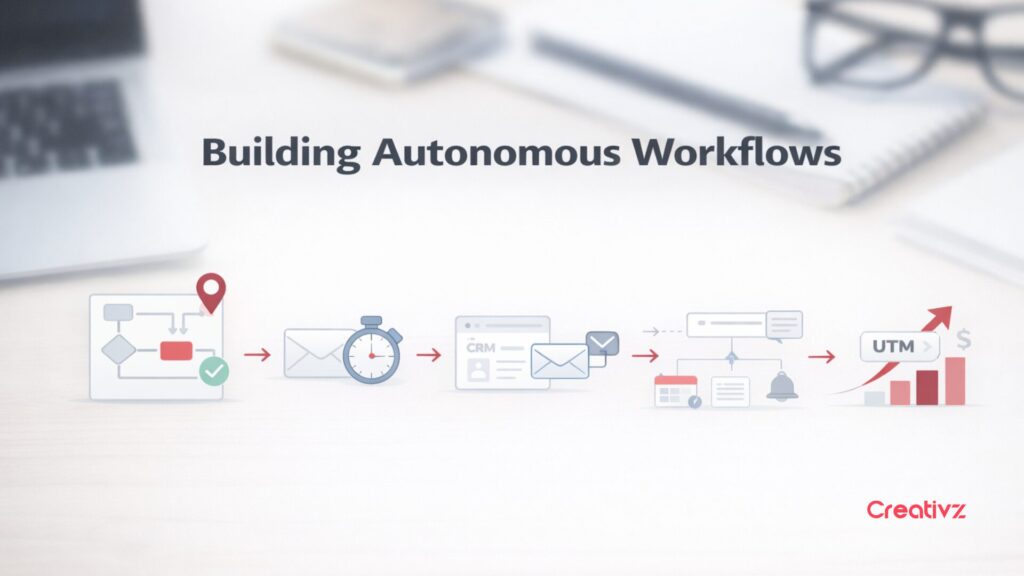
1. Map your current workflow from lead to close.
List every step. Mark every place where a human has to manually move information, make a decision, or remember to follow up. Those marks are your bottlenecks.
2. Prioritize response time first.
This is the highest-leverage fix. Set up an automated acknowledgment that fires within 60 seconds of a form submission. This single change immediately improves conversion rates.
Email Marketing in 2026: Why Full-Funnel Automation Beats Random Emails covers exactly how to structure the sequences that follow that first touchpoint.
3. Connect your core tools.
Your CRM, email platform, and funnel need to work together. A new lead should automatically enter the CRM, trigger an email sequence, and notify the right person without anyone having to touch a keyboard.
4. Build one branched follow-up sequence.
Not a generic email blast. A sequence that branches based on what the lead did: booked a call, downloaded something, or went quiet. Each branch delivers proof relevant to their situation.
For founders unsure where conversion is actually breaking, Why Your Funnel Converts the Wrong People is worth reading before building the sequence.
5. Add revenue attribution from day one.
Every link gets a UTM parameter. Every lead entering the CRM gets a source field populated. Every channel gets tracked against closed revenue, not just clicks. This is the data layer that tells you which systems are working and where to invest next.
Start with one workflow. Prove it. Then expand to the next. Systems compound this way.
Autonomous Workflow Diagnostic: Find Your Biggest Gap
Use this table to identify which workflow area is costing you the most. A disconnected area suppresses the entire downstream system.
| Workflow area | What connected looks like | Quick fix |
| Lead routing | Leads routed based on ICP tier and intent signal within 5 minutes | Assign routing rules in CRM by lead source and company size |
| Follow-up sequences | Branched sequences by use case, automated proof sends, reactivation loops | Build 3 use-case tracks; add 30, 60, 90-day reactivation |
| CRM data entry | All inbound leads enter CRM with source, use case, company size, and role | Connect your form tool directly to CRM via native integration or Zapier |
| Response acknowledgment | Automated response within 60 seconds of form submission | Set up a trigger in your email platform or CRM on new lead creation |
| Pipeline reporting | Revenue traceable by source in under 5 minutes | Enforce UTM discipline and add source field to every CRM entry |
| Nurture for cold leads | Re-engagement sequence fires automatically after 60 days of inactivity | Build one nurture track with one useful insight per week, exit on intent signal |
The Future of Autonomous Workflows Is Already Running
AI agents handling entire workflows is not a prediction. It is already live in forward-thinking businesses today.
What that looks like in practice right now:
AI agents and predictive analytics are replacing manual revenue systems in B2B. Lead scoring, routing, follow-up sequencing, pipeline forecasting: all of it running without a human initiating each step.
- Predictive systems that flag which leads are most likely to close based on behavioral signals, not gut feel.
- Real-time dashboards that show exactly where deals are stalling, which sources are producing revenue, and which workflows need attention, without pulling reports manually.
First-party data strategy is becoming the foundation layer for all of this. Businesses that own their data own their ability to act on it.
The gap between businesses running autonomous workflows and those still running on manual processes is not staying the same. It is accelerating. Every month, a business waits to build systems, and a competitor with systems moves further ahead.
This is not a future problem. It is a right-now problem.

Want to Go Deeper on Autonomous Workflows?
These posts cover the specific systems and infrastructure behind what this blog outlines:
- The Cost of Disconnected Tech Stacks: How to Build an Integrated Growth Stack—what to do when your tools are not talking to each other.
- How Smart Automation Frees Founders and Boosts Predictable Revenue—what reclaiming 10 to 20 hours per week actually looks like in practice.
- Email Marketing in 2026: Why Full-Funnel Automation Beats Random Emails—how to build the follow-up infrastructure that converts leads instead of losing them.
- How AI Agents and Predictive Analytics Are Replacing Manual Revenue Systems in B2B—where autonomous workflows are heading and how to build for it now.
- Why Fast Response Time Wins More Deals Than Better Marketing—the data behind why speed is your highest-leverage conversion variable.
- Digital Growth Audit Checklist: 90 Minutes, 6 Areas—the full audit framework that maps every gap in your current workflow.
Final Thought
The businesses that scale fastest in 2026 are not the ones with the most people. They are the ones with the best systems.
Autonomous workflows are not about replacing your team. They are about removing the manual layer that slows your team down and caps your growth at your current headcount.
Every manual handoff in your operation is a delay. Every disconnected tool is a gap. Every follow-up that depends on someone remembering is a lead at risk.
The infrastructure to fix all of that exists. The bottleneck is knowing where to start.
If you are not sure which workflow is costing you the most, that is exactly what the Free Digital Growth Audit uncovers. We map your current operation across six areas, identify the highest-leverage gaps, and give you a prioritized build list. You will receive a concise report outlining the biggest workflow bottlenecks, clear recommendations on what to tackle first, and a practical action plan you can implement immediately.
