
Speed to Lead: How to Go from 3 Hours to 12 Minutes (And What That Does to Revenue)
Two founders sell the same SaaS product. Both receive a lead from the same channel on the same day.
Founder A responds in 4 minutes with a message that references exactly what the lead submitted. Founder B sees the lead 47 minutes later and sends a generic template.
The lead books a demo with Founder A, but Founder B never receives a reply.
Product quality did not decide that deal. Price did not decide it. Speed to lead did.
This post shows you the exact 4-step system we use to cut response time from hours to minutes for SaaS companies scaling past $500K — and what that change does to revenue.
What the Data Says About Speed to Lead in 2026
The research on lead response time has been consistent for over a decade. If anything, the numbers have become even harder to ignore.
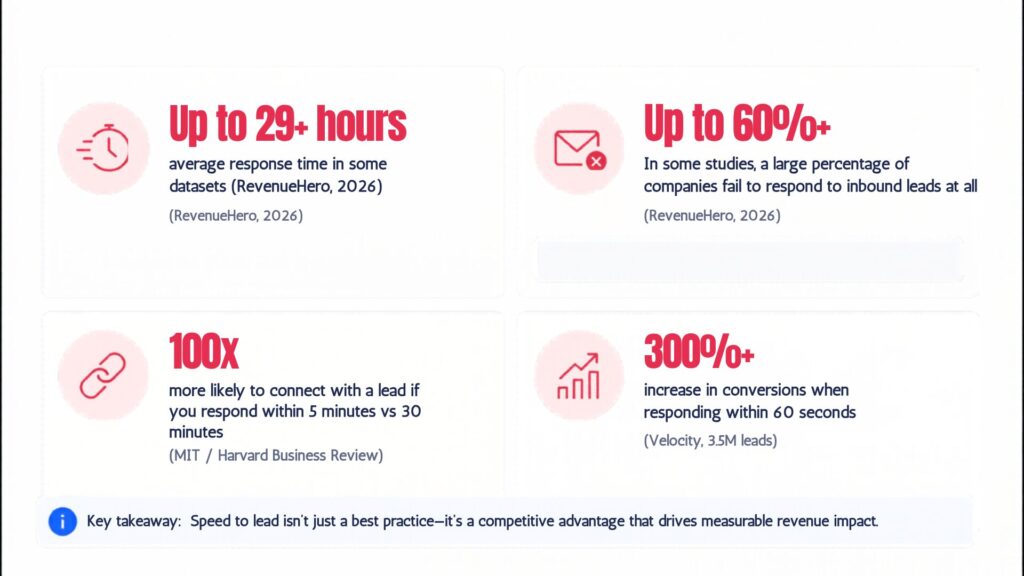
The Blazeo 2026 Speed-to-Lead Benchmark Report analyzed 573 companies and found that 74 percent miss the five-minute response window entirely. Even among leaders who say a five-minute response is essential, 38 percent still fail to meet their own standard.
That is an important reminder: knowing speed matters and building a system for it are not the same thing. The average B2B company takes 29 hours to respond to a lead.
Top performers respond in under 5 minutes. That gap is not about effort alone. It is about infrastructure.
Why Leads Go Cold: The 4 Real Failure Points
It is easy to assume leads go cold because of a weak offer or bad timing. But the data points somewhere else. In most cases, leads go cold due to process failures that occur within the first 60 minutes.
- Shared inbox limbo.The lead lands in a general mailbox with no owner assigned. Because of this, there is no trigger, no alert, and no urgency. The lead arrived and no one even knows it.
- No clock on the response. Teams are not actively tracking when forms come in. Minutes turn into hours because the process depends on someone remembering to check.
- Generic first touch. The first response reads like a receipt rather than a real message. It signals low effort and weakens trust before the conversation even starts.
- Cold context on the call. The rep who eventually responds has no page history, form details, or company context. The conversation starts from zero.
The Common Thread Across All Four
These are not people problems. They are system problems. And the good news is that they are fixable in two to three weeks.
What Slow Speed to Lead Is Costing Your Business
If your SaaS company is closing $50K in new ARR per month, a three-hour average response time translates to $8K to $15K in lost deals every single month.
That is not a theoretical number. Instead, it is what happens when you apply the MIT conversion curve to a real pipeline. The leads are already in your funnel. The revenue is simply not closing because the response came too late.
Blazeo found that 81.2 percent of companies responding after one hour report losing leads to faster competitors. Not because their product was worse, but because they were second.
The first responder wins approximately 50 percent of competitive deals regardless of product quality. In SaaS, where buyers are often evaluating three to five vendors at the same time, being second often means becoming invisible.
The 47-Minute Story
Two leads filled out the same pricing form on the same day with the same intent.
Company A used a shared inbox. The lead sat there for 47 minutes before anyone noticed. By that point, the lead had already booked a demo with Company B, which responded in four minutes with a message that referenced exactly what the lead submitted.
Company A sent a follow-up two hours later. By that point, no reply came. The lead was already in Company B’s pipeline. The deal closed four days later.
Same product. Same price range. Same lead. The only difference was 47 minutes and a system.
The 4-Step Speed-to-Lead System
Tools alone do not fix response time. Every major CRM can support this. The gap is almost always configuration, not software. Here is the exact system.
Step 1: Instant CRM Capture
The moment a form is submitted, the lead should be created in your CRM automatically. No manual step. No forwarded email. No human trigger required.
- Use webhooks or native form integrations to push data directly into your CRM on submission
- Capture the source, company size, submitted message, and visited page automatically
- As a result, every lead gets a record immediately, regardless of the time of day or day of the week.
Why this matters:
Without instant capture, leads live in email. As a result, email does not give you routing logic, scoring, or alerts. A structured CRM record is the foundation on which everything else depends.
2026 data from Chili Piper shows that letting prospects book directly from a form submission doubles inbound conversion rates, from 30 to 66.7 percent. Only 8 percent of top B2B SaaS companies use this. That gap is a real opportunity for you.
Step 2: Auto-Assign to the Right Rep
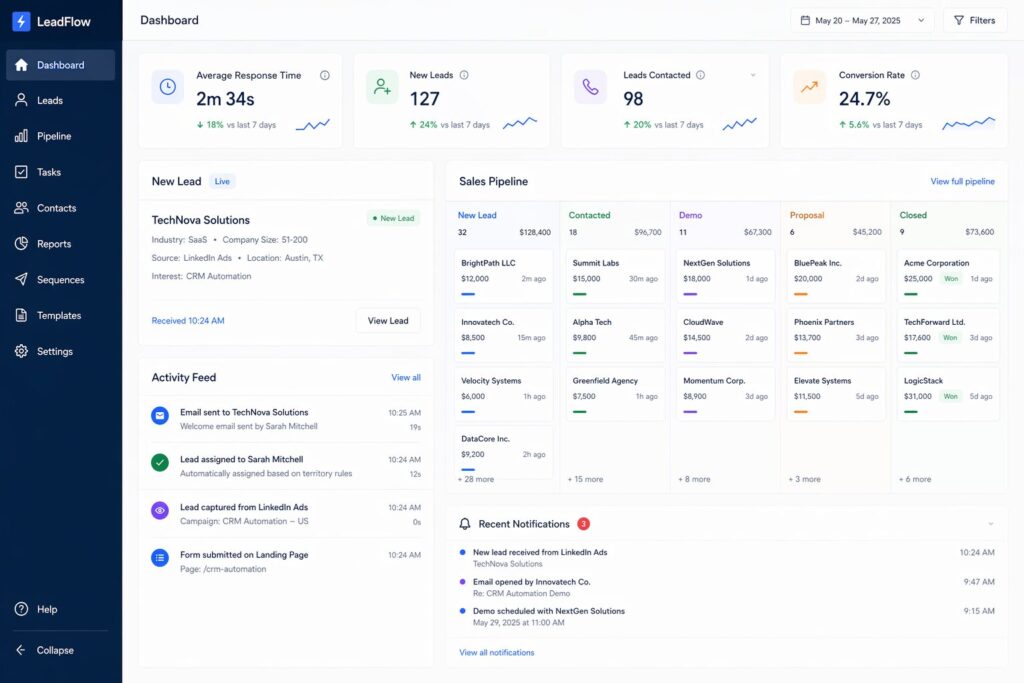
As soon as the CRM record is created, the assignment rule should be triggered automatically. The lead goes to the best-fit rep based on territory, segment, or product expertise. That rep should receive a push notification to their phone within seconds.
- Round-robin assignment helps distribute volume; rules-based assignment protects high-value leads
- High-scoring leads go to experienced closers, not just whoever is available
- Within 11 seconds, the assigned rep receives a notification that a new lead is waiting.
Why this matters:
A lead without an owner rarely gets a response. For this reason, assignment with an immediate trigger creates accountability within seconds, not hours. Companies with a formal response SLA respond within 15 minutes at nearly twice the rate of those without one — 54.9 percent versus 29.5 percent (Blazeo, 2026).
Step 3: Personalized First Touch in Under 5 Minutes
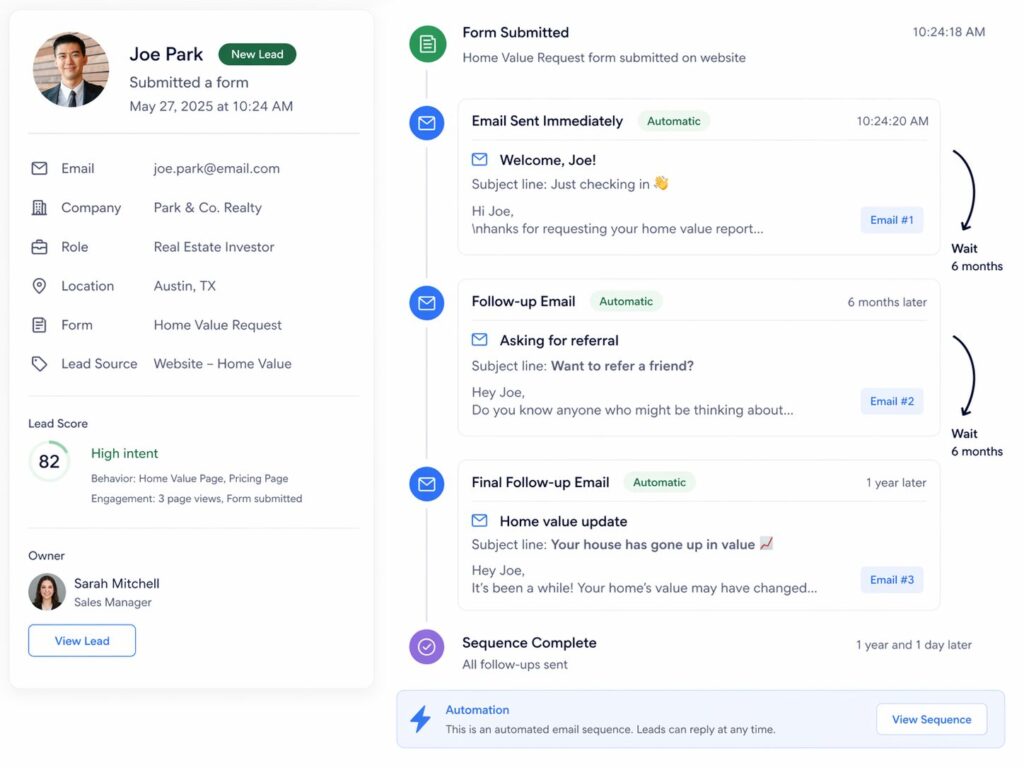
An automated email should go out within 5 minutes of form submission. Not a generic autoresponder. A message built around what the lead submitted.
- The email references the exact page or form from which the lead came.
- It acknowledges what they asked or submitted in the first sentence
- A direct booking link is included so they can schedule without back-and-forth.
Why this matters:
The MIT study confirmedthat contacting a lead within 5 minutes makes you 100 times more likely to connect. After 30 minutes, the odds drop sharply. Automation is the only reliable way to ensure that the window is open 24 hours a day, 7 days a week. Beyond that, personalization is not about making automation sound human. It is about helping the lead feel seen. Referencing what they submitted does that immediately.
Step 4: Full Context Before the Call
When your rep picks up the phone or joins the call, they should already know the lead’s company size, the pages they visited, what they submitted, and any previous interactions with Creativz content.
- CRM surfaces page visit history from marketing automation data.
- Rep sees submitted form content, lead score, and company profile before dialing.
- The call starts with context, not with “tell me about your business.”
Why this matters:
A warm call converts better and shortens the sales cycle. Your rep can skip questions they already have answers to. As a result, that time goes toward creating value instead. Context is what turns a call into momentum.
What This Looks Like in Practice

One B2B SaaS company at $700K ARR had an average lead response time of 3 hours and 20 minutes. 60 percent of inbound leads were never followed up on because they were getting lost in a shared inbox.
We built the 4-step system in two weeks: form-to-CRM integration for instant capture, scoring-based assignment with mobile notifications, a personalized first email with a booking link, and rep call prep surfaced from CRM and marketing automation data.
The results after 90 days were clear: response time dropped from 3 hours and 20 minutes to 12 minutes. Demo conversion rate increased 16 percent. Monthly new ARR jumped 23 percent. Same traffic. Same team. Different system.
Without the System vs With the System
The difference is not subtle. In fact, it is visible at every stage of the lead’s journey.
| Time | Without the System | With the System |
| Minute 0 | Lead lands in shared inbox, no record created | Lead enters CRM automatically, source and message captured |
| Minute 5 | No alert, nobody knows a lead arrived | Assigned rep notified; personalized email fires |
| Minute 23 | Lead is still waiting, no response | Rep has full context, follow-up already sent |
| Hour 4 | First human response; lead has moved on | Rep follows up again if no booking is confirmed |
| Day 4 | Lead is cold; inbox moves to new tasks | Demo completed; close decision underway |
| Outcome | Revenue lost silently | Predictable pipeline, higher conversion rate |
Want to Go Deeper?
These posts build directly on what is covered here:
- How to Set Up a CRM That Actually Closes Deals—the CRM configuration that makes this system work.
- Why Fast Response Time Wins More Deals Than Better Marketing—the original data and argument for speed as a revenue lever.
- Autonomous Workflows: How to Scale Without Adding Headcount —how automation beyond lead response compounds across your entire revenue system.
Frequently Asked Questions
What is speed to lead?
Speed to lead is the time between a prospect submitting an inquiry. Filling out a form, requesting a demo, or clicking a contact link, and your team makes first contact. It is the single most researched variable in B2B sales conversion. The MIT Lead Response Management Study, conducted with InsideSales.com across 15,000 leads, found that responding within 5 minutes makes a company 100 times more likely to connect with a lead than responding after 30 minutes. Speed to lead, also called lead response time, remains the highest-leverage operational change a SaaS sales team can make in 2026.
What is a good lead response time for SaaS?
Under 5 minutes is the benchmark for best-in-class SaaS teams. The industry average across all B2B companies is 29 hours, according to a 2026 RevenueHero study of over 1,000 companies, and 63 percent never respond. For SaaS specifically, where buyers evaluate multiple vendors simultaneously and make decisions quickly, a response time of over 15 minutes can cost a deal to a faster competitor. The target should be under 5 minutes for the first automated touch and under 15 minutes for a personal follow-up from an assigned rep.
How do I automate lead response without it feeling robotic?
The key is to include the lead’s submitted information in the first message. An automated email that opens with ‘Thanks for asking about [specific thing they submitted]’ feels personal because it is accurate and specific. A generic autoresponder that says ‘Thanks for reaching out, we will be in touch’ feels robotic because it says nothing. Use your form fields as personalization tokens. Include the rep’s name, photo, and direct calendar link. Speed signals responsiveness. Personalization signals competence. Both together build trust before any human conversation happens.
What tools do I need to build a lead response system?
The core stack consists of three tools: a CRM with native form integration or webhook support, a marketing automation platform or workflow tool, such as Zapier or Make, and a scheduling tool, such as Calendly. Most modern CRMs, including HubSpot, Pipedrive, and Close, include form integration, lead routing, and automation in their entry-level plans. The specific brand is less important than whether the tools can be connected. A properly integrated basic stack will outperform an unconnected enterprise stack every time. The system is the differentiator, not the software.
Why do leads go cold even when the product is a strong fit?
Intent decays fast. When a buyer submits a form or request, their intent is at its peak. They are actively thinking about the problem, actively comparing options, and actively ready to have a conversation. Every minute that passes after that submission moves them closer to a competitor’s response, a different solution, or simply moving on to other priorities. Research published in the Journal of Marketing Research found that response speed is the number one factor prospects use to judge service quality before making a purchase decision. A great product cannot compensate for a slow response that signals low operational quality.
What is the difference between lead response time and speed to lead?
They refer to the same concept. Speed to lead is the more common term used in sales operations and revenue operations circles in 2026. Lead response time is the traditional term used in earlier research, including the MIT and Harvard Business Review studies. Both measure the same thing: the elapsed time between a prospect’s inquiry and your first meaningful contact. Some teams also use ‘time to first contact’ or ‘time to first touch’ to describe the same metric. Regardless of the term, the benchmark is the same: under 5 minutes for automated outreach, under 15 minutes for a human follow-up.
Final Thought
The product is strong. The pricing is competitive. The team is skilled. But if a faster competitor gets to the conversation first, that advantage disappears before you ever get a chance to show your value.
Speed to lead is not a nice-to-have operational metric. Instead, it is a revenue decision. Every hour of average response time means part of your pipeline is quietly moving to someone who built a better system.
The 4-step system in this post takes two to three weeks to implement. And in the first 90 days, the results are measurable.
If you want to find out exactly how much your current response time is costing you, the Revenue System Scorecard includes a full section on lead generation infrastructure. It takes under 10 minutes and helps you spot the biggest leak.
Book a Free Digital Growth Audit, and we will walk you through your full lead-response infrastructure.
