
You Built a $1M Business Selling Everything Yourself. That Is Now the Reason You Are Stuck
For the past three years, you’ve closed every deal yourself. You know the pitch inside and out. Every objection? You handle it. On discovery calls, you know exactly what to say to move a prospect from interested to committed.
The business grew because you were its best salesperson. Your involvement drove every win.
But now, you can’t take two weeks off without the pipeline freezing. You hired a sales rep six months ago, and they closed only half of what you expected. Prospects still ask for you before they sign. What built the business is now the ceiling holding it back.
This post shows you how to step out of founder-led sales without losing revenue. You’ll see exactly what to build before your next sales hire.
In this blog, you’ll learn:
- Why founder-led sales stop working at $1M ARR
- The best tools to use before you transition
- How to document your outbound process so it can be handed off
- The 4-stage system for moving to a scalable revenue model
- What to build before you hire your first dedicated sales rep

Why Founder-Led Sales Works, and Why It Stops Working at $1M ARR
Why Founder-Led Sales Work Early On
As a founder, you know the product inside out. You handle objections with credibility, tailor your pitch on the spot, and bring an authority that junior reps can’t match. That’s why many fast-growing SaaS companies—like early Salesforce, Notion, and Superhuman—relied on founder-led sales. The founder’s conviction was often the company’s strongest asset.
With 3 to 5 new customers a month, founder-led sales is not only manageable—it’s the most efficient approach.
Where the Founder-Led Sales Strategy Starts to Break Down
But as the business grows, this model hits a ceiling. Once you’re handling 15 to 20 prospects a month, cracks start to appear in a short time.
- A founder can’t be in two sales conversations at the same time
- The entire sales process lives in the founder’s head. No one can replicate or hand it off without difficulty.
- The business depends on one person’s availability, energy, and focus. That makes real scaling impossible
According to Winning by Design, companies that don’t systematize their sales process by $1M ARR take 2.3 times longer to reach $3M than those that build a repeatable system earlier. The cost isn’t time—it’s compounded lost revenue.
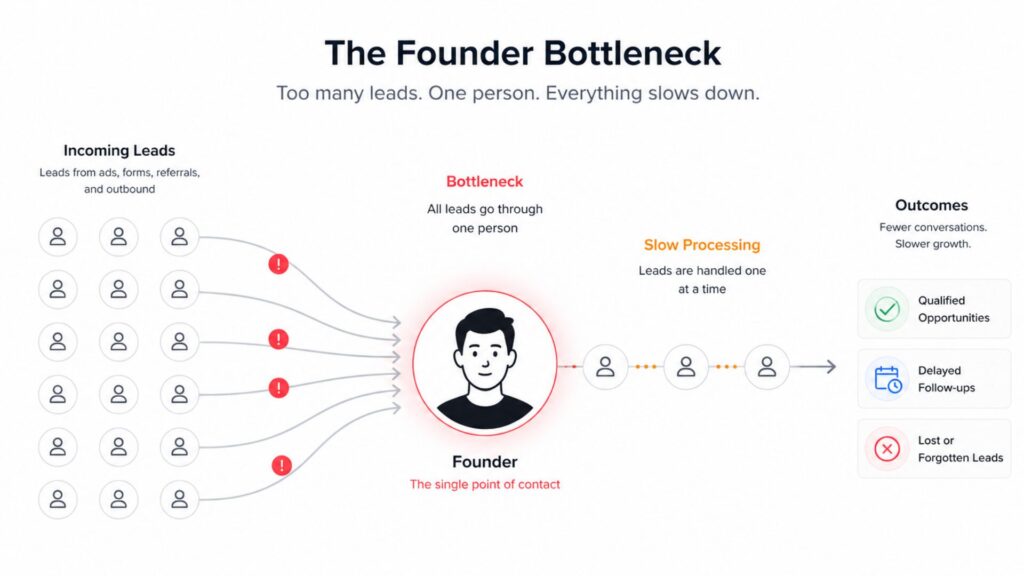
5 Signs Your Founder-Led Sales Model Is the Bottleneck
Before you can fix the founder-led sales problem, you need to confirm it. These five signs help identify if the system or something else is blocking growth.
Sign 1: Every qualified lead expects to speak to you
When reps handle first calls, prospects still request you before signing. Reps act as gatekeepers, not closers. This points to a system issue, not hiring.
Sign 2: Revenue velocity drops the moment you're unavailable
If you take a day off, leads go uncontacted. When you travel, the pipeline stalls. The business should not depend on weekly attention.
Sign 3: Your sales rep consistently misses performance targets.
They are smart, motivated, and experienced, but they sell by watching you rather than using a documented system. Reps will underperform until the system is in place.
Sign 4: Revenue is predictable only when you are active
Good months align with your sales focus. Bad months happen when you focus elsewhere. Predictable revenue should not depend on founder availability.
Sign 5: Pipeline visibility disappears when a deal leaves your list
You track every deal because you’re involved in them. Visibility fades once someone else handles it. This is a process issue, not a CRM issue.
What Founder-Led Sales Is Actually Costing You
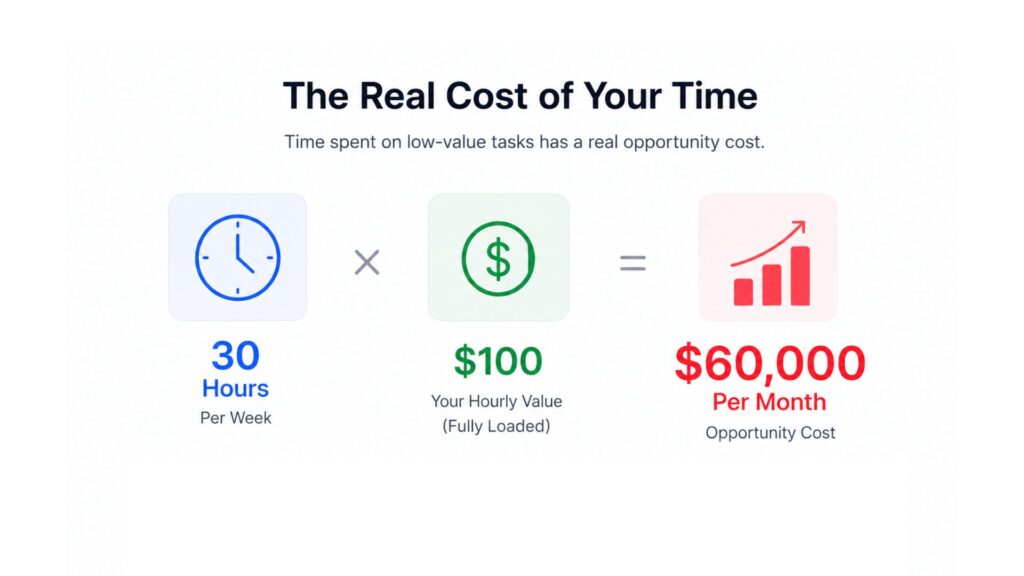
When a founder spends significant time on sales while the company is at 1 million in annual recurring revenue, the cost can be substantial, especially in businesses with many customers. As several 2026 analyses note, if your startup has a low average contract value, it can mean hundreds or even thousands of customers, making it nearly impossible for just one founder to manage sales manually. This highlights the high opportunity cost of founder‑led sales and underscores the need to systematize and delegate sales functions as the company scales. This illustrates the hidden cost of founder‑led sales: valuable leadership time invested in tasks better handled by scalable systems.
Instead of spending $720,000 per year, take action now: delegate sales to a trained rep and implement a reliable system.
The math isn’t about the founder’s sales ability.
This isn’t a question of sales skill—it’s about prioritizing time between closing deals and building scalability.
According to Gartner, one of the top commercial threats facing sales leaders in 2025 is the growing pressure to balance revenue growth with operational efficiency, especially as founders delay transitioning away from unscalable sales approaches. This ongoing founder dependency can put future sales hires at risk of underperforming if a more systematic sales structure is not established. The same gaps that caused the last rep to underperform will cause the next one to underperform in the same way. The system is the variable, not the rep.
Best Tools for Founder-Led Sales Teams Before You Transition
Use these tools today to streamline founder-led sales and prepare to transition by documenting processes and training a successor.
| HubSpot / Pipedrive | CRM | Pipeline tracking, deal stages, next-action logging |
| Apollo.io | Outbound Sequencing | Multi-step cold email automation + LinkedIn data |
| LinkedIn Sales Nav | Prospecting | SaaS founder filters, verified contact discovery |
| Loom | Async Demos | Personalized video walkthroughs without live presence |
| Calendly | Scheduling | Friction-free booking from first-touch email |
| Gong / Chorus.ai | Call Intelligence | Record and transcribe discovery calls for playbook building |
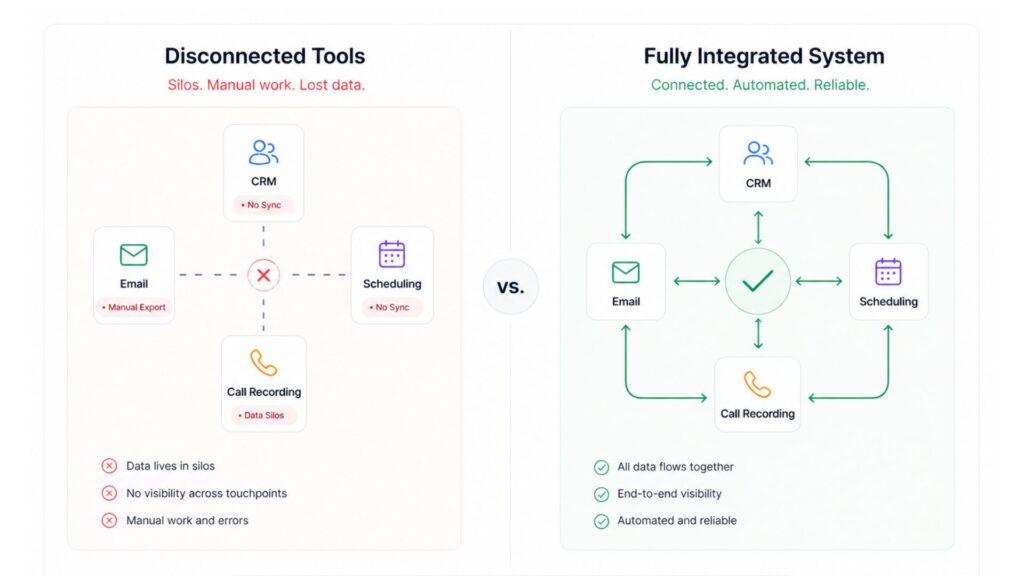
Why the integration between these tools matters more than any single tool
A disconnected stack of good tools produces the same result as no tools at all. Apollo sequencing needs to feed your CRM. Calendly bookings need to trigger a CRM record. Gong recordings need to be searchable. The stack is only as strong as the connections between its parts.
According to Vidyard’s 2026 Video Selling Report, Loom and async video walkthroughs generate 3x higher response rates than text-based follow-ups in B2B SaaS. Chili Piper data shows that letting prospects book directly from a first-touch email doubles inbound conversion rate. These numbers hold because they remove friction at the exact moments where founder-led sales lose deals.
How to Document Your Founder-Led Sales Outbound Process Before You Hand It Off
The biggest reason sales transitions fail is not the new rep. It is that the founder’s process was never written down. The subject lines that get replies, the discovery questions that uncover real pain, the objection responses that move deals forward, and the proof points that close. When a new rep is hired, they get a CRM and a product deck and are told to figure it out on their own.
They cannot replicate what they have never seen documented.
What to capture before you transition your founder-led sales outbound process
The outbound sequence. The exact cold email structure, including subject line formula, opening line approach, value proposition, proof point, and CTA. Include the follow-up cadence, how many emails, at what intervals, and what each one says. Document the LinkedIn connection note formula and the first DM sequence.
The discovery call framework. Not a rigid script but a documented structure. The opening question that gets founders talking. The three or four follow-up questions that surface real pain. The moment in the call when the pitch shifts from exploration to solution. The proof point that closes the most deals.
The objection response library. Every objection the founder handles and the exact response that moves the deal forward. These live in the founder’s head. Get them out before the transition starts.
The proof archive. The three client stories that close deals most consistently. The specific numbers from each, including time saved, revenue recovered, and efficiency gained. The industry and company size of each client so reps can match them to the right prospect.

The 4-Stage Transition from Founder-Led Sales to Scalable Revenue System
Stage 1: Document everything before you change anything
Record your calls using Gong or Chorus for 30 days before starting the transition. Pull the patterns. What questions do you always ask? What objections always come up? What proof points close most deals? This becomes the playbook.
Stage 2: Build the founder-led sales infrastructure before hiring
Record your calls using Gong or Chorus for 30 days before starting the transition. Pull the patterns. What questions do you always ask? What objections always come up? What proof points close most deals? This becomes the playbook.
Stage 3: Hire into the system, not around the gap
Give the rep the documented playbook, the configured CRM, the outbound sequences already built in Apollo, the Loom demo library, and a 30/60/90 day plan with specific targets. Their job is to execute the system, not invent one.
Stage 4: Remove yourself from deals progressively
- Week 1: The rep handles all first-touch outreach
- Week 4: The rep handles all discovery calls
- Week 8: The rep handles all follow-up through to the proposal
- Week 12: The rep closes independently; the founder is available for escalations only
Each removal is a test of whether the system is strong enough to hold without you. Fix what breaks before removing the next layer.
Founder-Led Sales vs Systematized Revenue: Side-by-Side Comparison
This table shows exactly what changes when a documented system replaces founder dependency. The infrastructure is the same. The outcomes are not.
| Founder-Led Sales | Systematized Revenue | |
| Deal Dependency | Every deal requires founder | Rep closes independently from documented playbook |
| Outbound Process | Founder sends every email manually | Automated sequences run 24/7 |
| Response Time | Depends on founder availability | Automated first touch in under 5 minutes |
| Pipeline Visibility | Founder knows because he is in every deal | CRM shows every deal stage in real time |
| Rep Onboarding | New rep watches founder and guesses | New rep follows documented playbook from day one |
| Scalability | Revenue ceiling is founder’s time | Revenue scales with system capacity |
Want to Go Deeper on Revenue Systems and Founder-Led Sales?
- How to Set Up a CRM That Actually Closes Deals (For Founders Scaling Past $1M) Your CRM is supposed to close deals, not collect contacts. If your pipeline is a mess and follow-ups fall through, this blog shows you how to set up a CRM that works the way your sales process actually runs.
- The Lead Response System: How to Go from 3 Hours to 12 Minutes (And What That Does to Revenue) Every hour you wait to follow up on a lead, your close rate drops. This blog breaks down the exact system that cuts response time from hours to minutes and how that single change impacts your revenue.
- Autonomous Workflows: How to Scale Without Adding Headcount Hiring more people to handle more volume is not a growth strategy. This blog shows you how to build workflows that run without you, so your business scales without your payroll doing the same.
Founder-Led Sales: Frequently Asked Questions
What is founder-led sales?
Founder-led sales is a model where the founder manages key tasks. They handle prospecting, make discovery calls, address objections, and close deals. It works well in the early stages. The founder’s product knowledge and belief are unmatched. It stops working when the founder’s time limits revenue growth. This usually happens between $500K and $1M ARR in B2B SaaS.
How do founder-led sales strategies impact startup growth?
In the early stages, founder-led sales boost growth. The founder can quickly change the pitch. They handle technical objections well and close deals faster than junior reps. As the company scales, the model inverts. The same founder involvement that drove growth becomes a structural bottleneck. A deal needing founder input cannot go forward without the founder being available.
When should a founder stop selling and build a sales team?
Build the system if the founder spends over 20 hours a week on sales, if revenue growth has stalled despite high demand, or if a second sales hire is necessary. The rule is to build the system before you hire, not after. Every hire made before the system exists is a hire set up to underperform.
What are the best tools for founder-led sales teams?
Use HubSpot or Pipedrive for CRM. For outbound sequencing, try Apollo.io. Use LinkedIn Sales Navigator for prospecting. Loom is great for async demos. Schedule meetings with Calendly. For call recording, consider Gong or Chorus. The integration between these tools is what makes them effective. A disconnected stack of good tools still produces the same result as no tools.
How do you document a founder-led sales process before transitioning?
Capture four key items
- Outbound sequence, including subject lines and follow-up timing
- Discovery call framework with essential questions
- Objection Response Library
- Proof archive of three client stories that close effectively
Record every call for 30 days before starting the documentation phase. The recordings reveal patterns that the founder is unaware of.
How long does it take to transition from founder-led sales to a scalable revenue system?
The documentation phase takes 30 days if the founder consistently records calls. The infrastructure build takes 2 to 4 weeks. Rep onboarding and progressive removal take 90 days. Total time from starting documentation to the founder being fully out of individual deals: 4 to 5 months.
Final Thought
Founder-led sales is not the problem. Staying in it past the point where it scales is the problem.
The $1M ARR threshold is not a milestone to celebrate and move on from. It is the exact moment where the model that got you here starts costing you the growth that should come next. Every month the transition is delayed means lost deals. Follow-up slows down, the pipeline becomes invisible, and the new sales hire is set up to fail before they even begin.
The fix is not hiring faster. It is building the system first, then hiring into it.
Find out exactly where your revenue system is leaking.
The sales infrastructure section shows founders exactly what is missing before their next hire.
