
A strong B2B pricing strategy for service businesses starts with a question, not a number. Ask yourself: Does your prospect know the value of the outcome before they see the price?
For most B2B service founders, the answer is no. The proposal leads with deliverables, the investment sits at the bottom, and the prospect reads the number before absorbing the value. That sequence is the root cause of most stalled deals.
The instinct when a deal stalls is to discount. That instinct is almost always wrong. Discounting does not fix a framing problem. Instead, it signals low confidence and trains every prospect to negotiate.
This post breaks down why deals stall at the proposal stage, which pricing models work for B2B service businesses, and how to structure your offer so the value lands before the number appears. If you are still transitioning from informal sales to a structured process, read Founder-Led Sales first.

Why B2B Deals Stall at the Proposal Stage
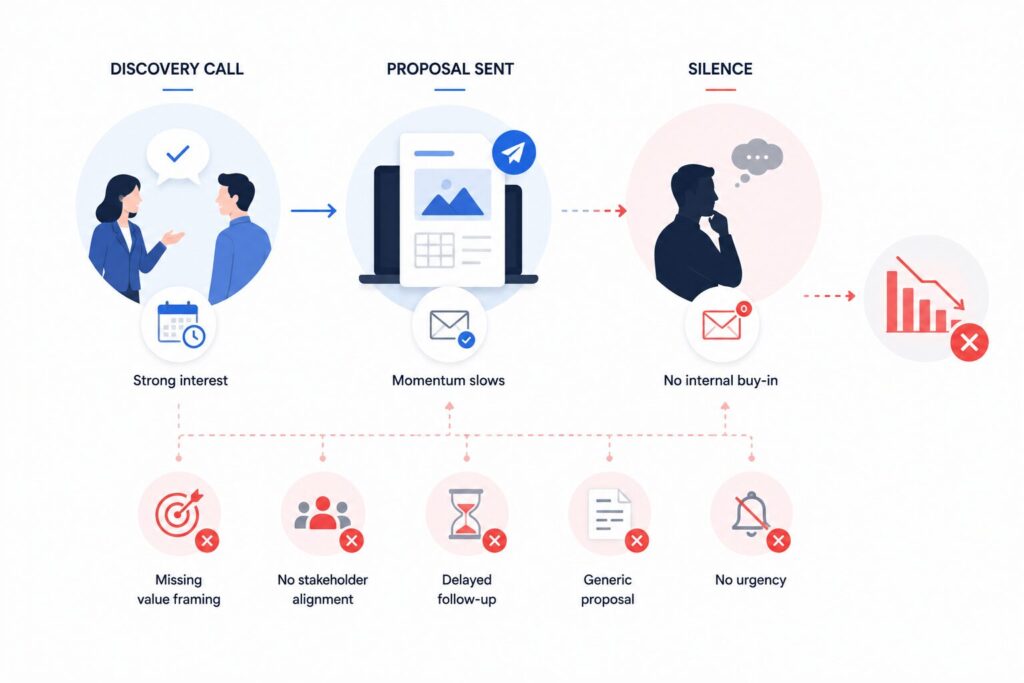
The discovery call went well. Your prospect asked thoughtful questions, you sent the proposal, and then you heard nothing.
The HubSpot State of Sales Report says 58% of deals stall not because of budget issues, but because buyers cannot clearly explain the value of the purchase to others in their company. In other words, they cannot get internal buy-in. This is a framing problem, not a pricing problem.
Three structural problems cause most B2B service proposals to stall:
- The offer is not clearly defined. If prospects do not know exactly what they are getting, they compare your price to other options or even to doing nothing. Unclear deliverables lead to unclear value.
- The value comes after the price. Most proposals list deliverables first, then the cost. This means the prospect sees the price before they understand the return. Without context, the number feels too high.
- There is no anchor. If you only offer one option, the prospect must say yes or no. Giving structured choices, especially with a clear middle option, makes it easier for them to say yes.
Why This Matters
Deals do not stall because your price is too high. They stall because the value was not established before the number appeared. Fixing the sequence of your proposal is more effective than adjusting the price.
The 3 Pricing Models That Work for B2B Service Businesses
There is no one-size-fits-all pricing model for B2B services. The best choice depends on what you deliver, your confidence in the results, and how smooth you want your sales process to be.
Here are three pricing models that work well for founders with $500K to $5M in annual recurring revenue:
| Model | Best For | Main Risk |
| Outcome-based pricing | Engagements with measurable, concrete results | Requires confident delivery and a clear baseline |
| Productized service | Founders who want to scale without custom scoping | Can feel commoditized if the scope is too narrow |
| Tiered packaging | Founders with multiple buyer segments or budget ranges | The middle tier must be clearly the best value, orthe tiers confuse the buyer |
Model 1: Outcome-Based Pricing
Outcome-based pricing means the engagement is priced against a specific, measurable result, not against hours or deliverables.
For example, the proposal does not say: We will build your CRM pipeline. It says: we will reduce your manual sales operations time by 15 hours per week and increase your lead response rate to under five minutes.
This model works best for startups because the outcomes are clear and measurable. Things like revenue recovered, time saved, and higher close rates are known before the project starts. These numbers help show why the investment makes sense.
However, this model requires real confidence in your ability to deliver. If you cannot show a starting point and promise a clear result, it can lead to tough conversations. Use this approach once you have three to five client results to share.
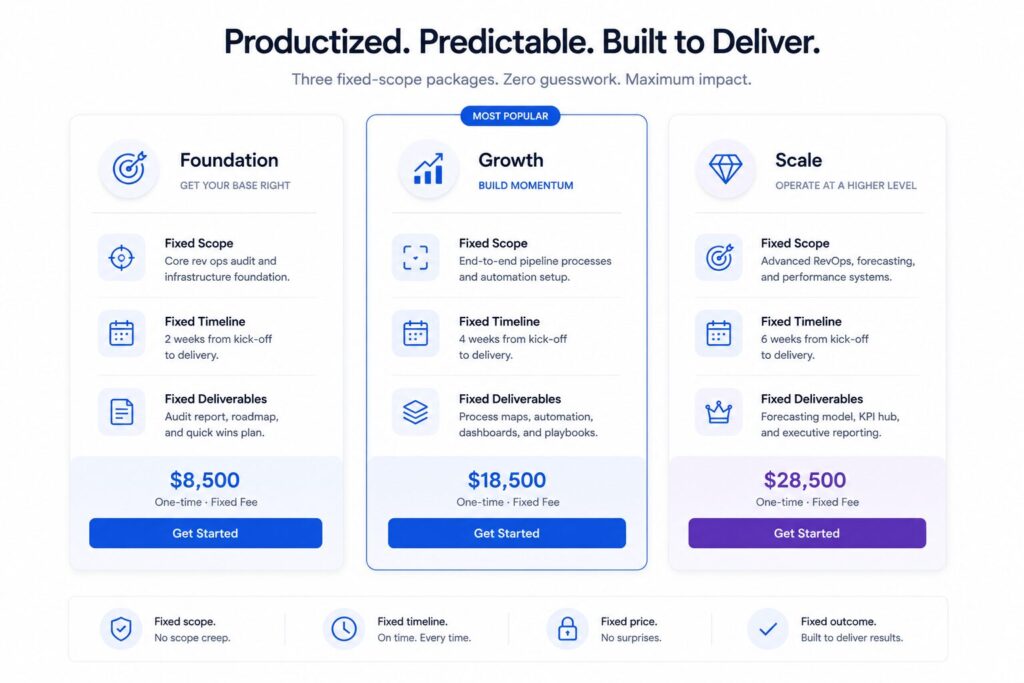
Model 2: Productized Service Pricing
A productized service has a fixed scope, a fixed price, and a fixed timeline.
The buyer knows exactly what they are getting. There is no custom scoping conversation, no scope creep risk, and no negotiation on deliverables.
If you want to scale your business without creating a new proposal each time, productized pricing makes sales smoother. Instead of custom consulting, you offer a clear outcome with a set delivery process.
The risk is becoming a commodity. If your offer is too narrow or generic, prospects will compare you only on price. To avoid this, make your productized offer specific enough that it is hard to compare directly.
Model 3: Tiered Packaging
Tiered packaging presents three options with different scopes and price points.
The middle tier is what you actually want to sell. The top tier anchors the value upward. The bottom tier creates a clear entry point without devaluing the core offer.
This approach works because people tend to pick the middle option when given three choices. The top tier makes the middle seem fair, and the bottom tier makes it feel like the best choice.
Structure your tiers so the middle option includes everything the prospect genuinely needs, and the bottom option is clearly insufficient for their stated goals. The Sales Playbook for Startups covers how to present tiered options in a discovery-to-proposal sequence.
How to Structure Your B2B Pricing So Value Comes Before the Number
The sequence of your proposal matters as much as the content. Most proposals are structured around what is convenient for the seller to write. A high-converting proposal, however, is structured around what the buyer needs to understand before they can say yes.
Below is the proposal logic sequence that works. It mirrors the value-stack structure used in our THRIVE Method because the principle is the same: establish the problem and its cost before presenting the solution and its price.
- Start with the diagnosis. Clearly explain what is not working in the prospect’s current situation. Use specific details from your discovery call. The goal is for the prospect to feel you truly understand their challenges.
- Present the outcome. Before describing what you will do, describe what the client will have when the engagement is complete.
Be specific. Not: we will improve your pipeline.
But: your sales team will have a fully automated follow-up system that replies to new leads within five minutes.’
- Explain your process. Briefly outline how you will deliver the outcome. Focus on the essentials—the prospect cares more about results than methods. Give enough detail to show credibility, but not so much that it raises more questions.
- Anchor the value. Before you show the price, explain what the outcome is worth. For example, if your work recovers 10% of a $3 million revenue base, that is $300,000. Make sure to compare your price to this value.
- Present the investment. The number now lands in a context where it has already been outweighed by the value established above. That is where pricing feels obvious rather than arbitrary.
Why This Matters
The sequence is everything. A prospect who sees a $15,000 investment before understanding the $200,000 outcome it produces will negotiate. A prospect who understands the $200,000 outcome first will rarely question the $15,000. Same number. Different context.
The Discount Trap and How B2B Service Founders Should Respond
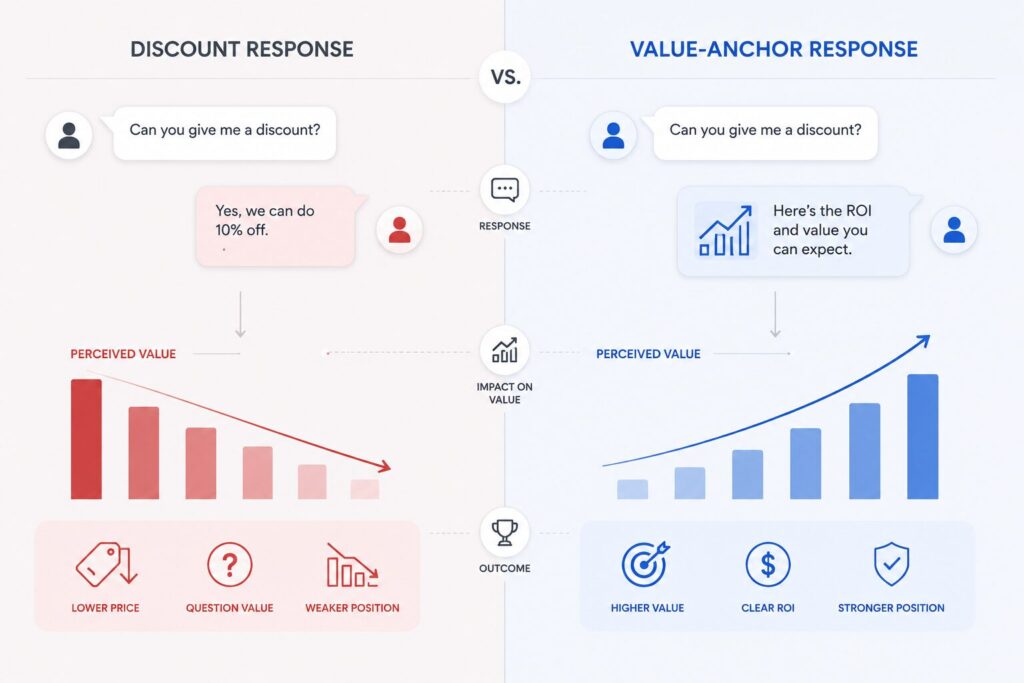
When a prospect says your price is high, the default founder response is to offer a discount. That response almost always makes the situation worse, not better.
Offering a discount suggests your original price was not firm. It shows prospects that they can negotiate with you, so they will try every time. It also cuts into your profit on work you have already priced.
According to Bain and Company Pricing Research, a 1% improvement in price realization generates an average 11% improvement in operating profit for service businesses. As a result, the math of holding your price is significantly better than the math of discounting to close.
The correct response to a price objection is a question, not a concession:
When Your B2B Pricing Strategy Is Right but the Sales System Is Broken
A well-structured offer only works if your sales system is solid. You can have the right price, packaging, and proposal, but still lose deals if the steps between agreement and contract are not handled well.
The most common system failures at the proposal stage are:
- Follow-up is often manual and inconsistent. The prospect shows interest, but the founder gets busy, and weeks go by without contact. The deal does not fall through because of price—it is lost to neglect.
- There is no clear next step after the discovery call. The prospect leaves without knowing when they will get the proposal or when the next call is. This causes momentum to stall.
- The proposal is sent as a PDF with no follow-up sequence. There is no automated check-in at day 3, no value-add touch at day 7, and no breakup message at day 14. The proposal sits in an inbox with no system driving it forward.
Your pricing strategy and sales system need to work together. Check out CRM Setup for Startups to learn how to set up follow-up automation that keeps your proposals moving after they are sent.
Why This Matters
You can have the right price and still lose deals because the infrastructure around your offer is broken. A deal accepted in principle but stalled in follow-up is a systems problem, not a pricing problem. Both need to be right.
Frequently Asked Questions
What is value-based pricing for B2B services?
Value-based pricing for B2B services means setting your price based on the measurable outcome the client receives, not on the hours you spend or the deliverables you produce. For example, if an engagement consistently recovers $300,000 in annual revenue for clients, a $20,000 investment is priced against that return, not against a day rate or a scope of work.
How do you price consulting services for the first time?
Start by identifying the specific, measurable outcome your engagement produces. Then research what that outcome is worth to your target buyer. Build your price from the value down, not from your costs up. A productized service with a fixed scope and fixed price is the lowest-friction starting point for founders who have not yet formalized their pricing. It removes custom scoping conversations and creates a clear, repeatable offer.
What is the best pricing model for B2B service businesses?
There is no single best model. Outcome-based pricing works best when you can point to concrete, measurable results and have the delivery confidence to commit to them. Productized pricing works best when you want to scale without custom scoping on every engagement. Tiered packaging, on the other hand, works best when you have multiple buyer segments with different budget ranges and needs. The most effective founders test all three and standardize on the one that closes fastest with the least objection friction.
How do you avoid discounting in B2B sales?
Avoid discounting by anchoring the value before the price appears. When a prospect raises a price objection, respond with a question about the outcome they are comparing the investment to. If they cannot answer that question, the discovery conversation did not establish the cost of inaction clearly enough. Return to the diagnosis before responding to the price. A prospect who understands the full cost of their current problem rarely objects to a reasonably priced solution.
Want to Go Deeper?
These blogs cover the systems that sit around your pricing and proposal process:
- Founder-Led Sales to Scalable Revenue System: The 4-Stage Transition. Understand where your current sales process sits and what needs to change before a structured pricing model will stick.
- Sales Playbook for Startups: The Essential Sections, Tools, and Templates That Actually Scale. Build the proposal and follow-up process that keeps deals moving after you send the investment number.
- CRM Setup for Startups: How to Set Up a CRM That Actually Closes Deals. Set up the follow-up automation that keeps proposals alive and prevents deals from dying in your inbox.
Final Thought
Deals usually do not stall because your price is too high. They stall because the value was not clear before the price, the proposal showed cost before context, or the follow-up system did not keep the deal moving after the proposal was sent.
Fix how you present your offer before changing the price. Make sure your proposal shows the outcome before the investment. Set up a follow-up system that keeps proposals moving without needing your constant attention.
If your deals are stalling and you are unsure if the problem is pricing, packaging, or your sales system, a diagnostic is the quickest way to find out.
Not ready for a full audit? Use the Revenue System Scorecard to benchmark your revenue infrastructure across 6 criteria. It takes 5 minutes and shows you exactly where your sales system is creating friction at the proposal stage.
