
Zero-click search B2B is no longer a future trend. Right now, buyers are using AI tools to research vendors, compare solutions, and form opinions before your website ever loads.
Traffic is declining, even at companies with strong content. Organic sessions keep dropping, despite steady keyword rankings. When founders see these numbers, they often assume their strategy is broken, overlooking the underlying dynamics at play.
This shift is fundamentally a visibility and infrastructure issue, not simply an SEO one. Businesses that recognize this early can build systems to capture demand through AI-driven channels, while those who do not will continue to optimize for outdated metrics that no longer provide the full picture.
In this blog, you will learn what zero-click search actually means for B2B businesses:
- why traditional traffic metrics are no longer telling the full story,
- how buyer behavior is shifting inside AI-driven channels,
- and what your digital growth system needs to look like to stay visible and competitive in 2026.

The Shift From Search Engines to Answer Engines in Zero-Click Search B2B
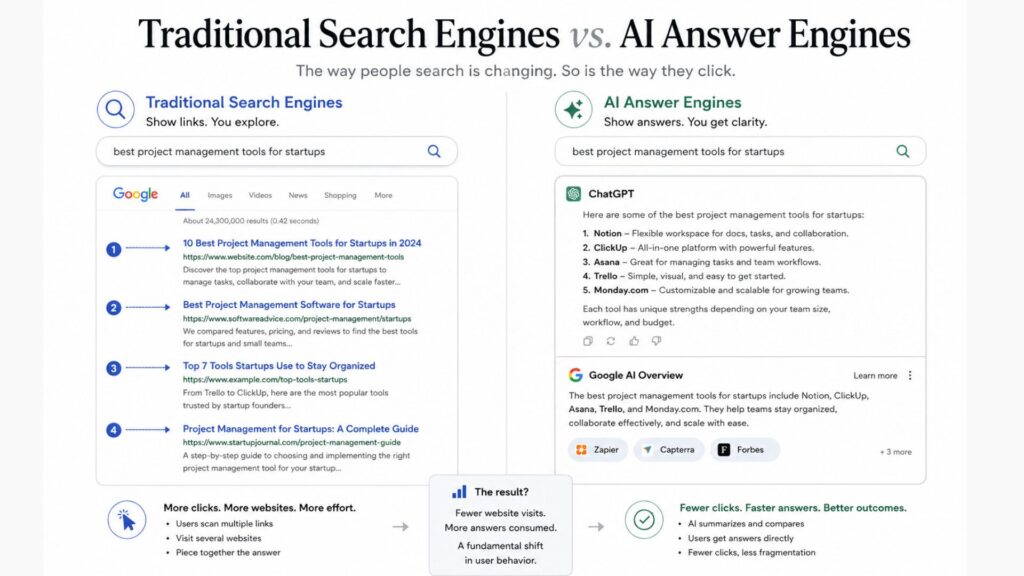
Before exploring how answer engines have disrupted traditional SEO, it’s crucial to understand the underlying structural evolution. Search has changed at a structural level. Google is no longer primarily a directory that sends traffic. Instead, it is increasingly an answer engine that resolves queries inline, using AI Overviews to summarize content, extract key points, and present conclusions without requiring a click.
ChatGPT, Perplexity, Gemini, and other AI assistants have further accelerated this behavior. A founder researching “best CRM for a logistics company” is just as likely to ask ChatGPT and read a synthesized answer as they are to open five browser tabs.
What Answer Engines Are Doing to Organic Traffic
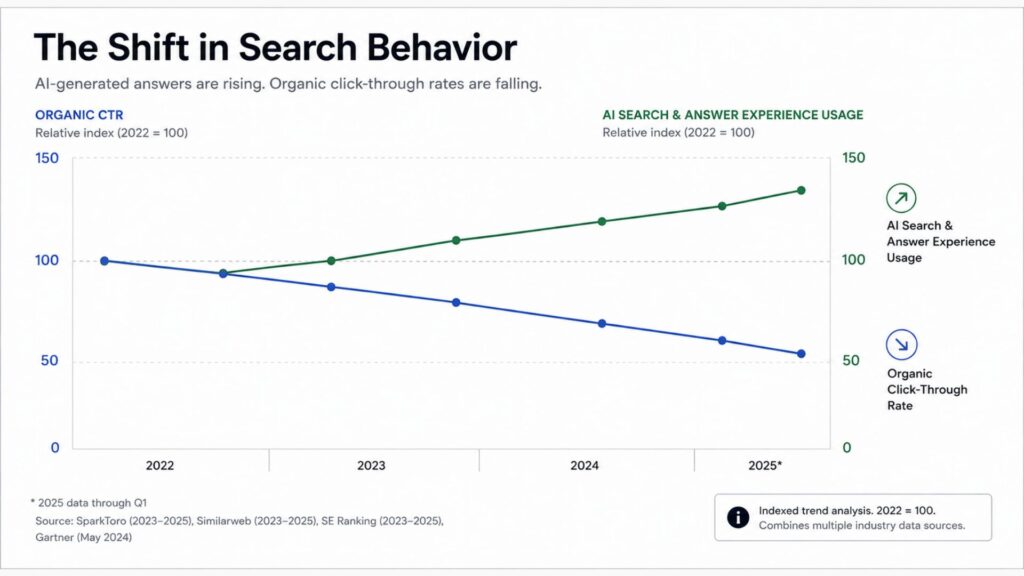
Google AI Overviews now appear in roughly 12-14% of all search queries. For informational and comparison-based searches—the very queries that drive B2B demand—this percentage climbs even higher, underscoring how significantly they impact organic traffic.
For instance, HubSpot’s 2025 State of Marketing Report shows that over 60 percent of marketers have already observed declining organic click-through rates, particularly in informational content categories. This broad shift in user engagement illustrates how zero-click trends are materially affecting B2B marketing efforts.
Perplexity is growing fast among professional users. Because it answers complex business questions with source citations, it is already influencing B2B consideration cycles without your brand receiving a single session in Google Analytics.
- Google AI Overviews absorb clicks on informational queries
- ChatGPT answers vendor and solution questions directly
- Perplexity synthesizes and cites sources for research-heavy buyers
- Gemini integrates with Google Workspace, shaping internal buying conversations
These shifts mean your brand can be evaluated, compared, and dismissed before a single website visit occurs. The key question is no longer if this is happening, but whether your brand is included in these AI-generated answers—highlighting the importance of adapting to these trends.
Why Traditional Traffic Metrics Are Misleading in the Zero-Click Search B2B Era
Traditionally, measuring growth by sessions, clicks, and traffic volume made sense because those metrics aligned closely with buyer interest. In 2026, however, they now only represent a narrow slice of actual buyer activity, making it vital for businesses to consider the broader shift in how buyers engage.
Consider this: a prospect who reads an AI Overview of your service category and then searches for your brand name to visit your site shows up as direct traffic. A buyer who asks ChatGPT to compare you to a competitor and decides in that conversation never shows up at all.
The Attribution Blind Spots Growing Inside Your Funnel
Research from Forrester’s B2B Buying Study confirms that B2B buyers now complete 70 to 90 percent of their research before engaging a vendor. As a result, AI tools have made that pre-engagement phase faster, quieter, and less visible to attribution models.
This creates three specific blind spots worth understanding:
- Impression-to-click gap: Your content earns a placement in an AI summary. The buyer reads it and trusts you more. But no click fires, so it registers as zero engagement.
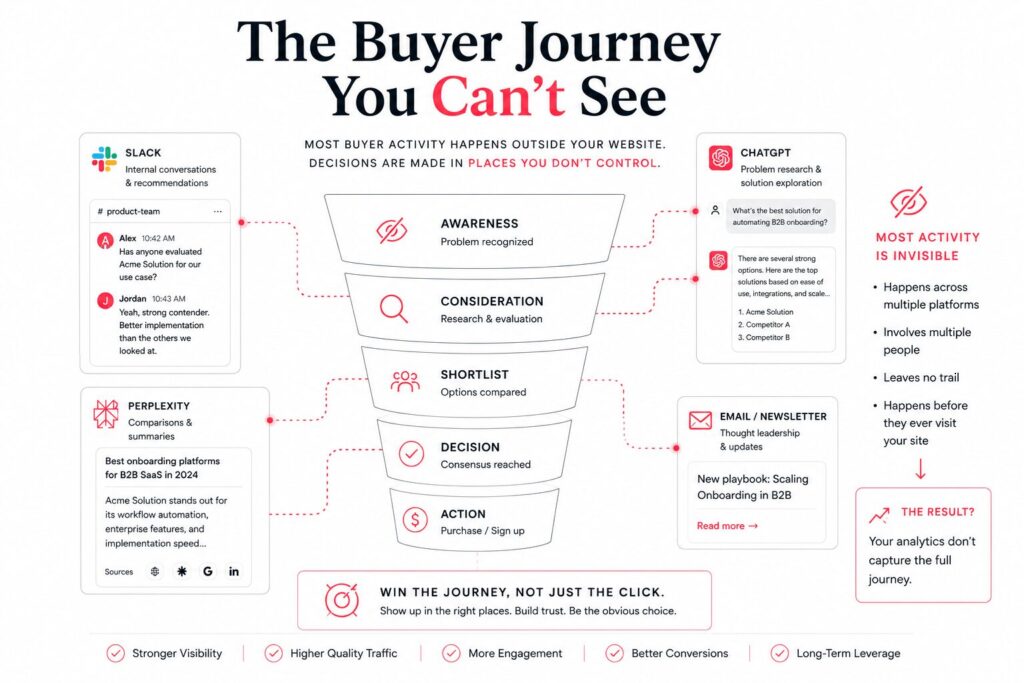
- Dark funnel activity: Buyers discuss vendors in Slack channels, forward AI summaries, and share Perplexity responses. This word-of-mouth accelerated by AI is invisible to any standard analytics setup.
- Brand-search inflation: Increased AI visibility often drives direct and branded search. Without tracking branded keyword growth alongside direct traffic trends, you will misread your own momentum.
The takeaway is not to abandon traffic measurement, but to recognize that traffic is no longer a comprehensive proxy for demand. Demand might be growing even if traffic appears flat—making it crucial to adopt updated measurement frameworks.
How B2B Buyer Behavior Is Changing With Zero-Click Search B2B
The B2B sales cycle has not gotten shorter. The visible part of it has. Buyers are doing more work, faster, in channels you cannot track.
For example, a buyer evaluating a digital infrastructure partner in 2026 will typically ask three or four AI tools to summarize the space, read Reddit threads that surface in Perplexity, compare pricing pages that appear in ChatGPT responses, and form a shortlist before reaching out to anyone.
What Buyers Are Doing Before They Contact You
Self-education is now the primary buying activity—no longer simply a pre-sale nicety. Buyers join discovery calls better informed and less patient, having already formed an initial opinion about your value through prior deep engagement with your category content. This increases the importance of strong brand clarity at the top of the funnel, reducing reliance on the sales pitch later.
Additionally, tolerance for gated content has sharply declined. When buyers can easily get answers from ChatGPT or Perplexity, they tend to bypass forms that require email addresses. As a result, gated content is losing effectiveness at the awareness and education stage. To succeed, companies must publish their most valuable content openly, signaling expertise through specificity and depth rather than through a paywall.
Three Behavioral Shifts Shaping the Modern B2B Buyer Journey
1. Self-education before sales calls.
Buyers arrive with context, not questions. They have read summaries of your positioning, compared you to alternatives, and formed an initial view long before a call is booked. This compresses the education phase of your sales cycle and raises the stakes for top-of-funnel brand clarity.
2. Reduced tolerance for gated content.
Friction that was once acceptable is now a filter. If a buyer can access the same information through an AI tool without submitting a form, most will. Consequently, gated whitepapers and locked guides are losing their utility at the top of the funnel, particularly for solution-aware buyers.
3. Faster, AI-assisted comparison cycles.
Comparison queries that once took hours of research can now be answered in minutes. For example, asking “Which CRM is better for a $5M service business?” delivers structured responses with pros, cons, and recommendations almost instantly. If your brand is not included in those AI-generated comparisons, you are excluded from consideration sets you may not even realize exist.
What B2B Businesses Need to Build in Response to Zero-Click Search B2B
Adapting does not mean chasing each new AI platform or rewriting all your content. Instead, it requires building a digital infrastructure suited for AI-driven ecosystems and capturing demand through diverse, interconnected channels.
Authority-Based Content at Scale
AI tools consistently cite authoritative sources, specifically content that is structured clearly and attributed to a credible, domain-specific source. Generic blog posts optimized around keyword density are being replaced by content that demonstrates genuine expertise.
Google confirmed this directly in its May 2026 guide on optimizing for generative AI features in Search. The guidance explicitly calls out the importance of providing non-commodity content, meaning original, specific, and experience-backed material that goes beyond what any generic source already covers. As a result, publishing detailed, opinionated, data-supported content on a consistent schedule is no longer optional for brands that want AI visibility.

The goal is not to rank on page one. The goal is to become the kind of source that AI engines trust when constructing answers for your buyers.
Structured Educational Content for AI Readability
AI Overviews and answer engines extract and synthesize information more reliably from structured content. Clear definitions, numbered lists, direct answers to common questions, and explicit “why this matters” sections all increase the likelihood that your content gets cited in AI-generated summaries.
This is the foundation of Generative Engine Optimization (GEO), a discipline distinct from traditional SEO but dependent on many of the same fundamentals: clarity, depth, and source credibility.
Strong Brand Positioning
When a buyer asks an AI tool to compare options, brands with clear, consistent positioning stand out more. Vague or category-generic positioning causes AI tools to default to more established brands with stronger signals.
In that sense, sharpening your positioning is not a marketing exercise. It is an infrastructure investment that affects how your brand is represented across every AI platform covering your category.

First-Party Data Capture and Owned Channels
As AI absorbs more of the discovery phase, direct relationships become more valuable. Email newsletters, communities, podcast audiences, and LinkedIn followings represent channels where you can reach buyers without competing for an AI citation.
Moreover, first-party data provides a signal that dark-funnel activity cannot. When a subscriber reads your newsletter and books a call six months later, you know exactly what moved them. That insight compounds over time.
The New Digital Growth Strategy for Zero-Click Search B2B Environments
Growth in 2026 is not a traffic generation problem. At its core, it is a visibility-and-trust infrastructure problem.
The businesses that will scale consistently over the next three years are building what we call a digital visibility system: an integrated stack of content, positioning, distribution, and first-party data that works across both traditional search and AI-driven discovery channels.
What a Digital Visibility System Actually Looks Like
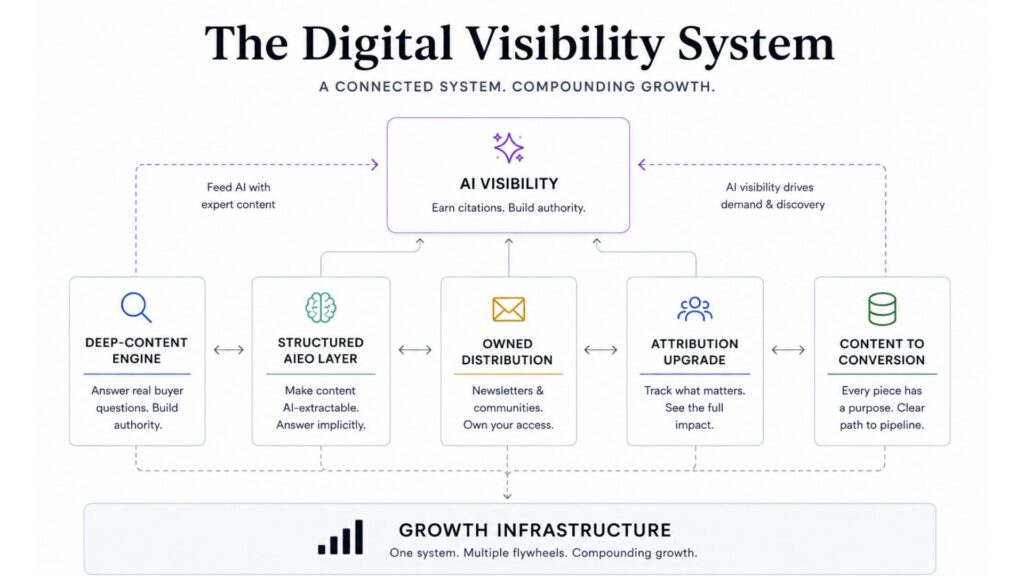
- Deep-content engine: Publish highly specific content that earns AI citations and builds brand authority. Target questions buyers are already asking AI tools, not just keywords they type into Google.
- Structured AIEO layer: Format existing content for AI extractability. Specifically, add definitions, FAQs, and summary sections that answer implicit questions without requiring the reader to dig.
- Owned distribution: Build newsletter and community assets that maintain direct access to buyers regardless of how AI search evolves. Platform dependency is a compounding business risk.
- Attribution model upgrade: Add branded search tracking, direct traffic analysis, and assisted conversion reporting alongside standard session metrics. Stop making decisions based on incomplete data.
- Integrated content-to-conversion pipeline: Content does not exist in isolation. Every article, post, and resource should connect to a clear path into the commercial funnel, from awareness to booked call.
Ultimately, the companies positioned to win in this environment are not the ones spending the most on content. They are the ones building the most coherent digital infrastructure. This is the gap that Creativz closes.
Zero-Click Search B2B: Old Visibility Strategy vs. New Digital Growth System
| Old Visibility Strategy | New Digital Growth System |
| Optimize for Google clicks | Optimize for AI citations and brand visibility |
| Measure sessions and traffic volume | Measure branded search, direct traffic, and assisted conversions |
| Gate content for lead capture | Publish openly to earn AI citations, capture via owned channels |
| Single-channel content distribution | Multi-channel content ecosystem feeding AI and direct audience |
| SEO as a standalone tactic | SEO integrated with AIEO, GEO, and owned distribution |
| Traffic decline = marketing failure | Traffic decline may signal AI absorption, not audience loss |
FAQ: Zero-Click Search B2B and AI-Driven Buyer Behavior
What is zero-click search?
Zero-click search occurs when a search engine or AI tool returns results directly on the results page, without the user clicking through to any website. In B2B contexts, this includes Google AI Overviews, ChatGPT responses, and Perplexity summaries that answer vendor-, comparison-, or category-related questions without sending traffic to source websites.
Why are fewer people clicking on Google results?
Google now answers many queries directly through AI Overviews, featured snippets, People Also Ask boxes, and knowledge panels. Buyers get the information they need without having to scroll through organic listings. Click-through rates on informational queries have declined significantly since Google expanded its AI-generated answer features through 2024 and 2025.
Does SEO still matter in 2026?
Yes, but its role has shifted. SEO remains essential for establishing authority, earning citations in AI tools, and capturing high-intent transactional queries. The difference is that content optimized purely for keyword ranking without structural depth, authority signals, or AIEO formatting will earn fewer clicks than it did in 2022. SEO in 2026 requires integrating traditional ranking signals with AI-readability and brand positioning.
How can B2B companies stay visible in AI search?
Build content that answers specific questions buyers are already asking AI tools. Structure the content clearly with definitions, summaries, and FAQ sections that AI engines can extract and cite. Publish consistently under a recognizable brand with clear positioning. Invest in external authority signals (links, citations, mentions) that AI tools use to determine source credibility.
What metrics should businesses track beyond traffic?
Track branded search volume, direct traffic trends, assisted conversions, content citation rates, and share of voice within your category. Also monitor how your brand appears when you query AI tools with the questions your buyers are asking. This qualitative AI visibility check is an underused but practical way to understand where your content infrastructure is working.
Want to Go Deeper?
These resources build directly on the systems and strategies covered in this blog:
- Lead Scoring for Startups: How to Prioritize the Right Buyers at the Right Time — Once buyers find you through AI search, not all leads are equal. This blog shows you how to build a lead-scoring system that separates serious buyers from the noise, so your team focuses on the conversations most likely to close.
- How to Build a Sales Playbook That Scales: The Startup Founder’s Guide — AI search changes how buyers arrive. This blog covers what happens next: building the sales infrastructure to convert warm, self-educating buyers into paying clients without relying on manual follow-up or guesswork.
- Why Founders Must Own Their Audience Before Renting Traffic — As AI absorbs more discovery traffic, owned channels become the most reliable growth asset a business can build. This blog makes the case for newsletters, communities, and direct audiences as the foundation of a durable digital growth system.
Final Thought
If your business is still measuring growth solely by traffic, it is worth auditing how visible your brand actually is in today’s AI-driven buying journey.
Traffic metrics tell you how many people clicked through. What they do not tell you is how many buyers evaluated you inside a ChatGPT response and decided you were not specific enough, or encountered your brand in a Perplexity summary and moved on because your positioning was unclear.
In practice, the companies scaling past seven figures in 2026 are not chasing clicks. They are building digital visibility systems that work whether a buyer arrives through Google, an AI tool, a newsletter, or a referral. That infrastructure is the competitive advantage now.
If you are ready to understand where your brand actually stands in today’s AI-driven buyer journey, start with a Free Digital Growth Audit. We will map your current visibility, identify where demand is leaking, and show you exactly what to build first.
Not sure where your digital growth system stands today? Take the Revenue System Scorecard, a diagnostic covering lead generation, CRM health, funnel performance, analytics, and AI readiness. Get your score in under 10 minutes.

Creativz.io
Creativz.io is a digital growth consulting firm that builds revenue infrastructure for B2B founders scaling from $500K to $10M ARR. The team architects conversion systems, CRM pipelines, lead-nurture automation, and analytics infrastructure that turn website traffic into predictable revenue. Creativz has worked across construction, SaaS, fintech, B2B services, and logistics, with a focus on systems that scale without scaling headcount.
