
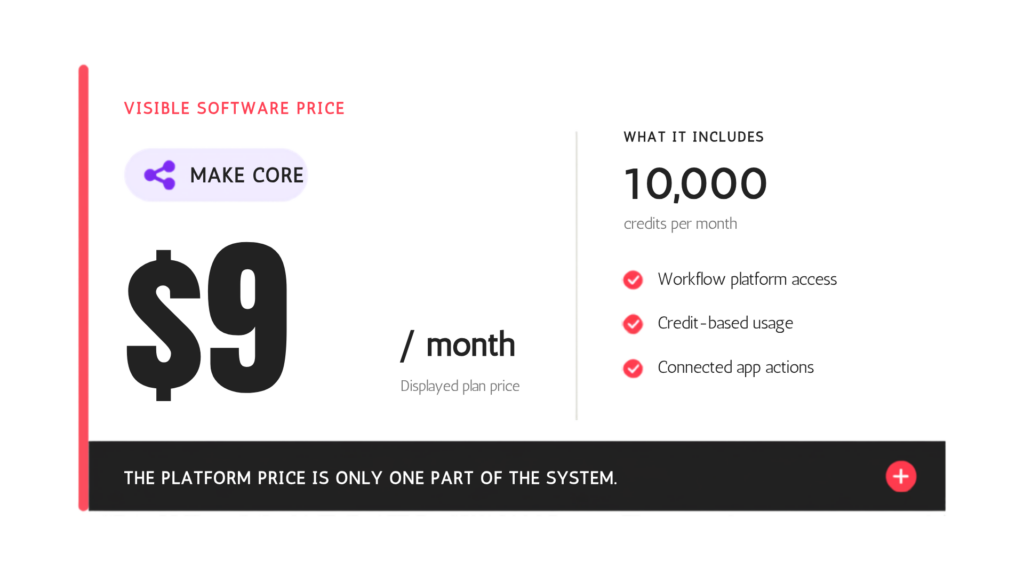
Each number sits on a 2026 pricing page for a platform used to build or run AI automation. None of the answers address the question a founder is asking. What will a working system cost?
Make bills credits. Zapier bills tasks. n8n bills full workflow runs. Microsoft Copilot Studio bills agent activity through Copilot Credits. Model providers add token charges on top of all four.
Your business still has to define the workflow. Then connect the systems and clean the data. Test failures. Train your people. Review risky decisions. Keep the whole thing running.
This is why AI automation costs for small business teams never appear on a single pricing page. The tool price is visible. Your system price has to be worked out.
In this blog, you will learn how the five billing models work. You will also get the eight cost factors, a first-year formula, and a worked example with the assumptions made visible.
How Much Does AI Automation Cost for a Small Business in 2026?
Several automation platforms start below $20 per month on their published pricing pages.
A plan buys access to software. Access does not buy a mapped, tested, working system.
Four layers make up the real number.
- One-time costs. Mapping, build, wiring, testing, and training.
- Recurring costs. Software plans, seats, add-ons, and connected apps.
- Variable costs. Tokens, tasks, credits, runs, retries, and peak demand.
- Contingent costs. Human review, fixes, vendor changes, and failed runs.
Creativz does not publish a single average project price. No honest one exists. Scope, systems, data quality, and accuracy targets move the figure by a wide margin.
What follows instead is the method. Price one workflow. Count all four layers. Then measure the result across twelve months.
Why this matters: A monthly plan is one line in the budget. Founders lose money on the seven lines nobody quoted.
Why Software Price Is Not the Full AI Automation Cost
Five platforms, five billing units. Each one answers a different budget question.
| Platform | Published entry point | Billing unit | What the price excludes |
|---|---|---|---|
| Make Core | [PRICE SLOT A] per month at the displayed credit tier | Credits for module actions | Workflow design, model charges, build, upkeep |
| Zapier | [PRICE SLOT B] per month, plan name to confirm | Tasks, with rates set by action type | Process mapping, connected app fees, governance, review |
| n8n Starter | 20 euro per month billed annually for 2,500 runs | Full workflow runs | Model usage, hosting, build work, production support |
| Microsoft Copilot Studio | [PRICE SLOT D] per month for a credit pack | Copilot Credits by response or action | Qualifying services, Azure usage, build effort, controls |
| OpenAI API | Usage-based pricing, no single monthly price | Input, cached input, output, storage, tool calls | Workflow platform, wiring, testing, monitoring, staff time |
Prices read on official vendor pages. Check each figure before you commit budget. Annual billing, usage, add-ons, taxes, and currency change the final charge.
These are entry points and billing structures. They are not quotes for a finished AI project.
The units matter more than the prices. Here is what creates the bill in each model.
| Billing model | What creates the bill | Budget question |
|---|---|---|
| Per seat | Number of licensed employees | How many people need direct access? |
| Per task or credit | Each action, response, or connector call | How many actions does one outcome need? |
| Per execution | Each full workflow run | How often will the workflow run and retry? |
| Per token | Text sent to and produced by a model | How much context and output does a run use? |
| Custom or managed | Scope, wiring, service level, support | What operating duty sits with the provider? |
One example shows how far apart these models sit. n8n counts a single run for the whole workflow, whatever the number of steps inside. A task-based tool bills every step in the same workflow on its own.
Same business outcome. Different bill by a factor of ten or more.
Watch the stacked charges too. n8n includes 2,300 AI Assistant credits per month on the Starter plan. Your own AI nodes still bill through the model provider.
Why this matters: Two platforms with similar sticker prices produce different invoices at the same volume. Map your billing unit before you compare plans.
Eight Factors Behind AI Automation Cost for a Small Business

Creativz prices automation with the AI Automation Cost Stack. Eight layers sit under every working system. Software is the smallest one.
Each layer carries a budget question. Answer the eight questions and you have an estimate.
1. Workflow definition
Map the trigger, steps, expected outcome, exceptions, owner, and baseline. Do this before you pick software.
Budget question: what result does this workflow produce, and who owns it?
2. Platform access
Count every seat, plan, add-on, and connected app.
Budget question: how many paid tools does one workflow touch?
3. Model and usage
Estimate prompts, tokens, calls, files, runs, retries, and peak demand.
Budget question: how many billable steps does one finished outcome need?
4. Data preparation
List the cleanup, labeling, file order, access rules, and stored sources.
Budget question: is your data clean enough for a machine to act on alone?
5. Integration and build
Count the systems, APIs, fields, logins, branches, and custom parts.
Budget question: how many links have to hold for the workflow to finish?
6. Testing and controls
Budget for normal cases, edge cases, accuracy checks, approvals, logs, and rollback.
Budget question: what happens the day a case arrives nobody planned for?
7. Adoption and training
Include training, written steps, process changes, and time spent learning the tool.
Budget question: how many hours pass before your team stops working around the system?
8. Operations and recovery
Include monitoring, upkeep, human review, vendor changes, failed runs, and support.
Budget question: who fixes this in month seven, and for how many hours?
Why this matters: Skipping a layer does not remove the cost. Skipping a layer moves the cost into someone’s week, where no dashboard reports it.
Three Levels of AI Automation Cost and Scope
Scope drives the estimate. Compare structure and cost drivers first. Then apply the formula in the next section.
| Level | Typical structure | Primary cost drivers | Example |
|---|---|---|---|
| AI assistant | One tool, limited business data, every output reviewed | Seats, adoption, staff time | Drafting, summarizing, research support |
| AI-assisted workflow | Two to four linked systems, fixed trigger, approvals and exceptions | Build, wiring, tasks, model use, upkeep | Lead intake, CRM updates, proposal prep |
| Production AI agent | Several tools or channels, live actions, set authority and monitoring | Data, permissions, testing, uptime, review, recovery | Customer service, qualifying, scheduling, operations |
Notice the shift in drivers. At the assistant level you buy seats. Higher up, you buy uptime, and uptime is the costly part.
Most founders price level one, then build level two.
How to Estimate First-Year AI Automation Cost
Here is the formula. Copy the line into a spreadsheet and fill in your own numbers.
First-year cost = build + twelve months of software and usage + data and wiring work + testing and training + human review + upkeep + a recovery reserve.
A worked example with visible assumptions
The numbers below are illustrative inputs for one linked workflow. They are not a market average, a benchmark, or a Creativz quote.
| Cost input | Assumption | Calculation | First-year cost |
|---|---|---|---|
| Workflow mapping, build, testing | 30 hours at $75 | 30 x $75 | $2,250 |
| Employee training | 8 hours at $40 | 8 x $40 | $320 |
| Software and usage | $100 per month | $100 x 12 | $1,200 |
| Human review | 3 hours monthly at $40 | 3 x $40 x 12 | $1,440 |
| Maintenance | 2 hours monthly at $75 | 2 x $75 x 12 | $1,800 |
| Recovery reserve | 10 percent of subtotal | $7,010 x 10% | $701 |
| Illustrative total | One linked workflow | Sum of all inputs | $7,711 |
Read the third row again. Software is $1,200 of a $7,711 first-year figure.
The plan costs roughly 16 percent of the budget here. Human effort accounts for the rest.
Swap every assumption for your own labor cost, provider quote, workflow volume, and review time. Keep the arithmetic on show, so your team argues with the inputs instead of the total.
Then set the number against one measured outcome. Hours returned, deals recovered, or errors removed.
Why this matters: Time saved is not cash until you name what the freed hours produce. Twelve hours back per month means nothing until those hours sell, deliver, or collect.
What Raises AI Automation Cost for a Small Business
Eight conditions push the estimate upward. Count how many apply to your workflow before you budget.
- More systems, fields, channels, and handoffs
- Messy, duplicated, outdated, or restricted data
- Customer-facing, financial, legal, clinical, or production actions
- High accuracy needs and low tolerance for error
- Frequent exceptions, retries, or manual approvals
- Large prompts, long outputs, heavy files, audio, or live chat
- Custom wiring or software with limited APIs
- Uptime, audit, security, and support needs
Four or more of these and you are pricing a production system, not an assistant.
When Low AI Automation Cost Becomes Expensive
The visible bill and the total operating effort are different numbers. Six patterns explain the gap.
Staff verify every output. Saved time returns as review work. Automation runs, the person still reads.
The workflow creates duplicate records or sends. Your team repairs the data downstream, usually in a spreadsheet, usually on a Friday.
Usage scales faster than planned. One business outcome turns out to need nine billable steps rather than three.
Overlapping tools survive. Nobody owns the cleanup, so three plans do one job.
A provider changes an API, model, or billing unit. Your workflow needs rebuilding on a schedule you do not control.
The workflow fails at peak demand. No monitoring exists, so the failure surfaces through a customer complaint.
Every pattern above shares one shape. The bill stays small while the operating effort grows.
Low software cost does not equal low operating cost.

How to Control AI Automation Cost Before Launch
Eight controls, all applied before production.
- Choose one repeated workflow with a baseline you already measure.
- Price one business outcome instead of a list of AI features.
- Estimate normal volume, peak volume, retries, and human review.
- Use the cheapest model meeting your approved accuracy target.
- Set usage caps, alerts, and budget ownership before launch day.
- Pilot with real cases and count the fixes in the cost.
- Write upkeep, vendor changes, and shutdown duties into the scope.
- Compare first-year value with first-year cost before you add a second workflow.
Control four returns the most money. Teams reach for the strongest model on the shelf. Then they pay premium token rates for work a smaller model handles at the same accuracy.
AI Automation Cost by Delivery Model: DIY, Freelancer, Partner, Custom
Four routes exist. Each one hides a different cost.
| Approach | Budget advantage | Cost often missed | Best fit |
|---|---|---|---|
| DIY | Lowest cash entry point | Founder time, testing depth, upkeep, abandoned builds | Narrow internal workflow with spare technical time |
| Freelancer | Focused build cost | Written steps, backup ownership, support after launch | Defined workflow with few systems |
| Systems partner | Strategy, build, and operating design in one scope | Ongoing usage and internal adoption | Linked revenue or operations workflow |
| Custom development | Maximum control and product fit | Engineering, hosting, security, support, ownership | Distinct process with real scale or competitive value |
The DIY row deserves a second look. Say a founder bills $200 per hour. Forty hours of their own build time costs $8,000 before the first software charge.
Ask for a specialist quote once the workflow touches revenue, customers, or money movement.
Want to Go Deeper on AI Automation Cost?
- Automation Readiness Audit: What to Fix Before Adding AI to Your Revenue System. Run this review first. Data quality and process stability decide how many of the eight layers get expensive.
- The Cost of Disconnected Tech Stacks. Where fragmentation adds cost before AI enters the picture.
Final Thought: AI Automation Cost Belongs to the Workflow, Not the Tool
Return to the four pricing pages from the opening.
The platform price is real. It does not describe the work that goes into a reliable business result.
You need one first-year estimate covering build, use, review, upkeep, and recovery. One workflow, one owner, one measured result.
Price the workflow, not the tool.
Before you buy another AI tool, map out the full cost of a single workflow. Book a Digital Growth Audit with Creativz, and we will walk the eight layers with your real numbers.
Want a faster starting point? The Revenue System Scorecard shows where your systems leak time and revenue today.

Creativz.io
Creativz.io is a digital growth consulting firm that builds revenue infrastructure for B2B founders scaling from $500K to $10M ARR. The team architects conversion systems, CRM pipelines, lead-nurture automation, and analytics infrastructure that turn website traffic into predictable revenue. Creativz has worked across construction, SaaS, fintech, B2B services, and logistics, with a focus on systems that scale without scaling headcount.
