
A customer expansion strategy replaces guesswork with a system for spotting revenue signals inside your existing client base.
Your next revenue opportunity might already be a client.
Most founders track every new lead with real discipline. Dashboards, pipelines, and weekly reviews all point toward the next signed deal. Existing clients rarely get the same attention. A customer expansion strategy fixes this gap. It gives your team a repeatable way to notice, score, and act on signals showing a client is ready for more.
We built this framework after watching the same pattern repeat across dozens of B2B service engagements. A client hits a milestone, and nobody logs it. The same client asks for a manual fix three times, and nobody flags it. Six months later, the client signs with a competitor for a service your team already delivers to five other accounts. The revenue was there the whole time. Nobody was watching for it.

What Is a Customer Expansion Strategy?
A customer expansion strategy is a documented process for spotting, scoring, and acting on growth signals from clients you already serve. It covers renewal, cross-sell, upsell, and referral opportunities, treating each one as a distinct motion rather than one vague category labeled “more revenue.”
The word strategy matters here. Without a defined process, expansion depends on one account manager remembering to mention a second service during a call. This is a habit, not a strategy, and it disappears the day that person leaves or gets busy.
Why this matters: Revenue tied to individual memory is difficult to forecast. A written process turns expansion into a line item your team plans around every quarter.
Why Expansion Differs From Random Upselling
Random upselling waits for an opening. A rep senses a client seems happy and pitches an add-on. Sometimes the pitch lands. More often it feels dropped into an unrelated conversation, and the client notices the shift in tone right away.
Expansion strategy starts earlier. It builds on evidence already sitting inside delivery notes, support tickets, and account conversations. The offer connects directly to a problem the client already named or a milestone the client already reached. The pitch feels like the obvious next step, not a sales moment.
Three differences separate the two approaches:
- Random upselling reacts to a mood. Expansion strategy reacts to a signal.
- Random upselling depends on whoever remembers to try. Expansion strategy assigns clear ownership.
- Random upselling rarely gets tracked. Expansion strategy gets scored and reviewed every month.
Where Expansion Opportunities Disappear
Expansion revenue does not vanish all at once. It leaks out through a few predictable gaps.
Delivery teams notice signals but have no channel for reporting them. A project lead hears a client mention a second department needing support, then moves on without telling anyone in sales.
Account managers focus on retention instead of growth. Keeping the client happy becomes the entire job, and proposing new work starts to feel like risking the relationship instead of strengthening it.
Sales teams stay focused on new logos. Commission structures reward closing new deals, so existing accounts get a quick check-in instead of a real growth plan.
Nobody owns the handoff between delivery, account management, and sales. Each team assumes another team is already watching for the signal.
The Client Signals Worth Tracking
Six signals appear repeatedly across B2B service accounts before they expand. Train your team to log these the moment they appear.
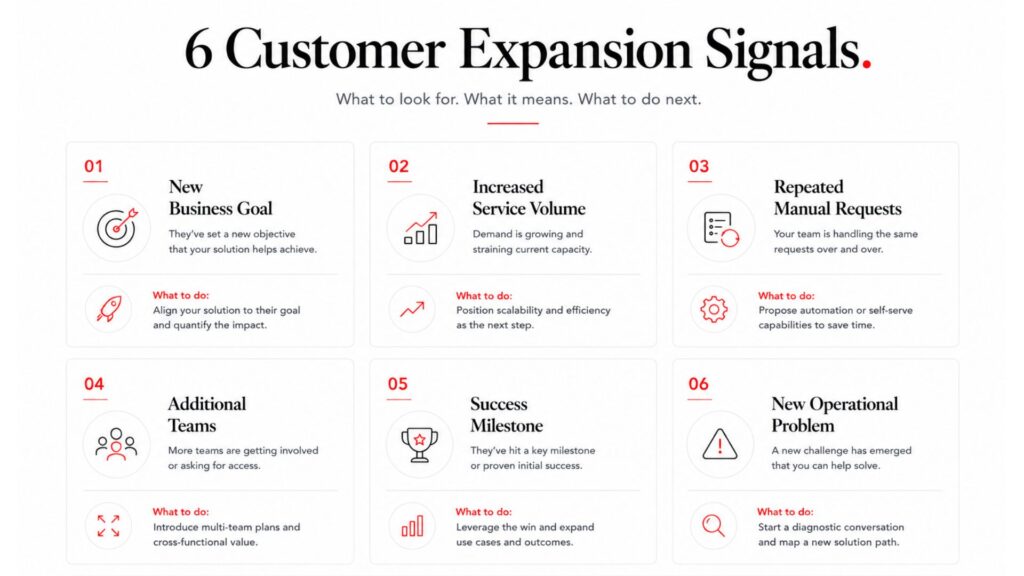
A New Business Objective
A client mentions a goal outside your current scope. This often surfaces during quarterly reviews or casual check-in calls, and it fades from memory within days if nobody writes it down.
Increased Service Volume
The client is using more of your current service than the contract assumes. Growing usage inside a fixed scope is one of the clearest signs the scope itself needs to change.
Repeated Manual Requests
The client asks your team to handle the same task three or more times. A repeated request usually points to an unmet need sitting outside your current service line.
Additional Teams Needing Support
A different department at the client company starts joining calls or asking questions. New stakeholders showing interest often signal an account already expanding.
A Completed Success Milestone
The client reaches a result you promised, whether a revenue number, a launch date, or a finished rollout. A milestone is the natural moment to discuss the next objective, while the win still feels fresh.
New Operational Problems
The client describes a new pain point during a routine call. Teams treat these moments as small talk far too often, when they mark the start of the next proposal.
How to Build an Expansion Signal Score
Not every signal deserves the same response. An Expansion Signal Score gives your team a simple way to rank signals so the strongest ones get attention first.
Score each signal on three factors:
- Urgency: how soon the client needs a resolution.
- Fit: how closely the need matches a service you already deliver.
- Access: how much influence your team already holds with the person raising the signal.
Rate each factor from one to three, then add the numbers together. A signal scoring seven or higher moves to the account lead within 48 hours. Anything below seven gets logged and reviewed at the next account meeting.
This removes guesswork from prioritization. A junior delivery lead does not need years of sales instinct to know a signal deserves escalation. The score tells them directly.
Who Owns Each Expansion Opportunity
Ownership breaks down when every team assumes someone else is watching. Assign a specific role to each signal type, not a department.
| Client signal | Meaning | Next action | Owner |
| Service volume increasing | Current scope is becoming too small | Review capacity and scope | Account lead |
| Client repeats a manual request | Another workflow needs support | Run a process audit | Delivery team |
| First outcome achieved | Client has proof of value | Discuss the next objective | Strategy lead |
| New department becomes involved | Account usage is expanding | Map new requirements | Sales and delivery |
How Delivery, Account Management, and Sales Should Hand Off the Opportunity
A clean handoff follows three steps, and skipping any one of them is where most opportunities stall.
First, the person who spots the signal logs it in a shared system within 24 hours, rather than relying on memory during a Friday recap.
Second, the account lead reviews the score and decides whether the opportunity needs a strategy conversation or a direct proposal.
Third, sales or the account lead schedules a conversation focused on the client’s stated goal, not a generic upsell pitch.
Why this matters: A handoff without a deadline turns into a handoff nobody completes. Build the 24-hour rule into your process, not only your intentions.

What to Automate and What Should Stay Human
Automation should catch signals. Judgment should decide what happens next.
Automate signal detection wherever the data already exists. Usage thresholds, support ticket volume, and renewal dates trigger an alert, even if no one remembers to check manually.
Keep the conversation human. A client discussing a new business goal wants a real exchange with someone who understands their account, not an automated sequence built for cold prospects.
One useful rule: automate the noticing, and protect the talking.
Expansion Metrics Founders Should Review Monthly
Four numbers show whether your expansion strategy works.
- Signals logged per month, showing whether your team watches for opportunities.
- Signal-to-proposal conversion rate, showing whether logged signals turn into real conversations.
- Expansion revenue as a share of total revenue, showing the size of the opportunity you capture.
- Average time from signal to proposal, showing whether your handoff process works.
Review these numbers in the same meeting where you review new business pipeline. Expansion deserves the same visibility as acquisition, not a separate conversation nobody schedules.
A 90-Day Customer Expansion Workflow
Days 1 through 30: Build the system. Set up a shared log, train delivery and account teams on the six signals, and assign ownership using the matrix above.
Days 31 through 60: Run the process live. Score every signal coming in, and hold the account lead to the 24-hour logging rule.
Days 61 through 90: Review the four metrics above, and adjust ownership or scoring criteria based on what the data shows.
By day 90, expansion no longer depends on memory. It becomes a process your team runs the same way every month.

Why Expansion Matters Right Now
McKinsey research points to existing customers as the main driver of growth at top-performing companies, with roughly eighty percent of value creation coming from the core business rather than new logo acquisition. Founders chasing growth only through new leads are ignoring where most of the value already sits.
Gainsight’s 2025 Customer Success Index surveyed more than four hundred companies and found revenue accountability becoming a standard expectation for client-facing teams. Gainsight’s Chief Revenue Officer has pointed out that expansion revenue makes up close to forty percent of total revenue at some SaaS organizations.
For a B2B service business, the lesson is direct. The clients you already serve are quietly generating a large share of the growth you keep chasing elsewhere.
Want to Go Deeper?
Final Thought
Expansion revenue is not hiding. It sits inside calls, tickets, and check-ins your team already runs every week. A customer expansion strategy makes sure someone logs what they hear and acts before a competitor does. Start with the six signals. Build the score. Assign the owners. The next ninety days will show how much revenue was already sitting inside your client base, waiting for a system to catch it.
Book a Digital Growth Audit for a clear picture of the expansion opportunities inside your current client list.
Run your business through the Revenue System Scorecard for a faster gut check on your revenue infrastructure.

Creativz.io
Creativz.io is a digital growth consulting firm that builds revenue infrastructure for B2B founders scaling from $500K to $10M ARR. The team architects conversion systems, CRM pipelines, lead-nurture automation, and analytics infrastructure that turn website traffic into predictable revenue. Creativz has worked across construction, SaaS, fintech, B2B services, and logistics, with a focus on systems that scale without scaling headcount.
