
If you want to know how to build an outbound sales strategy for B2B without hiring a full sales team, you are in the right place.
Inbound leads are inconsistent. Referrals plateau. Eventually, waiting for leads to find you stops being a growth strategy and becomes a risk.
The answer is not hiring an SDR. Instead, the answer is building a system.
Founders at the $500K to $5M ARR stage often hit the same wall. They have product-market fit. They have some inbound traction. However, their month-over-month pipeline is still unpredictable because they have no reliable way to generate net-new demand on command.
Outbound is that mechanism. Yet outbound without infrastructure is just spam with good intentions.
In this post, we break down what that infrastructure looks like and explain how to build it without a dedicated sales team.

Why Most Founders' Outbound Fails Before the First Email Send
Most founders blame their copy when outbound does not work. They think the messaging was off. They assume the subject line was wrong. Sometimes, they even believe the list was too cold.
However, that diagnosis is almost always incorrect.
According to the HubSpot State of Sales Report, 44% of salespeople give up after one follow-up. Yet 80% of deals require five or more touchpoints to close. So, the problem is not the first email. Rather, the problem is everything that should happen after it.
Three infrastructure failures cause most founder-led outbound to collapse before it has a chance to work:
- No list infrastructure. Prospecting by hand through LinkedIn searches, without enrichment or qualification, wastes hours on the wrong people. The list is the foundation. Without a qualified, enriched list, no sequence performs well.
- No sequence automation. Follow-up is manual and inconsistent. As soon as the founder gets busy with delivery, the outreach stops. As a result, deals fall through not because the prospect said no, but because nobody followed up.
- No CRM integration. Replies land in email with no tracking, no pipeline stage, and no alert when a lead goes cold. Therefore, there is no visibility into what is working and no record of who said what.
This is the same pattern we see in almost every Lead Scoring for Startups audit. The outreach exists. The system does not.
Why this matters
Founder outbound fails at the infrastructure level, not the messaging level. In other words, fixing the copy before fixing the system is like optimizing a landing page before fixing the traffic source. The order matters.
How to Build an Outbound Sales Strategy for B2B Without a Sales Team
Building an outbound strategy without an SDR comes down to one principle: automate everything that does not require judgment, and reserve your attention for the conversations that do.
A founder should never be manually copying contacts into a spreadsheet, sending individual follow-up emails, or checking a Gmail inbox for reply signals. Those tasks belong to a system. The founder belongs in the conversation once a reply signals genuine interest.
The structure that makes this possible is a three-layer outbound stack.
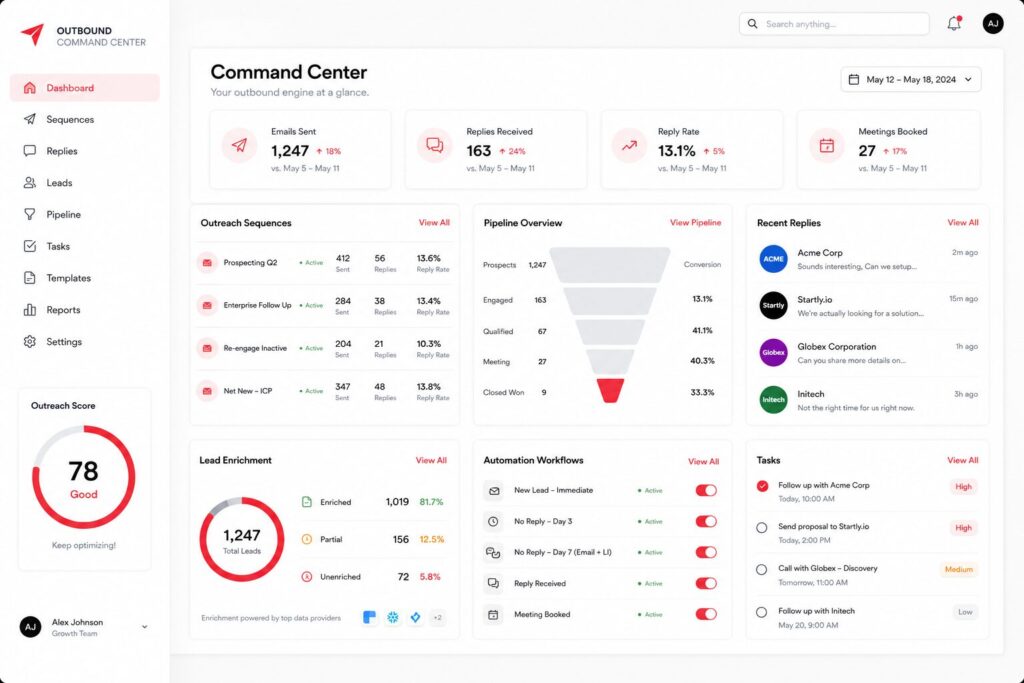
The 3-Layer Outbound Stack Every Founder Needs
This is the core framework. Each layer has a distinct function. Remove any one of them, and the system breaks.
Layer 1: List and Enrichment
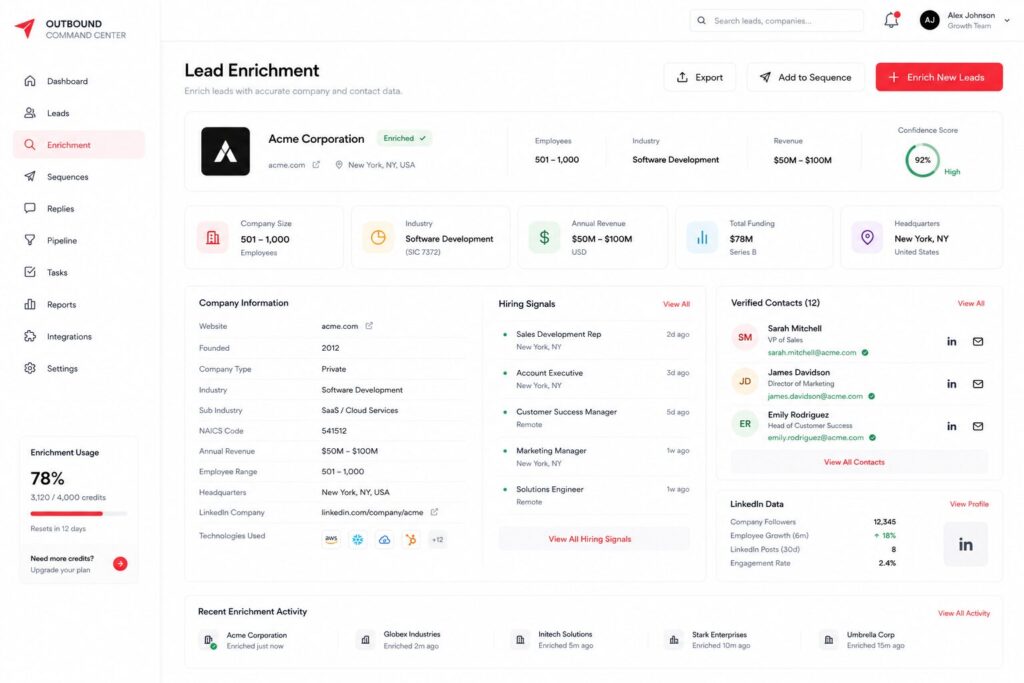
A qualified, enriched lead list is the foundation of any outbound strategy. Without it, you are sending the right message to the wrong people.
Build your list using Sales Navigator with tight filters such as industry, company size, revenue range, title, and geography. Then export those contacts and enrich them using a tool like Clay or Apollo to pull verified email addresses, LinkedIn URLs, technology stack data, and recent hiring signals.
Qualification happens before outreach begins. Use the lead scoring criteria from Lead Scoring for Startups to filter out low-fit prospects before they enter any sequence. A list of 200 well-qualified contacts outperforms a list of 2,000 unqualified ones every time.
Why this matters
Most founder outbound starts with a bad list. You cannot automate your way out of targeting the wrong people. List quality is the single highest-leverage variable in outbound performance.
Layer 2: Sequence and Automation
A 3 to 5 touch sequence with defined timing and triggers is what turns a list into a pipeline. The first touch is human. After that, every follow-up is automated.
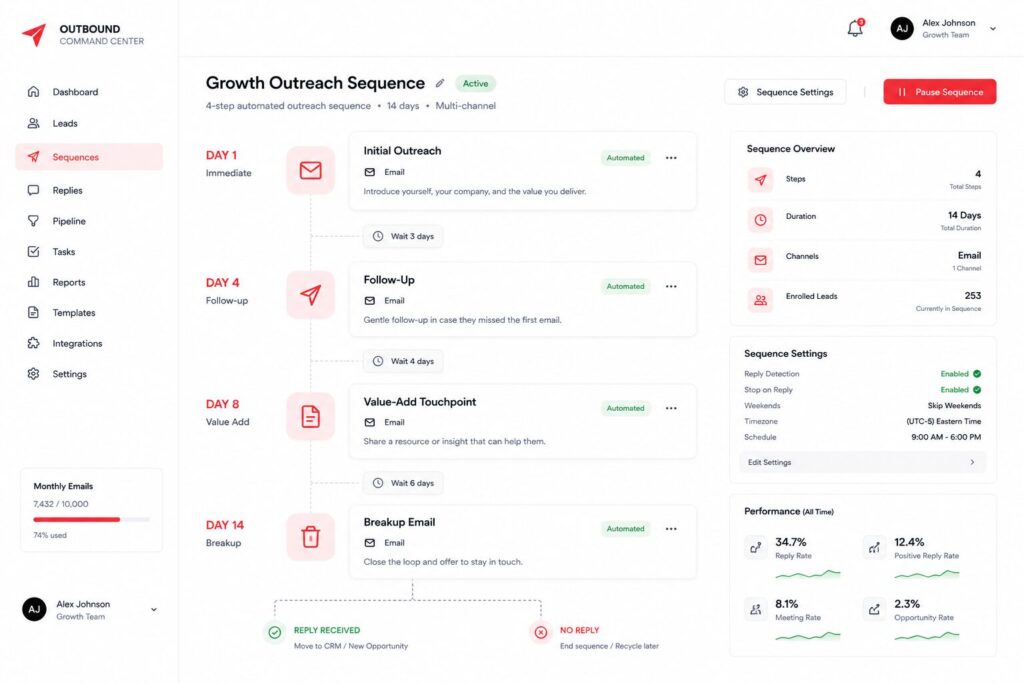
A basic sequence structure that works for B2B founders without a sales team looks like this:
- Day 1: Send a personalized connection request or cold email. Reference a specific signal from the prospect’s profile or company.
- Day 4: Send a follow-up. Keep it to one sentence. Reference the first message. Do not pitch.
- Day 8: Add value. Share a relevant insight, case study, or resource. However, do not ask for anything.
- Add value. Share a relevant insight, case study, or resource. However, do not ask for anything.
- Day 14: Send a breakup message. Keep it short, direct, and low-pressure. Still, leave the door open.
Tools like Lemlist, Instantly, or Apollo handle this sequence automatically once a contact enters the workflow. As a result, the founder writes the sequence once, and the system runs it for every contact. This connects directly to the playbook structure in Sales Playbook for Startups.
Layer 3: CRM Integration and Pipeline Visibility
Every reply, every booked call, and every non-response should trigger an automatic CRM update. In other words, the founder should never manually move a lead through a pipeline stage.
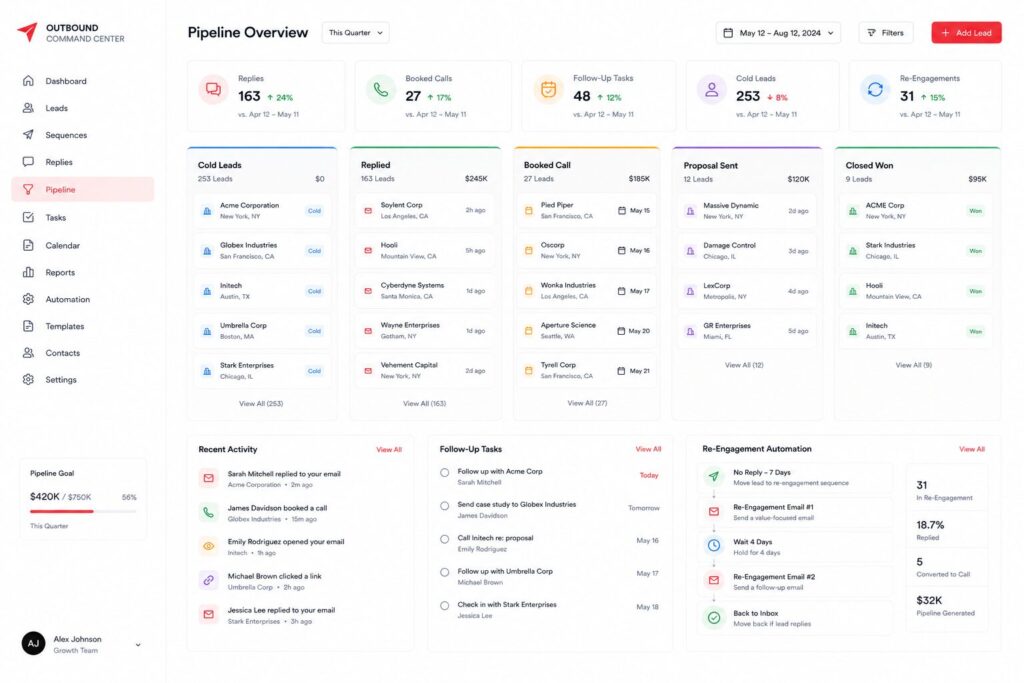
When a prospect replies, the CRM creates a contact record and moves them to an active conversation stage. When a call is booked, the CRM logs it and assigns a follow-up task. If a lead goes cold after the sequence, the CRM flags them for re-engagement in 30 days.
This is the layer founders skip most often. However, it is also the layer that determines whether outbound produces pipeline visibility or just email activity. See CRM Setup for Startups for the exact configuration we use.
Why this matters
Without CRM integration, outbound is invisible. You have no idea which sequences are converting, which lead sources are performing, or where deals are stalling. Ultimately, visibility is what turns outbound from an activity into a system.
The Benchmarks to Measure Your Outbound Strategy Against
One of the most common questions founders ask when starting outbound is simple: how do I know if this is working?
According to Gartner B2B Sales Research, B2B buyers now interact with sales content across an average of 10 channels before making a purchase decision. Therefore, consistency and sequence depth matter more than any single message.
Use this table to evaluate your current outbound performance against what a system-backed approach produces:
| Metric | No System | With System |
| Connect-to-reply rate | 1 to 3% | 8 to 15% |
| Reply-to-call rate | 10 to 20% | 30 to 45% |
| Manual hours per week | 8 to 12 hrs | 1 to 2 hrs |
| Follow-up consistency | Ad hoc | Automated and trackable |
The manual hours gap is the clearest signal. If outbound is taking more than 2 hours per week of founder time once the system is running, then something in the infrastructure is still manual. That is the first thing to fix.
When to Hire an SDR vs. When to Build the System First
The instinct when outbound is not working is to hire someone to do it. However, that instinct is almost always premature.
An SDR without a system is an expensive manual process. In practice, you are paying a person to do work that should be automated, and you have no way to measure whether their effort is converting or not.
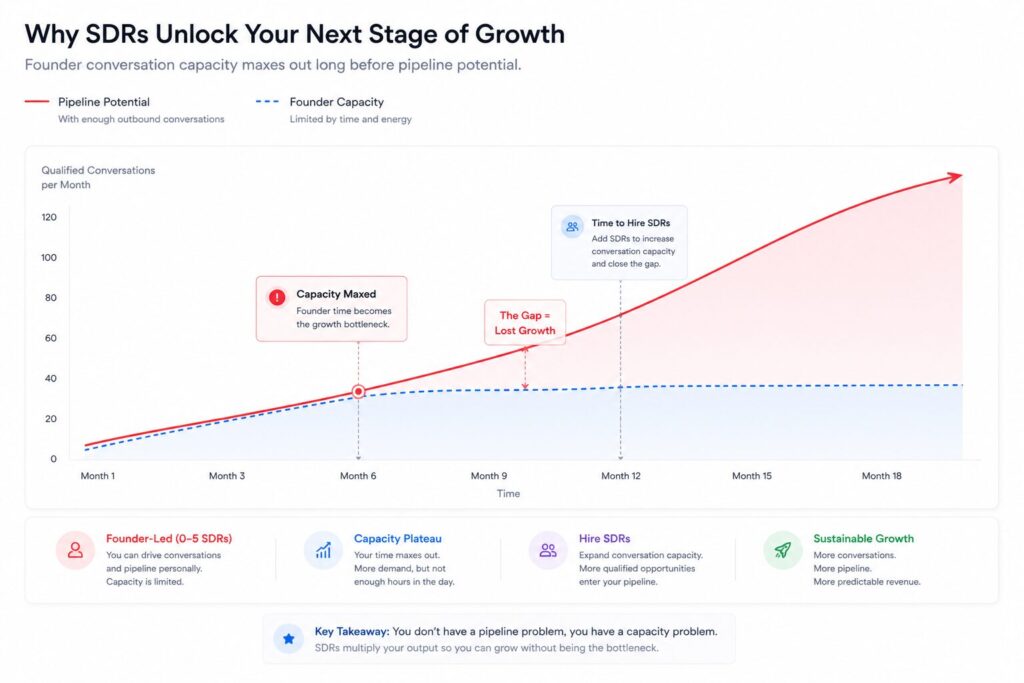
The hire comes after the system is proven, not before. More specifically, there are a few clear signals that it is time to bring in an SDR:
- Your sequence is generating qualified replies at a consistent rate.
- Your calendar is booking calls faster than you can take them.
- The constraint is conversation capacity, not lead generation.
At that point, the SDR is hired to run a proven system, not to build one from scratch. Consequently, that is a fundamentally different job description. More importantly, it produces results instead of consuming your runway while you wait for traction.
Frequently Asked Questions
What is a B2B outbound strategy for a small team?
A B2B outbound strategy for a small team is a structured system for generating net-new pipeline through proactive outreach. It includes a qualified lead list, an automated multi-touch sequence, and CRM integration to track replies and pipeline movement. The goal is to generate consistent conversations with target accounts without requiring a dedicated sales team to run manually.
How many outbound touches does it take to get a reply?
Research consistently shows that 80% of B2B deals require five or more touchpoints before a prospect responds. Therefore, a 3 to 5 touch sequence over 14 days is the minimum viable structure for outbound. By comparison, single-touch outreach, which most founders attempt, has a reply rate below 3%.
What tools do founders use for outbound without a sales team?
The most common tool stack for founder-led outbound includes Sales Navigator for list building, Clay or Apollo for enrichment, Lemlist or Instantly for sequence automation, and HubSpot or Pipedrive for CRM integration. However, the specific tools matter less than the integration between them.
How do you build an outbound pipeline from scratch?
Start with the list. Define your ideal customer profile tightly and build a qualified, enriched list of 200 to 500 contacts. Next, set up a 4-touch automated sequence with a human first touch. Then integrate your sequence tool with your CRM so every reply is tracked automatically. Finally, measure connect-to-reply rate weekly and adjust messaging based on what is generating responses, not what feels right.
Want to Go Deeper?
These posts cover the systems that sit underneath a high-performing outbound pipeline:
- Lead Scoring for Startups: How to Build a Lead Scoring System for Startups (And the Tools That Make It Work) Learn how to qualify leads before they enter your outbound sequence so your pipeline is filled with the right contacts, not just more contacts.
- Sales Playbook for Startups: The Essential Sections, Tools, and Templates That Actually Scale. Build the repeatable sales process that sits underneath your outbound stack and turns replies into closed deals consistently.
- CRM Setup for Startups: How to Set Up a CRM That Actually Closes Deals (For Founders Scaling Past $1M) Configure the CRM pipeline that tracks every outbound reply, automates follow-up, and gives you full visibility into where deals stand.
Final Thought
Outbound does not fail because founders are bad at sales. Instead, it fails because they run outbound without the infrastructure that makes it consistent, measurable, and scalable.
The three-layer stack covers list quality, sequence automation, and pipeline visibility. Build all three before you send a single message, and you will see a fundamentally different result from every previous outbound attempt.
If you want to know exactly where your current pipeline is breaking down before building anything new, start with a diagnostic.
Not ready for a full audit? Use the Revenue System Scorecard to benchmark your outbound readiness across 21 criteria. It takes 5 minutes and shows you exactly which layer of your outbound stack needs the most attention.
