
Most B2B websites quietly lose around 60 percent of their visitors before a single conversion event fires. Visitors arrive on your site, skim a page or two, and disappear without leaving a trace. When that happens, the default reaction is usually to push harder on acquisition—buy more traffic, run more ads, publish more content. Yet in most cases, the real issue is not volume.
From the visitor’s perspective, the path from first click to signed contract is almost impossible to see. There are no clear next steps, no low-risk ways to engage, and no reason to trust a company they discovered a few minutes ago. Without any small commitments along the way, even high-intent visitors stay passive and slip through the cracks.
A micro-conversion strategy addresses this by mapping the full buying journey and creating meaningful, low-friction actions at every stage. Each step is designed to earn a bit more trust, collect a bit more data, and move a visitor closer to becoming a warm lead—often before anyone ever books a call.
In this article, you will see how to build that kind of system, why most B2B companies postpone this work, and what changes in your revenue performance once the strategy is in place.

What a Micro-Conversion Is (and Why the Definition Matters)
A micro-conversion is any small action a visitor takes that signals intent and moves them one step closer to becoming a client. Think of someone scrolling through a full-service page, downloading a checklist, or watching most of a video; none of these is a sale, but each one shows interest.
Inside most companies, however, only one conversion gets serious attention: the form submission, the booked call, or the purchase. Every decision a visitor makes before that moment is effectively invisible. When you operate this way, it is like managing a sales team by only tracking closed deals.
You see the final outcome, but you have no idea where prospects stalled, what slowed them down, or which part of the pipeline quietly broke.
Common micro-conversions in a B2B funnel
- Scrolling past the 50 percent mark on a service page
- Downloading a lead magnet (audit checklist, scorecard, guide)
- Watching more than 30 seconds of a video
- Clicking to a case study or pricing page
- Returning to the site within 7 days
- Opening a follow-up email from a lead magnet sequence
- Completing a quiz or self-assessment tool
Each one of these is a data point. Together, they build a behavioral profile. That profile tells you who is buying before they raise their hand.
Why Most B2B Websites Leak Revenue at Every Stage
The standard B2B website is built around a single assumption: visitors arrive ready to buy. In reality, that is almost never the case.
A cold visitor landing on your site from an organic search is usually in research mode. They are trying to define their problem, explore options, and understand the landscape. Trust in your company does not exist yet. Despite this, the typical website responds with a hero section, a list of services, and a single high-commitment call to action: “Book a Call.”
From the visitor’s point of view, that jump is too big. The experience rushes them past the early stages of their buying journey, dropping them straight into a sales conversation. In doing so, the site effectively skips five stages of awareness in a single page, and most of your hard-won traffic quietly slips away.

The Five Stages Most Websites Ignore
In Breakthrough Advertising, Eugene Schwartz introduced one of the most important ideas in marketing: customer awareness.
Every visitor arrives on your website with a different level of awareness:
- Unaware: They do not yet recognize they have a problem
- Problem-aware: They know the problem but have not identified a solution
- Solution-aware: They know the solution exist and are comparing approaches
- Product-aware: They are evaluating specific providers including you
- Most aware: They are ready to act and need a final reason to choose
Most B2B websites are built almost entirely for product-aware and most aware visitors. The experience leans heavily on service pages, pricing, demos, and contact forms. Those elements work for buyers who are already close to making a decision.
A large share of your traffic is not there yet. Many visitors are still defining the problem, exploring different ways to solve it, and looking for clear, practical answers. When they cannot find content that speaks to their stage of awareness, they leave without engaging.
A strong micro-conversion strategy closes that gap. It gives each visitor a relevant next step based on where they are in the journey, whether that is downloading a guide, reading a case study, subscribing to ongoing insights, or eventually booking a call.
As Eugene Schwartz argued, effective marketing does not create demand from nothing. It channels existing demand by meeting people where they already are. The same principle should guide how your website is structured.
The Conversion System: Five Layers That Work Together
A conversion system is not a single tactic. It is five interconnected layers. Remove any one of them and the system leaks.
Layer 1: Traffic Segmentation
Not all traffic signals have the same intent. A visitor from a branded search (“Creativz review”) is at stage four or five. A visitor from an informational search (“how to fix CRM pipeline”) is at stage two or three.
The first layer maps the traffic source to the awareness stage. Each source gets a different entry point and a different first micro-conversion offer. Sending all traffic to a generic homepage is the most common reason conversion rates stay flat despite growing traffic.
Layer 2: Stage-Matched Content
Each awareness stage requires content that meets visitors where they are.
| Awareness Stage | Content Type | Micro-Conversion Goal |
| Unaware | Blog, SEO article, short video | First scroll, time on page |
| Problem-aware | Guide, checklist, assessment | Download or quiz completion |
| Solution-aware | Case study, comparison page | Case study read, return visit |
| Product-aware | Pricing page, testimonials, VSL | Pricing page scroll, video watch |
| Most aware | Book a call, limited-spot offer | Discovery call booked |
The goal at each stage is one thing: earn the next micro-conversion. Not a sale. Not a booking. The next step.
Layer 3: Lead Capture That Fits The Stage
Most B2B lead capture does not match the visitor’s stage of awareness. A company puts a “Book a 30-minute call” button in front of a stage-two visitor who is still not sure whether they need an agency, a hire, or a tool. Faced with that level of commitment, the visitor does the simplest thing and leaves.
Stage-matched lead capture takes a different approach. It changes the offer based on where the visitor is in the journey:
- Stage two: a free self-assessment or checklist (“Score your revenue system in 3 minutes”)
- Stage three: a case study or benchmark report
- Stage four: a short video walkthrough or product demonstration
- Stage five: a direct call booking with a specific diagnostic framing
The key insight here, drawn from quiz funnel data across dozens of businesses, is that interactive lead capture converts at two to three times the rate of static forms. When visitors answer questions about their own situation, they naturally lower sales resistance. They feel understood before a single human conversation happens.
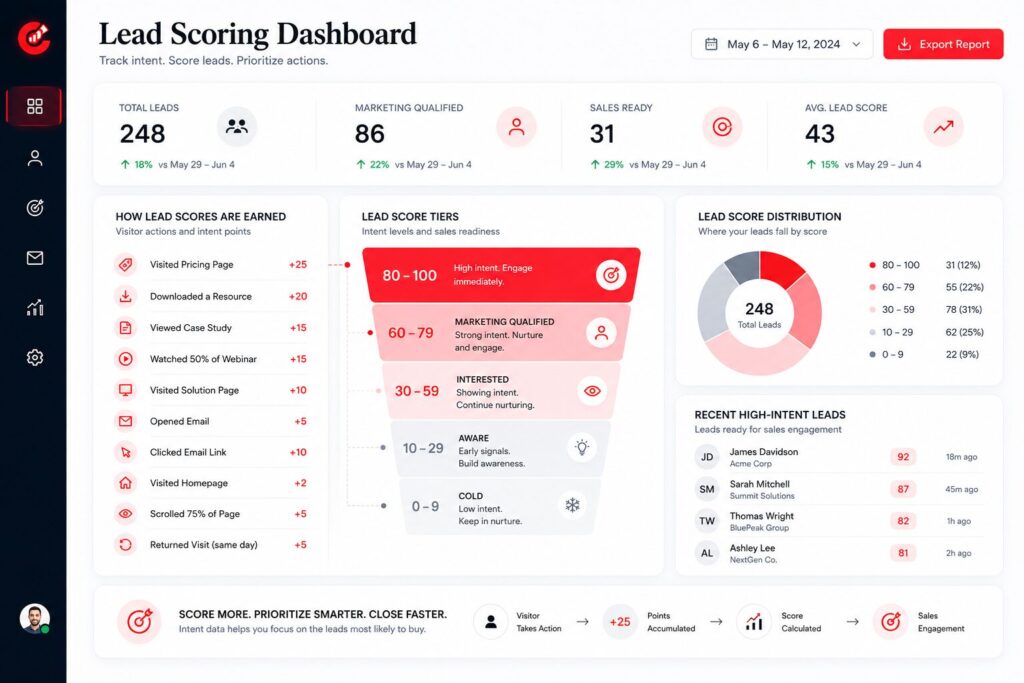
Layer 4: Behavioral Tracking and Lead Scoring
A micro-conversion strategy without tracking is a leaking bucket. You need to know which specific actions actually predict revenue, not just which ones feel important.
Start by setting up event tracking for every meaningful micro-conversion in your funnel. Then score leads based on accumulated behavior, not a single action:
- Visited pricing page: +20 points
- Downloaded lead magnet: +15 points
- Watched 50% of a VSL: +25 points
- Returned to the site within 7 days: +10 points
- Opened 3 or more nurture emails: +15 points
Once a lead crosses your threshold score, trigger an automated follow-up or alert a sales rep. This is how you compress the sales cycle. You contact the right person at the right moment, instead of reaching out two weeks after their interest peaked.
Layer 5: Nurture Sequences That Advances The Stage
Most nurture sequences work like broadcasts. Every subscriber receives the same message on the same schedule, no matter what they have or have not done.
Stage-matched nurture takes a different approach. It detects where the subscriber is in the journey and sends content designed to move them one step further. Someone who downloaded a checklist at stage two, for example, should receive a case study that illustrates a solution at stage three, not another checklist that repeats the same idea.
The sequence itself does not have to be complex. Three to five emails, each triggered by the previous micro-conversion, is usually enough to move a meaningful share of subscribers from cold to call-ready within about three weeks.
What This Looks Like in a Real Business
A B2B construction services firm came to Creativz with a straightforward problem: strong Google rankings, consistent traffic, and almost no inbound leads. Their website spoke almost entirely to stage-four visitors, so everyone earlier in the journey clicked away.
The audit revealed four specific gaps:
- No content addressing the problem-aware visitor (stage two)
- Lead capture limited to a single contact form
- No behavioral tracking beyond basic Google Analytics page views
- No nurture sequence after form submission
The build took 90 days. Here is what changed:
- Blog and SEO content targeting problem-aware search queries, focused on operational pain points rather than service descriptions alone
- A free Digital Growth Audit as the stage-two lead capture, replacing the generic contact form for cold traffic
- A Revenue System Scorecard as the stage-three offer, positioned as a self-diagnostic tool for founders evaluating their operations
- A 12-email nurture sequence that advanced subscribers based on their behavior instead of a fixed calendar
- Lead scoring in the CRM with automated sales alerts when a lead crossed the threshold
Result
Within 60 days of the system going live, inbound leads from organic traffic increased significantly. More importantly, lead quality improved. Prospects arrived on discovery calls already familiar with the firm’s approach, having engaged with multiple pieces of content before booking. As a result, the sales cycle was shortened and close rates rose. The volume of traffic stayed the same. The conversion system changed what that traffic was worth.
The Metrics That Tell You the System Is Working
A micro-conversion strategy generates a new set of leading indicators. These numbers show what your revenue will do over the next 30 to 90 days, not what it did last quarter.
| Metric | What It Measures | Healthy Benchmark |
| Micro-conversion rate by stage | % of visitors completing each step | Stage 2 capture: 3-8% |
| Lead score velocity | How fast do leads accumulate points | Call-ready in 14-21 days |
| Nurture email progression rate | % advancing to the next stage | Above 25% per email |
| Returning visitor rate | % who return within 7 days | Above 15% for warm traffic |
| Sales-qualified lead ratio | % of captured leads reaching threshold | Above 20% of total leads |
These metrics replace vanity numbers. Bounce rate and page views tell you almost nothing about revenue. Lead score velocity and micro-conversion rate by stage tell you everything.
The Most Common Mistakes Founders Make
Building a micro-conversion strategy is not technically complex. The hard part is usually strategic, not technological.
Mistake 1: Tracking activity instead of behavior
Page views on their own are not micro-conversions. Scroll depth, video watch time, return visits, and content downloads are the signals that matter. Instrument your analytics to capture these behavioral indicators, not just traffic volume.
Mistake 2: Treating all leads the same
A visitor who downloaded a checklist, read two blog posts, and visited the pricing page is not the same lead as someone who filled out a contact form cold. Treat them differently. Score them separately. Design your sequences so each type of lead gets a path that reflects their level of intent.
Mistake 3: Mismatching the offer to the stage
A stage-two visitor who is still defining the problem will not respond well to a direct sales call offer. They do not trust you yet. Give them something that fits where they are. A scorecard, diagnostic, or benchmark report delivers value and builds trust without demanding a high level of commitment.
Mistake 4: Building the funnel without building the infrastructure
Content and lead magnets are the visible part of a conversion system. The invisible parts are the CRM, lead-scoring rules, nurture automation, and behavioral triggers. Many businesses invest heavily in the visible layer while ignoring the underlying infrastructure. Leads come in, but they are not consistently captured, routed, or followed up on.
The Infrastructure Gap
In a Creativz audit of a $4M B2B services firm, the team found seven lead-capture points generating form submissions. None of them fed into the CRM. Leads were emailed to a shared inbox that was checked only occasionally. An estimated 60 percent of inbound leads from the prior 12 months had received no follow-up within 48 hours. The traffic and the content were doing their job. The infrastructure was not.
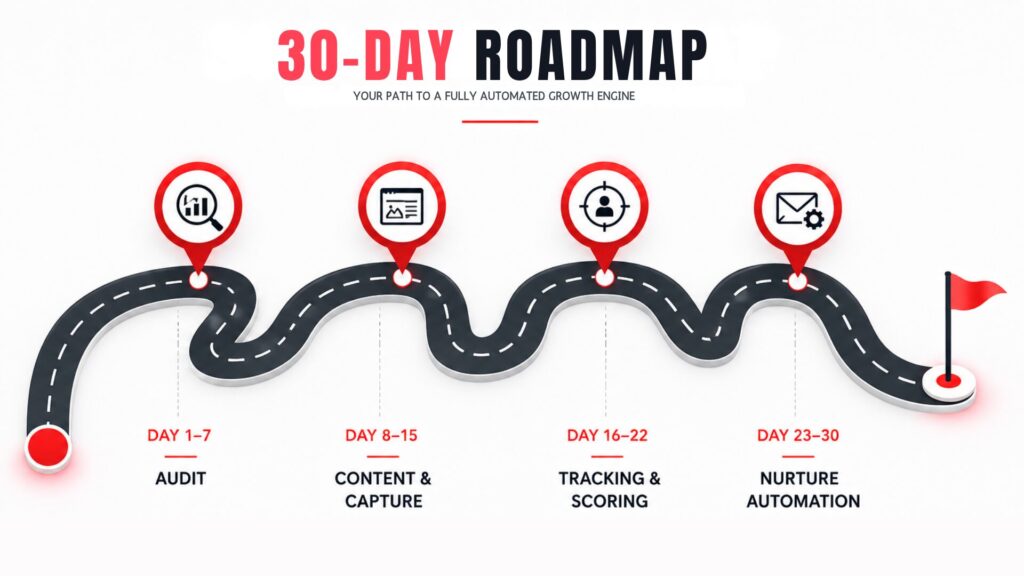
How to Build Your Micro-Conversion System in 30 Days
This is a practical sequence. Follow it in order. Do not move to layer three before layer one is in place.
- Week 1 – Audit: Map every traffic source and assign an awareness stage to each one. List every current conversion event on your site. Identify the points where visitors drop out.
- Week 2 – Content and capture: Create one stage-matched lead magnet for your largest traffic segment. For most B2B companies, this is a self-assessment or diagnostic tool for stage-two organic visitors.
- Week 3 – Tracking and scoring: Set up behavioral event tracking. Define your lead-scoring model, connect it to your CRM, and set the threshold that triggers a sales alert.
- Week 4 – Nurture sequence: Write and activate three to five emails, each triggered by the previous micro-conversion. End the sequence with a stage-appropriate call to action, not a generic sales pitch.
Run this system for 60 days and review the metrics every week. The data will show you which stage to improve next.
Want To Go Deeper?
These Creativz resources extend the thinking in this post:
- B2B Outbound Sales Strategy: How to build outbound systems that complement your inbound micro-conversion funnel, including lead qualification frameworks and Sales Navigator prospecting workflows.
- B2B Pricing Strategy: How pricing presentation affects conversion at every stage of the funnel, and why showing price too early or too late both kill deals.
Final Thought
Most B2B businesses are one system away from a different revenue outcome.
The traffic is there. The product is strong. The sales team knows how to close. But the path between “first visit” and “closed deal” has no infrastructure. Leads fall through. Follow-up is manual. The funnel leaks at every stage because there is no system to hold it together.
A micro-conversion strategy does not require more content, more ads, or more headcount. It requires a clearer picture of where your visitors are in the buying journey and a deliberate system that moves each one to the next stage.
The businesses that build this system in the next 90 days will not look back at traffic numbers to measure success. They will look at lead score velocity, conversion rate by stage, and sales cycle length. Those numbers tell the real story.
If you want to see where your funnel is leaking, start with a Free Digital Growth Audit.
In 30 minutes, you will know which stage of your conversion system needs the most work and what to fix first.

Creativz.io
Creativz.io is a digital growth consulting firm that builds revenue infrastructure for B2B founders scaling from $500K to $10M ARR. The team architects conversion systems, CRM pipelines, lead-nurture automation, and analytics infrastructure that turn website traffic into predictable revenue. Creativz has worked across construction, SaaS, fintech, B2B services, and logistics, with a focus on systems that scale without scaling headcount.
