
You send the proposal. The discovery call felt solid, the numbers were clear, and the prospect asked you to put everything in writing. Then the silence starts. No reply on day two. No reply on day five. A weak B2B proposal follow-up process quietly becomes one of the most common revenue leaks in a service business.
In most cases, the response is a single polite check-in, followed by a shrug when nothing comes back. Almost no B2B service firm has a deliberate system for this stage. Instead of fixing the follow-up process, most founders assume the prospect was not serious, or the timing was wrong, and the opportunity fades out of the pipeline.
Most founders default to blaming the prospect. They assume interest faded, a cheaper option appeared, or internal priorities shifted. That story is comforting because it takes the process out of the equation. In reality, many of these deals do not fall apart because the prospect suddenly loses interest. They stall because there is no infrastructure to keep the opportunity moving once the proposal is sent.
In this post, we break down why B2B proposals go silent, the four process gaps that cause it, and the exact follow-up system that keeps deals moving toward a decision.

Where most B2B proposal follow-up processes break down
The proposal is not the finish line. For many founders, it feels like the heaviest lift in the sales process. You define the scope, work through the pricing, write the summary, and send it over. All of that effort creates the feeling that the hard work is done.
In reality, the proposal marks the beginning of the most fragile stage in the sales cycle. The prospect now has to bring their document into their world, navigate internal conversations, and move a group of people toward a decision. Without a clear structure to support that process, silence becomes the default outcome.
Most B2B service businesses send the proposal and then wait. Waiting is not a strategy. It is what happens when there is no strategy for this stage.
Why Silence Is Not Rejection: What Your B2B Proposal Follow-up Data Shows
A prospect who goes quiet after receiving a proposal is not the same as a prospect who has said no. Research from HubSpot shows that 80 percent of sales require at least five follow-up touchpoints after an initial meeting, while 44 percent of salespeople stop after a single follow-up.
The silence is rarely about indifference. It is usually one of three things: the proposal raised questions, the prospect is unsure how to ask, or the internal decision-making process is moving more slowly than either side expected, or the proposal arrived a week after they had no time to review it.
A structured B2B proposal follow-up process does not chase or pressure the prospect. Instead, it gives them a clear, low-friction path to either move forward or close out the conversation. That clarity serves them as much as it serves you.
The proposal does not close the deal. The system after the proposal does.

The 4 Gaps That Kill Deals Before The Prospect Decides
Most deals that go silent share the same structural weaknesses. These are not closing technique problems. They are process gaps that exist long before the proposal is sent.
1. No agreed-upon next step before the proposal goes out
If the discovery call ends with the words ‘I will send that over,’ the deal is already at risk. Sending a proposal without agreeing on what happens next removes the prospect entirely from the process. They receive a document with no obligation to respond and no deadline to decide.
Before any proposal leaves your desk, the next step must be locked on the call. That means a specific date for a follow-up conversation, not a vague intention to be in touch.
2. No sequence is built into your B2B proposal follow-up system
One follow-up email sent three days after the proposal is not a system. It is a guess. A reliable B2B proposal follow-up sequence has defined touchpoints, defined messaging for each touchpoint, and defined timing that does not depend on the founder remembering to send it.
Day one: send a brief confirmation that the proposal has arrived and offer to answer any questions.
Day three: send a value-reinforcing message that references a specific problem from the discovery call.
Day seven: send a direct ask for a decision or a clear reason the timing does not work.
Each message has a purpose. None of them feels like pressure because they are built around the prospect’s decision process, not the founder’s anxiety.
3. No visibility into where each deal stands
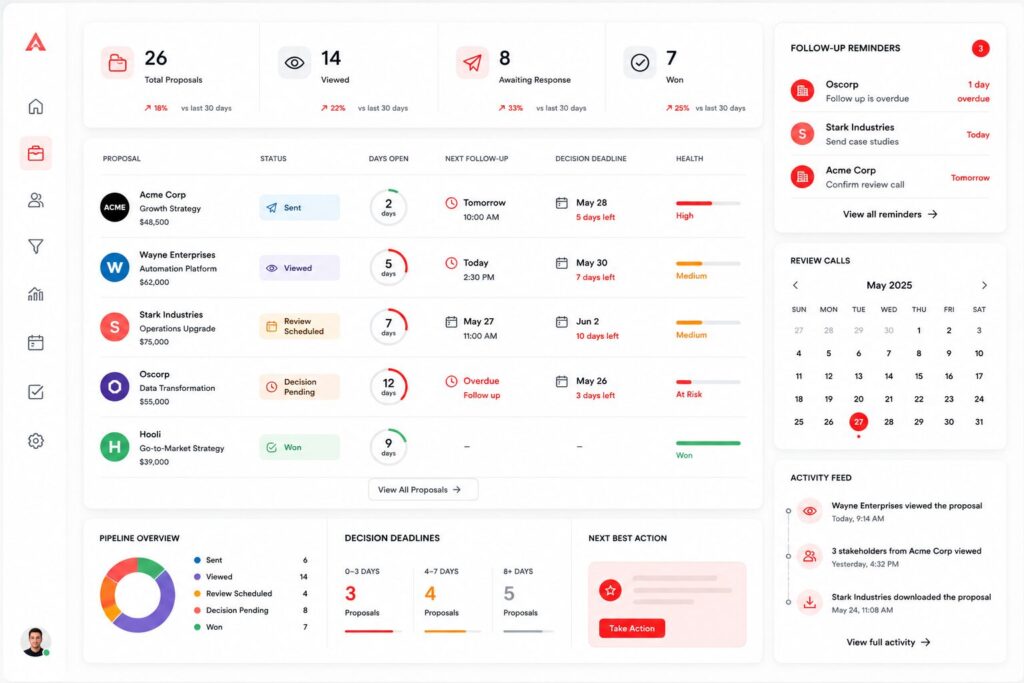
Most founders running a service business have no real-time view of their proposal pipeline. Proposals live in email threads. The status of each deal lives in memory. As a result, deals fall through the cracks not because of a lack of interest but because of a lack of structure.
A CRM with a defined proposal stage changes this completely. Every open proposal has a date, a status, and a next action. When a proposal has been open for seven days without a response, the system flags it. The founder does not have to remember. The process handles it.
4. No urgency mechanism that serves the prospect
Urgency is not pressure. Pressure is manufactured scarcity designed to force a decision. Urgency, on the other hand, is clarity about what happens if a decision is deferred.
Without a decision deadline, a clear start date, or an articulation of what delay costs the prospect, you give them every reason to defer. That is not a manipulation problem to fix. It is a structural gap to close.
A simple line in the proposal, such as ‘we are holding your project start date until the end of the week,’ is honest information. It respects the prospect’s time and yours
What A Strong B2B Proposal Follow-up System Actually Looks Like
This is not about sending more emails. It is about building a repeatable infrastructure that moves every deal forward or closes it out cleanly. The goal is for a process to run whether or not the founder is actively managing it.
First, agree on the next step before the proposal goes out. Lock a specific follow-up date on the call, not after it.
Second, send the proposal with a clear decision deadline and a one-paragraph summary of your discussion. The prospect should not have to re-read the full document to remember why they were interested.
Third, trigger an automated follow-up sequence the moment the proposal is sent. Day one, day three, and day seven touchpoints with distinct messages and distinct purposes.
Fourth, create a CRM pipeline stage specifically for open proposals. Any proposal remaining at that stage for more than 7 days without a status update triggers an alert.
Fifth, book the follow-up call in advance, before the proposal is sent. Do not request the call after silence. Schedule it while you still have the prospect’s attention.
This infrastructure separates a sales process from a sales habit. Habits depend on discipline. Infrastructure runs on its own.
Why This Matters More Than Refining Your B2B Proposal Format
Founders spend significant time refining proposal design, adjusting pricing structures, and polishing case study sections. That investment has real value. A proposal that communicates clearly and builds confidence is worth the effort.
That said, a mediocre proposal with a strong follow-up system will outperform a polished proposal sent into a void. According to Forrester Research, companies with a defined and consistently executed sales process see win rates improve by up to 28 percent compared to companies with inconsistent or informal processes.
The proposal is one asset in a process. The process determines whether the asset is used effectively.
Most founders already know which proposals are likely to close. They can feel it after the discovery call. The deals they lose are rarely the ones where interest was low. They are the ones where interest was genuine, but the process lacked the infrastructure to carry it through to a decision.
Want To Go Deeper?
How to Set Up a CRM That Actually Closes Deals
A practical guide to building a CRM pipeline that tracks every deal stage and stops proposals from falling through the cracks.
The Lead Response System: How to Go from 3 Hours to 12 Minutes
How faster response times at every stage of the sales cycle compound into significantly higher close rates.
Sales Playbook for Startups: The Essential Sections, Tools, and Templates That Actually Scale
Building a repeatable sales process that does not depend on the founder being in every conversation.
Final Thought
The deals that go silent after a proposal are not lost to better competitors or lower prices. In most cases, they are lost to process gaps that were never filled.
Every proposal that disappears into silence is data. It tells you that something in the sequence before or after the proposal is missing. Founders who treat that silence as a systems problem rather than a prospect problem are the ones who close more deals without sending more proposals.
If you want to know where your sales process is losing deals right now, the Digital Growth Audit gives you a clear picture in 90 minutes. It covers your pipeline, your follow-up infrastructure, and the specific points where revenue is leaking.

Creativz.io
Creativz.io is a digital growth consulting firm that builds revenue infrastructure for B2B founders scaling from $500K to $10M ARR. The team architects conversion systems, CRM pipelines, lead-nurture automation, and analytics infrastructure that turn website traffic into predictable revenue. Creativz has worked across construction, SaaS, fintech, B2B services, and logistics, with a focus on systems that scale without scaling headcount.
