
More than half of B2B marketers say creating content that prompts action is their top challenge. Nearly half admit their tech stack lacks proper lead-gen and nurture capabilities. And over half cannot attribute revenue to content or track the buyer journey. This data comes from the Content Marketing Institute’s 2025 B2B Benchmark Report.
The problem is not the quality of your writing. The problem is that your content has no system behind it.
Most businesses treat content like a publishing function. Write it. Post it. Move on. The result is a library full of articles that get traffic but generate zero pipeline.
According to Gartner, the average B2B buying group now includes 11 active members and cycles through multiple stages, often revisiting decisions. A single blog post is rarely a self-contained conversion event. It is one touch in a longer commercial sequence.
If that sequence is broken, no amount of great writing will save it.

What a B2B Content Pipeline Actually Means
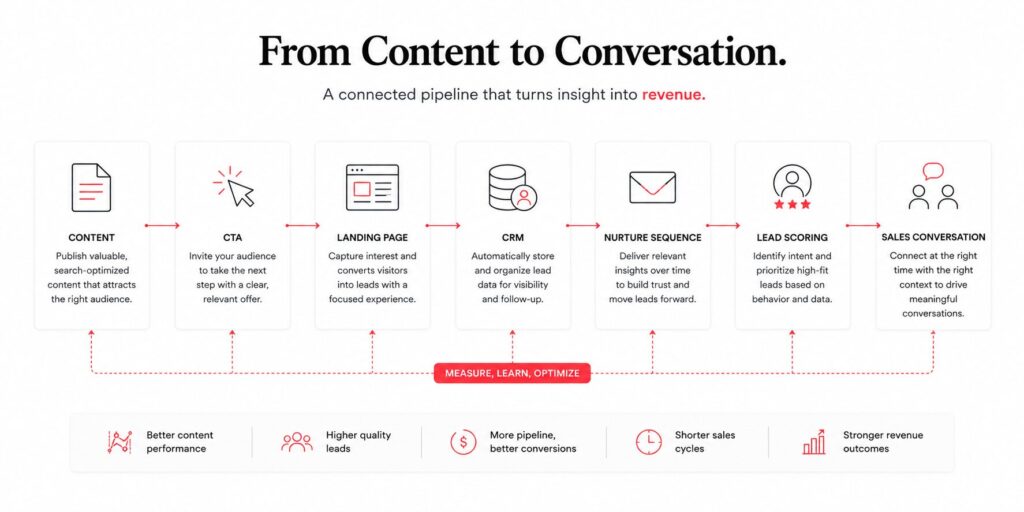
A B2B content pipeline is the path from a piece of content to a qualified sales opportunity.
It is not just content that ‘nurtures’ or ‘educates.’ It is a system where:
- Every post has a defined role in the buyer journey
- Every CTA leads to a continuity-driven next step
- Every form fill triggers a fast, relevant follow-up
- Every lead is tracked, scored, and handed to sales with full context
Most businesses have content. Almost none have this system. That gap is where the pipeline dies.
Why B2B Content Fails to Generate Pipeline: 5 System Breaks
The failure is not random. It happens in predictable places. Here are the five breaks that kill the B2B content pipeline before a single sales conversation starts.
Break 1: The Message-to-CTA Mismatch
Your article diagnoses a specific problem. Your CTA sends the reader to a generic homepage.
That is a context collapse. The reader was engaged. Your CTA broke the momentum.
Every piece of content needs a CTA that continues the exact conversation the article opened. Not a generic ‘Book a call.’ A specific, relevant next step tied to the pain the post addressed.
Example: A blog about slow lead response time should CTA to a ‘5-Minute Lead Response Checklist,’ not a homepage.
Break 2: A Post-Click Page That Loses the Thread
Even when the CTA is right, the landing page often resets to brand-level language.
The reader clicked because you made them feel seen. Then the page goes on to talk about ‘end-to-end digital solutions.’ They leave.
Post-click pages must mirror the specific pain the content addresses. Same vocabulary. Same problem frame. The only job of the page is to extend the problem and offer the next step.
Break 3: No Fast First-Touch After Form Fill
Harvard Business Review research shows that companies responding to online inquiries within an hour are 7x more likely to qualify a lead. Most B2B companies respond in 24 to 48 hours. Some never respond at all. That study on lead response time remains one of the most-cited findings in B2B sales, yet most teams still ignore it.
An automated first-touch that fires within five minutes, references the specific content the prospect engaged with, and offers a clear next step is not a nice-to-have. It is the difference between a warm lead and a cold trail.

Break 4: Nurture Sequences Disconnected from the Content Topic
A prospect reads your post on CRM setup problems. They fill out the form. They receive a generic welcome email about your company.
The nurture sequence has no idea why they showed up. It treats every lead the same.
Effective nurture is segmented by intent. The topic that brought someone in should drive everything that follows: the emails, the case studies, the offers. Relevance is what moves people to sales conversations.
Break 5: No Attribution, No Learning
If you cannot see which content is actually influencing the pipeline, you cannot improve.
Most teams measure what is easy: page views, email opens, and social impressions. Those numbers look good in reports. They have no relationship to revenue.
Real attribution tracks the full path: which post brought the lead, which touchpoints they engaged with, and what content they consumed before booking a call. Without that, you are optimizing for vanity while the system leaks.
Why This Matters for B2B Content Pipeline
Every break described above has a cost. Combined, they represent the bulk of what most companies consider ‘content not working.’
The real diagnosis: the content worked. The system failed after the click.
Key stat: CMI’s 2025 data show that 47% of B2B marketers say their stack lacks efficient lead-gen and nurture processes. That is a system problem, not a content quality problem.
Fixing these five breaks does not require a full martech overhaul. It requires a minimum viable pipeline architecture: one high-intent CTA, one continuity-driven landing page, one automated first-touch, one segmented nurture path, and one attribution layer in your CRM.
B2B Content Pipeline: Content-Only vs. Content-to-Pipeline System
| CONTENT-ONLY APPROACH | CONTENT-TO-PIPELINE SYSTEM |
| The blog gets traffic, zero leads | Every post feeds a defined conversion path |
| CTA links to the generic homepage | CTA links to a continuity-driven landing page |
| No follow-up after form fill | Automated first-touch within 5 minutes |
| Marketing and sales are siloed | CRM captures topic context from the first click |
| No attribution, no clarity | Full attribution dashboard, live data |
The Hidden Break: Context Loss After the Click
There is a sixth break most audits miss. It is the most expensive one.
Context loss happens when a prospect reads a specific, pain-focused article, clicks through, fills out a form, and then enters a system that knows nothing about why they came.
Marketing logged the lead source. But the CRM captured zero context about the problem the prospect was researching. Sales follows up with a generic intro. The lead goes cold.
Gartner’s research on the modern B2B buying journey makes this clear: marketing, sales development, and sales must work in parallel, not sequentially. That parallel motion is only possible if context travels with the lead from the first click to the first sales conversation.
The fix is simpler than most teams expect:
- Tags lead by the content topic that brought them in
- Pass that tag to the CRM on form fill
- Include the topic context in the sales handoff notification
- Let the sales rep open with the problem, not a cold introduction
One CRM field. Massive difference in conversion rates.
How to Build a B2B Content Pipeline That Actually Works
You do not need an enterprise martech stack. You need a connected operating system for your content.
Step 1: Audit Your Current Content-to-Pipeline Path
Pick your five most-trafficked blog posts. For each one, map:
- Where does the CTA go?
- What does the landing page say?
- What happens after the form is filled?
- What does the nurture sequence reference?
- Does the CRM capture the content source?
Most companies discover the path breaks at step two. That is where to start.
Step 2: Assign Every Post a Buyer Stage Role
Before publishing any piece of content, answer three questions:
- Who is the specific reader? (Title, company stage, pain point)
- What decision does this post help them make? (Not ‘educate’ — a specific decision)
- How will you know if it worked? (Demo requests, form fills, pipeline influenced)
If you cannot answer all three, the post is not ready.
Step 3: Build the Post-Click Path Before You Publish
Every post needs a defined path:
- A specific CTA tied to the article’s pain
- A landing page that continues the conversation
- An automated first-touch within five minutes of form fill
- A segmented nurture sequence based on the topic
- A CRM tag that travels with the lead
Build the system first. Then publish. Not the other way around.
Step 4: Add Attribution Before You Scale
Before you invest in more content, close the measurement loop.
Set up UTM parameters for every internal link. Connect your form tool to your CRM. Build one reporting view that shows the content source, pipeline stage, and closed revenue.
An imperfect attribution that you actually use beats a perfect system that sits unused.
Want to Go Deeper?
These posts cover the infrastructure behind a working B2B content pipeline:
- Speed to Lead: Why Your Lead Response Time Is Killing Your Close Rate Most founders know slow follow-up costs deals. This post shows exactly how much and what to automate first.
- CRM Setup for Startups: The Foundation Every Scaling Business Needs If your CRM is not capturing lead source and content context, your pipeline data is incomplete. Start here.
- Marketing Attribution for Founders: How to Know What Is Actually Working A practical guide to connecting content spend to revenue without a dedicated data team.
Frequently Asked Questions About B2B Content Pipeline
Why does my B2B content get engagement but no leads?
Engagement and pipeline are measured differently. Likes and shares signal that your content resonated. Leads require a connected system after the click: a relevant CTA, a continuity-driven landing page, a fast first-touch, and a nurture path tied to the topic. Most content stops at the publish step. The pipeline system is what comes after.
How do I know if content is influencing my pipeline?
You need attribution at the source level, not just the channel level. Set up UTM parameters on every internal CTA. Connect your form tool to your CRM so each submission captures the originating post. Build one reporting view that tracks from content source to pipeline stage to closed revenue. The imperfect attribution you actually use is better than a perfect system that no one checks.
Do I need a full martech stack to turn blog traffic into leads?
No. The minimum viable setup consists of five pieces: one specific CTA per post, one landing page that mirrors the post’s pain point, one automated email that fires within five minutes of form fill, one short nurture sequence segmented by topic, and one CRM field that captures the content source. You can run this on HubSpot, ActiveCampaign, or a similar mid-market tool. The architecture matters more than the software.
What should happen after someone clicks a blog CTA?
Three things in order. First, they land on a page that continues the exact conversation the post opened, not a generic services page. Second, after they fill out the form, an automated message goes out within five minutes that references the specific topic they engaged with. Third, the lead enters a nurture sequence relevant to that topic, and the CRM logs the content source so sales have context before the first conversation.
Final Thought
Your content is not the problem. The architecture between your content and your pipeline is.
Most B2B businesses have invested years in creating posts, videos, and guides. Almost none have built the five-layer system that connects that content to revenue. The result is a well-stocked library and an empty pipeline.
The businesses pulling ahead right now are not publishing more. They are building the operating system that makes every piece of content they already have work.
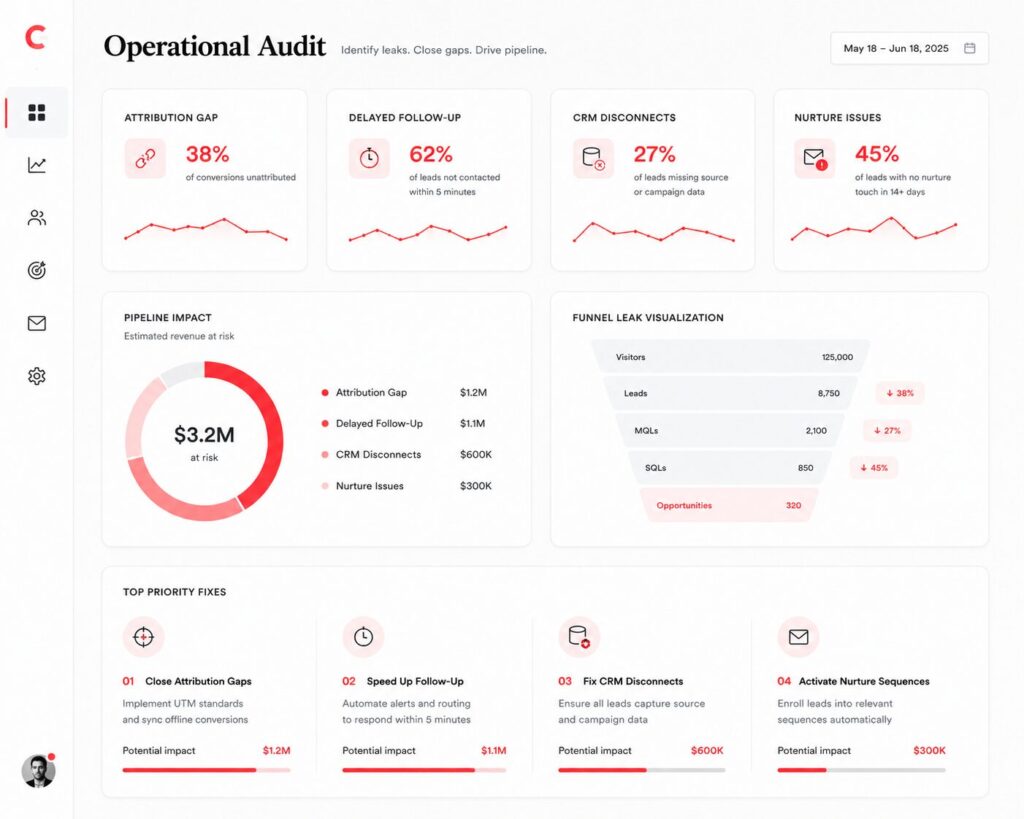
Ready to find the breaks in your system? The Creativz Digital Growth Audit maps your full content-to-pipeline path and identifies exactly where revenue is leaking.
Not sure where to start? Run your Revenue System Scorecard first. It takes 5 minutes and gives you a scored view across six categories, including funnel performance, CRM health, and marketing automation. You will know exactly which layer to fix first.
