
Your Sales Team Is Treating Every Lead the Same. That Is Why the Pipeline Feels Random
Last month, your sales team received 40 leads and worked through them in the order they arrived. The first 12 received same-day follow-up. However, the rest waited 2 to 4 days. During that delay, three of those leads were ready to buy, and two signed with a competitor that responded faster.
This is what happens without lead scoring for startups. When every lead looks the same, teams work by arrival order rather than buying intent. As a result, ready buyers wait while colder prospects get priority.
In this blog, you will learn:
- The key benefits of lead scoring for startup sales teams
- How to implement lead scoring in a small startup without a data engineer
- How to set up a basic lead scoring system step by step
- A tool-by-tool comparison of the best lead scoring software for startups with CRM integration
- Which free and affordable options work at the early stage
Benefits of Lead Scoring for Startup Sales Teams
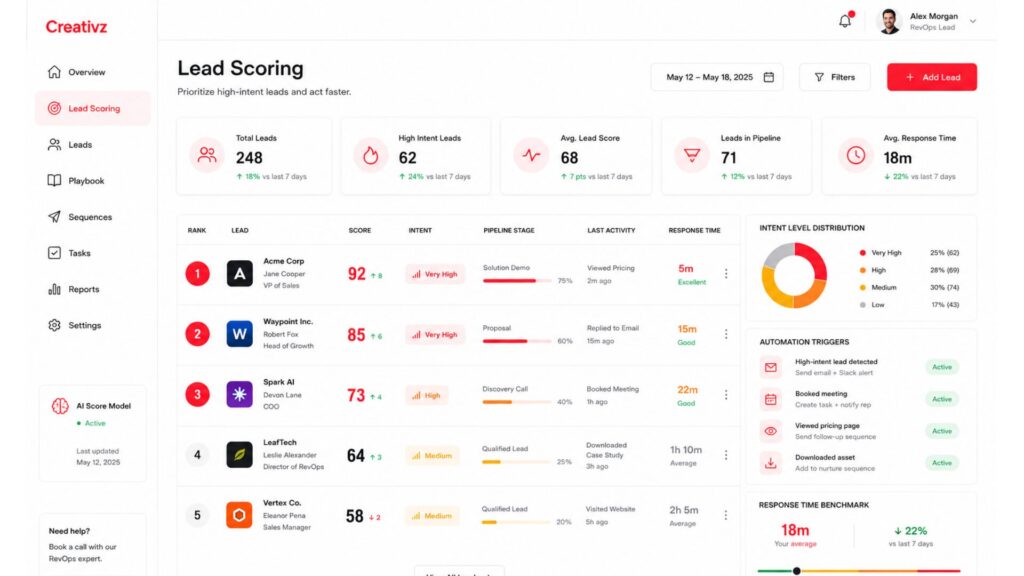
Your team focuses on the right people at the right time
Without lead scoring, reps spend the same amount of time on a lead who downloaded a checklist six months ago as on a lead who visited the pricing page twice today. Lead scoring separates those leads and routes them accordingly. As a result, high-intent prospects do not wait behind colder ones.
Response time improves where it matters most
High-scoring leads trigger immediate human follow-up, while low-scoring leads move into automated nurture sequences. As a result, the team spends more time on leads most likely to convert rather than on those who simply arrived first.
Pipeline data becomes meaningful
CRM carries a score; the pipeline no longer looks like a flat list of names. Instead, it becomes a ranked view of buying intent. Because the data reflects real signals rather than raw volume, leadership can forecast with more confidence.
Revenue becomes more predictable
According to Forrester Research, companies that excel at lead nurturing generate 50% more sales-ready leads at 33% lower cost. For a startup investing in paid acquisition, that gap compounds quickly.
Rep onboarding becomes faster
CRM shows new reps exactly who to call first on day one. Rather than relying on months of institutional knowledge, they can use the lead scoring system to prioritize from the start.
Companies using lead scoring see a 77% higher lead generation ROI, according to MarketingSherpa’s 2012 B2B Lead Generation Benchmark Report.
What Lead Scoring for Startups Actually Is
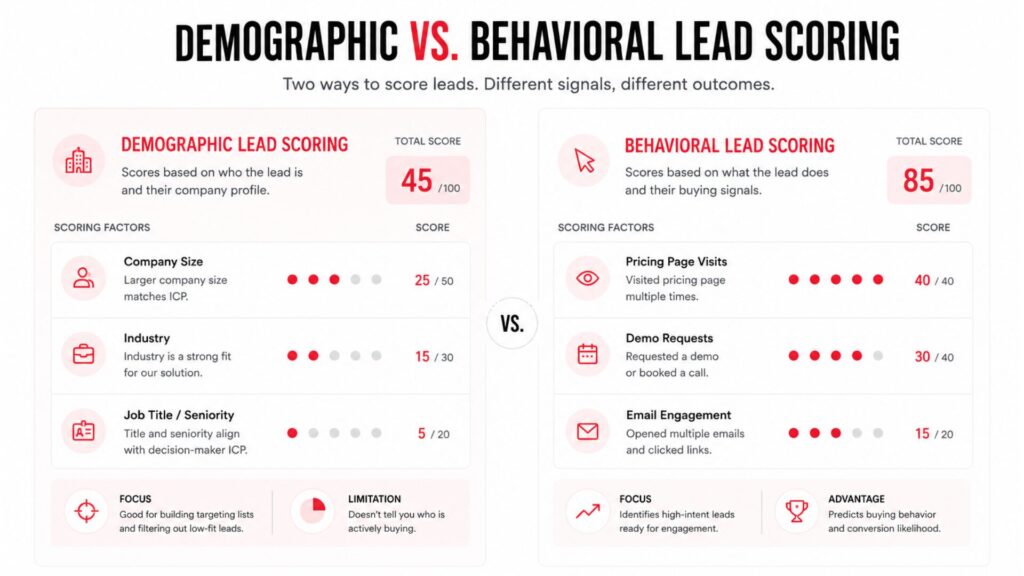
Lead scoring assigns a numerical value to each lead based on characteristics and behaviors that predict the likelihood of purchase. As a result, higher scores signal stronger buying intent and trigger the right follow-up action.
In practice, two types of signals shape a lead score. Both matter because most startups track only one.
Demographic Signals: Does This Lead Fit Your Profile?
Demographic signals include company size, industry, job title, geography, and annual revenue. Together, they show whether the lead matches your ideal customer profile on paper. However, a strong demographic match alone does not mean the lead is ready to buy.
Behavioral Signals: Is This Lead Actually Evaluating You?
Behavioral signals include pages visited, content downloaded, email opens, pricing page views, demo requests, and webinar attendance. Because these actions reflect active research, they often predict near-term conversion more accurately.
The best scores come from a combination of both signals: the right profile and the right behavior. If you rely on only one signal, your routing logic will miss important context.
How to Set Up a Basic Lead Scoring System for Startups
This is the step most founders skip. Instead of building scoring logic first, they buy a tool and try to reverse-engineer the model into it. However, the five steps below work with almost any CRM.
Step 1: Define your ideal customer profile in scoring terms
Before you assign any points, document the characteristics of your best-fit customers. Company size, industry, job title, geography, and annual revenue range all belong here. A lead that matches all five gets the maximum demographic score, while a lead that matches two gets a partial score.
Step 2: Identify your highest-intent behavioral signals
Look at your last ten closed deals. What did those leads do before they converted? Which pages did they visit? What content did they download? How many emails did they open before booking a call? These behaviors are your strongest conversion predictors, so they deserve the highest behavioral scores.
Step 3: Build the scoring matrix
Assign point values to each signal. The exact numbers matter less than the relative weighting. For example, a visit to a pricing page should score higher than reading a blog post. Likewise, a demo request should score higher than a visit to a pricing page.
A structure that works for most early-stage startups:
- Demographic fit: up to 50 points total
- Behavioral signals: up to 50 points total
- Maximum possible score: 100
Step 4: Define your score thresholds
Three tiers work well at the startup stage:
- Hot leads (70 to 100): Immediate human follow-up within 5 minutes
- Warm leads (40 to 69): Personalized automated email, then rep outreach within 24 hours
- Cold leads (under 40): Long-term nurture sequence, no immediate rep involvement
Step 5: Implement in your CRM and test
Configure the scoring rules in your CRM. Then run the model against your last 30 leads and check whether the scores match your intuition. If they do not, adjust the weights. Then recalibrate every 90 days as your data grows.
Read more on How to Set Up a CRM That Actually Closes Deals

Best Lead Scoring Tools with CRM Integration for Startups
These five tools cover the full spectrum, from free manual models to AI-powered enterprise scoring. Choose based on your current stage, not where you plan to be in three years.
HubSpot (Free with paid tiers starting around $45–$50/month per user)
HubSpot is one of the strongest entry-level options for startups. Its free CRM includes basic lead scoring. In addition, the Starter plan adds behavioral scoring based on email opens, page visits, and form submissions. Learn more at HubSpot’s lead scoring documentation.
- Best for: Startups already on HubSpot CRM that want scoring without adding a new tool
Pipedrive with LeadBooster (~$32.50–$39/month per company)
Pipedrive includes basic lead scoring in its CRM, but it pairs especially well with LeadBooster for stronger lead capture and qualification workflows. For deeper behavioral scoring (email opens, page visits, form submissions), many teams connect Pipedrive to a marketing automation tool such as ActiveCampaign.
- Best for: Startups that prefer Pipedrive’s visual pipeline and want to extend scoring with integrations.
ActiveCampaign ($29/month and up, depending on contacts)
ActiveCampaign includes strong behavioral scoring in its email marketing and CRM platform. It scores leads based on email engagement, site tracking, and custom events, and those scores live directly in the CRM so automations can trigger based on them.
- Best for: Startups running email‑heavy nurture sequences that want scoring to trigger automations.
Salesforce with Einstein Lead Scoring (Sales Cloud Enterprise or Unlimited, typically $150+/user/month with Einstein add‑ons)
Salesforce is the enterprise standard. Einstein uses AI to score leads based on historical conversion patterns. It may be too much for most startups under $1M, but it makes sense if you expect rapid growth and plan to stay on Salesforce long term.
- Best for: Startups already on Salesforce with enough historical deal data for AI scoring to be reliable.
Google Sheets plus GA4 (Free)
You can also build a manual scoring sheet and update it weekly with GA4 behavioral data and CRM demographic data. This approach will not scale past 50 leads per month, but it works as a practical starting point while you validate your model.
- Best for: Very early-stage companies that want to validate scoring logic before committing to a paid tool
Tool Comparison: Lead Scoring Software for Startups
| Tool | Starting Cost | Native Scoring | Behavioral Scoring | Best For |
| HubSpot | Free with paid tiers starting around $45–$50/month per user | Yes | Yes (Starter+) | Startups already on HubSpot CRM |
| Pipedrive + LeadBooster | ~$32.50–$39/month per company | No (via integrations) | Via ActiveCampaign | Visual pipeline fans who use integrations |
| ActiveCampaign | $29/month and up, depending on contacts | Yes | Yes (email + site) | Email-heavy nurture sequences |
| Salesforce + Einstein | $29/month and up, depending on contacts | Yes (AI-powered) | Yes | Startups on fast growth trajectory |
| Google Sheets + GA4 | Free | Manual | Manual (GA4 import) | Pre-tool validation stage |
The 4 Most Common Lead Scoring Mistakes in Startups
Even with the right tool and a solid scoring matrix, most startups stumble during execution. These four mistakes cause most scoring implementations to fail.
Mistake 1: Scoring on demographics only
A lead may fit your ICP perfectly and still not be a hot lead. If that lead has never visited your website, demographic fit alone is not enough. You need both fit and behavior.
Mistake 2: Never recalibrating the model
A scoring model built on 30 leads six months ago may no longer reflect current buyer behavior. As your pipeline grows, the signals that predict conversion change. Therefore, review and update the weights every 90 days using actual conversion data.
Mistake 3: Setting thresholds too high
If you set the hot lead threshold at 90 and only 2% of leads ever reach that threshold, the system will not route anyone for immediate follow-up. Instead of over-engineering the top tier, start with thresholds that create a realistic distribution—roughly 20% hot, 30% warm, and 50% cold. Then adjust from there.
Mistake 4: Scoring without connecting to automation
A score in the CRM is of little use if a human still has to check it manually. Instead, make the score trigger automatic routing the moment it crosses a threshold. That could mean an assignment rule, a notification, or a first-touch email. Without that automation layer, the scoring model becomes a number that nobody uses. Read more on: Why Fast Response Time Wins More Deals Than Better Marketing
No Scoring System vs. Lead Scoring System: Side by Side
| No Scoring System | With Lead Scoring | |
| Lead Prioritization | Arrival order: first in, first called | Score-ranked, highest intent first |
| Rep Time Allocation | Spread evenly across all 60 leads | Concentrated on top 20% by intent |
| Response Time | 4+ hours average across all leads | Under 5 min for hot leads, automated for warm |
| Pipeline Accuracy | Volume-based, headcount, not signal | Intent-based, reflects real buying behavior |
| New Rep Onboarding | 6 months to learn who to prioritize | Day-one clarity from scored CRM |
| Revenue Predictability | Unpredictable close rates | 31% improvement in 90 days |
FAQ: Lead Scoring for Startups
What is lead scoring for startups?
Lead scoring for startups assigns numerical values to leads based on how well they match your ideal customer profile and how actively they engage with your product or content. It helps your sales team decide who to call first, who to nurture, and who to deprioritize.
What are the key benefits of lead scoring for early-stage companies?
The main benefits include faster response times for high-intent leads, better allocation of rep time, more predictable close rates, and a CRM that reflects real buying behavior rather than raw lead volume.
How do I implement lead scoring in a small startup?
Start by defining your ICP in scoring terms. Next, identify your highest-intent behavioral signals from past closed deals. Then build a simple scoring matrix with 50 points for demographic fit and 50 points for behavior, set thresholds for hot, warm, and cold leads, and configure the rules in your CRM. Recalibrate every 90 days.
How do I set up a basic lead scoring system for a new business?
The fastest path: start with a Google Sheets model using GA4 data to validate your scoring logic, then migrate to HubSpot or ActiveCampaign once you have 30 to 50 leads worth of data to calibrate against.
What are the best lead scoring tools with CRM integration for startups?
The fastest path is to start with a Google Sheets model that uses GA4 data to validate your scoring logic. Then migrate to HubSpot or ActiveCampaign once you have 30 to 50 leads of data to calibrate against.
What free or affordable lead scoring solutions work for early-stage companies?
HubSpot’s free CRM includes basic scoring. Google Sheets paired with GA4 is fully free and works until you exceed roughly 50 leads per month. ActiveCampaign starts at $29/month and covers most behavioral scoring needs for early-stage teams.
What is the difference between demographic and behavioral lead scoring?
Demographic scoring measures whether a lead fits your ideal customer profile, including company size, industry, title, and geography. Behavioral scoring measures whether a lead is actively evaluating your solution through actions like page visits, email opens, and demo requests. High-converting leads usually score well on both dimensions.
Want to Go Deeper?
These three posts cover the adjacent systems that make lead scoring work. Read them in order if you are building your revenue infrastructure from scratch.
How to Set Up a CRM That Actually Closes Deals (For Founders Scaling Past $1M) — Your scoring model is only as good as the CRM it runs in. This post walks through the exact setup that supports scoring rules, pipeline automation, and lead routing without a Salesforce-level budget.
Why Fast Response Time Wins More Deals Than Better Marketing — Lead scoring tells you who to prioritize. This post explains what happens if the response that follows is slow. The data on response time decay is the single most important reason to connect scoring to automation.
Founder-Led Sales to Scalable Revenue System: The 4-Stage Transition — Lead scoring is one of the first systems that allows founders to step back from every sales conversation. This post maps the full transition from founder-led to system-led revenue.
Final Thought
Lead scoring is not a complexity you add when you are ready. It is the infrastructure you build to stop losing deals you already earned.
The leads are there. The team is there. However, most startups lack a system that connects the two based on intent rather than arrival order.
You do not need a data engineer or a six-figure CRM implementation. Instead, you need a two-dimensional scoring matrix, three score thresholds, and automation that acts the moment a lead crosses one.
Ready to see where your revenue is leaking before a scored lead even reaches a rep?
Not ready for a call yet? Run your Revenue System Scorecard. The CRM Health section covers lead scoring directly and gives you a diagnostic score across six revenue categories in under 10 minutes.
