
Sales Playbook for Startups: The Essential Sections, Tools, and Templates That Actually Scale
You hire a sales rep, show them the product, introduce a few prospects, and point them at the CRM. Then you wish them luck.
Three months later, they close half as many deals as you expected.
It looks like a hiring problem. In reality, it is a documentation problem.
You never wrote down your discovery questions, objection responses, proof points, or follow-up cadence, so your rep had nothing to replicate.
A sales playbook solves this. This post covers what to include, which sections matter most for early-stage B2B startups, and the tools that make it simple to build and use your playbook.
You will learn:
- What a sales playbook is,
- Why it matters for startups,
- The essential sections to include,
- How to build one step by step,
- What each section looks like,
- The best tools for small teams,
- Where to find free templates

What Is a Sales Playbook for Startups and Why Does It Matter
A sales playbook is a documented guide to how your company sells. It covers your ideal customer profile, sales process stages, discovery questions, objection responses, email sequences, proof points, and closing techniques. In short, it is the manual that lets any trained rep sell like your best rep.
For early-stage startups, the playbook does more than train reps. It gets the founder’s knowledge out of their head and into a format the team can use, scale, and improve. Without it, every new hire starts from scratch. With it, every hire starts from the founder’s best day.
The data backs this up. According to Sales Enablement PRO, organizations with a formal sales playbook achieve 33% higher quota attainment than those without. CSO Insights found that companies with dynamic sales playbooks experience 15.9% higher win rates.
The playbook is not optional. It drives revenue.
If you are still the primary closer in your business, read this first: Founder-Led Sales to Scalable Revenue System: The 4-Stage Transition.
The Essential Sections of a Sales Playbook for a New B2B Startup
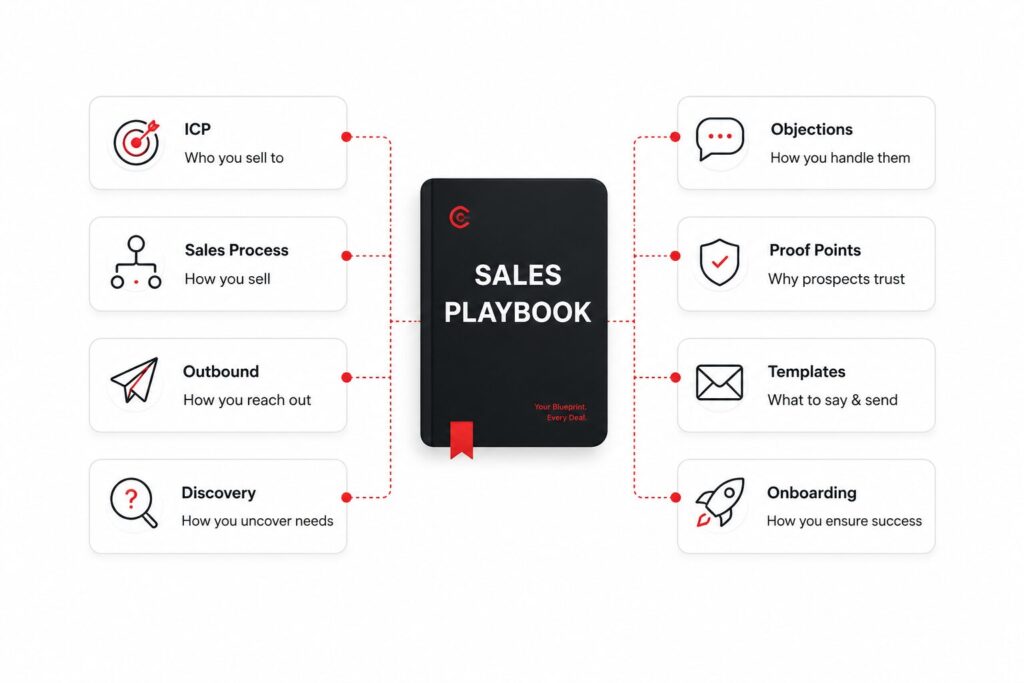
Most founders start with email templates and skip the foundation. The sections below follow a logical dependency order. Each one builds on the last. If you skip one, the system breaks.
Ideal Customer Profile
Who you sell to. This means company size, industry, geography, annual revenue range, tech stack signals, and buying triggers. Include both firmographic criteria and the specific pain points that indicate fit. One page maximum.
Have your rep read this before every prospecting session. If your ICP is wrong or vague, your team misses discovery questions, and your proof stories fall flat. Spend more time on this section than on any other.
The Sales Process
List every stage from first touch to closed deal. Define what happens at each stage, who owns it, and what must be true to move forward. Include exit criteria for each stage, not just stage names.
This maps directly to your CRM pipeline, so the playbook and the system are aligned. For a full walkthrough on pipeline setup, see: How to Set Up a CRM That Actually Closes Deals.
Prospecting and Outbound Sequence
Document your cold outreach structure: subject line formula, opening line, value proposition, proof point, and call to action. Also include the follow-up cadence—how many messages, at what intervals, and what each one says.
Most founders never write this section, but every sales rep needs it the most.
Discovery Call Framework
This is not a rigid script. Document the structure: the opening question that gets prospects talking, three to four follow-up questions to surface real pain, and the transition from exploration to solution.
Include example answers so reps know what a good response looks and sounds like—not just what to ask.
Objection Response Library
Every objection the founder has ever handled and the exact response that moved the deal forward. For example:
- “We already have a CRM.”
- “We cannot afford this right now.”
- “We need to involve the rest of the team.”
- “We tried something like this before.”
Document a response and follow-up question for each objection. This section takes the most work but delivers the fastest improvement for your reps.
Proof Archive
Document the three client stories that close deals most often. Structure each as situation, problem, solution, and result. Include specific numbers: time saved, revenue recovered, efficiency gained, payback period.
For example, a construction firm we worked with recovered $2M in operational savings in 8 weeks. That single story, when documented well, closes more deals than any feature list.
Email Templates and Follow-Up Sequences
Every email the rep will ever need:
- First touch after a form submission
- Follow-up after a discovery call
- Proposal sent and post-demo follow-up
- Re-engagement for cold leads
- Breakup email
Speed matters. The first-touch email only works if it goes out within 5 minutes of intent.
For the system that makes that happen automatically, read: Why Fast Response Time Wins More Deals Than Better Marketing.
Competitive Positioning
Show how your offer compares to what prospects are considering. Focus on when you are the right choice and when you are not, rather than on negative comparisons.
Reps who disqualify honestly build more trust than those who oversell.
Onboarding and Success Metrics
Document what happens after the deal closes: the first 30 days for the client, who owns each step, and what the rep should communicate during handoff. Without this, the gap between sales and delivery quickly hurts retention.
This is also where most new sales hires fail—not because of a lack of skill, but because of a lack of structure. See: Why Great Hires Fail in Growing Companies (And It’s Not a Talent Problem).
How to Create a Sales Playbook for an Early-Stage Startup: Step by Step
Step 1: Record Every Sales Call for 30 Days Before You Write Anything
Use Gong. Chorus or Fathom. Do not write from memory. Recordings reveal patterns you do not notice: the questions that always work, the objections that always come up, and the proof points that close deals. Start with data, not recollection.
Step 2: Write the ICP First
Everything in the playbook starts with knowing exactly who you are selling to. A vague ICP leads to a vague playbook. Once you define your ICP, use lead scoring to apply it in the CRM.
For how to build that response system once your ICP is locked: The Lead Response System: How to Go from 3 Hours to 12 Minutes

Step 3: Document the Outbound Sequence Second
This is the section reps need on day one. Before they can have a discovery call, they need to book one. Give them a tested sequence they can run immediately rather than asking them to build their own from scratch.
Step 4: Fill the Objection Library from Recordings
Review 10 to 20 recorded calls and log every objection. Write down the founder’s response and rate how well it moved the deal forward. Keep the responses that worked. Cut the rest.
Step 5: Test the Playbook Before Hiring Into It
Ask someone who was not on the sales calls to read the playbook and run a mock discovery call. If they cannot, the playbook is not complete. Fill the gaps before your new rep starts.
Step 6: Treat the Playbook as a Living Document
Review the playbook every 90 days. DDS’s new objections as they come up. Update proof stories with new results. Retire email templates that stop working. If you do not update the playbook, it will become outdated quickly.
Best Digital Sales Playbook Tools for Startups
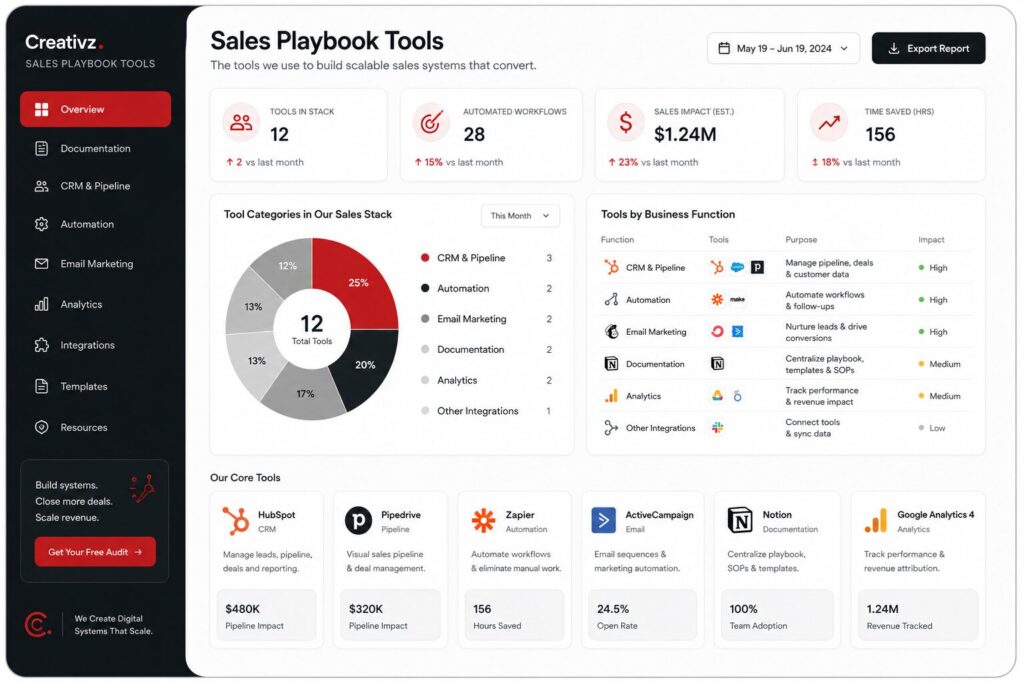
These are not recommendations from a vendor list. They reflect what works at different stages of growth.
Lightweight Options: Start Here
Google Docs (Free)
For early-stage startups, a structured Google Doc with section headers and shared access is a solid starting point. Focus on capturing knowledge before worrying about format. Do not let the lack of software stop you from starting.
Best for: founders in the documentation phase who are not yet ready to invest in dedicated tooling.
Notion (Free to $8/user/month)
Notion is the most common playbook tool for early-stage startups. It is flexible enough for every section and easy to search during calls. It also integrates with Slack, so reps can access the playbook without switching context.
Best for: startups that want a lightweight, searchable playbook without having to invest in dedicated sales enablement software.
Advanced Tools: When You Are Ready to Scale
HubSpot Sales Hub ($45/month)
HubSpot’s playbook feature surfaces inside CRM records during active deals. As a result, reps see relevant questions, objections, and talk tracks directly inside the deal view without switching tools.
Best for: startups already on HubSpot who want the playbook embedded in the CRM workflow.
Gong (Custom Pricing)
Gong is not a traditional playbook tool, but it is the most important input for building one. Gong records, transcribes, and analyzes every sales call, surfacing patterns like common objections, winning talk tracks, and moments that lead to closed deals. It turns your call history into playbook material.
Best for: any startup that wants to build a playbook based on real call data rather than memory.
Highspot (Custom Pricing)
Highspot is enterprise-grade sales enablement. It tracks which playbook content reps use and connects usage to win rates. It is overkill under $3M ARR and only worth planning for if you are scaling quickly toward Series A.
Best for: Series A and beyond with dedicated sales enablement investment.
Examples of Successful Startup Sales Playbooks in the Tech Industry
Salesforce: The Simplest Framework That Scaled
Marc Benioff built the first Salesforce playbook around one core framework: the discovery call structure that identified the prospect’s current CRM cost and projected the ROI of switching. As a result, every rep ran the same calculation in every call.
That consistency made scaling possible. In the early stage, a simple repeatable framework always beats a complex custom approach.
HubSpot: PIN Selling at Scale
In its early growth stage, HubSpot standardized its discovery calls around the SPIN model: Situation, Problem, Implication, and Need Payoff. HubSpot trained every rep on the same four-question framework.
Consistency improved win rates because it generated data the team could analyze and use to improve, not because the questions were magic. Documentation enables iteration.
Creativz.io Client Proof Story
A SaaS founder at $750K ARR. Three reps hired in 18 months. All three underperformed. The instinct was to blame hiring.
That was not the problem. The problem was documentation.
After Creativz conducted a sales playbook audit, the findings were clear: the founder had never documented the discovery framework, objection responses, or the follow-up sequence. All three lived in the founder’s head.
We built the full playbook in four weeks from 30 days of recorded calls.
The fourth rep joined the documented system and closed six deals independently in the first month. By month three, they exceeded the founder’s own close rate from the previous year. Same leads, same product, same price—just better infrastructure.
No Playbook vs. Documented Sales Playbook: Side by Side
| Factor | No Playbook | With a Sales Playbook |
| Rep Onboarding Time | 3 to 6 months | 3 to 6 weeks |
| Discovery Call Consistency | Varies by rep | Standardized across team |
| Objection Handling | Improvised | Documented and tested |
| Follow-Up Reliability | Inconsistent | Sequenced and tracked |
| New Hire Ramp Time | Slow and expensive | Faster and measurable |
| Revenue Predictability | Low | High |
The Sales Playbook Is One Piece. Here Is the Full System.
You now have the foundation, documented sales knowledge, and your reps can actually use. But a document does not close deals on its own. The next step is to build it into a system that runs without you.
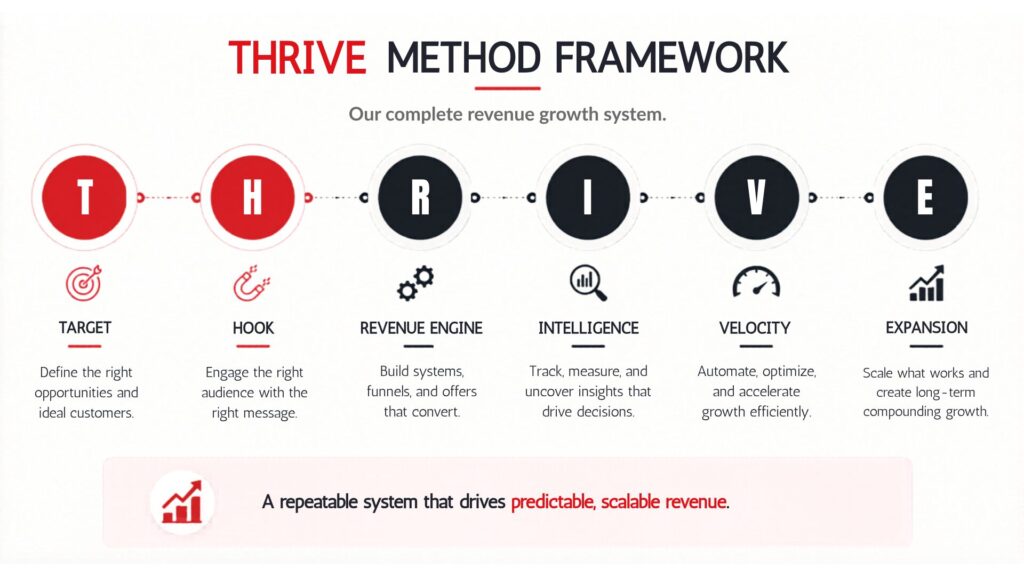
That is exactly what we build at Creativz through the THRIVE Method, our six-phase framework for turning scaling businesses from manual and chaotic to automated and predictable.
T — Target: Audit your full revenue system. Find where the money is leaking before building anything.
H — Hook: Build the messaging and lead capture infrastructure that attracts the right clients on autopilot.
R — Revenue Engine: Custom-build the automation layer—CRM flows, nurture sequences, pipelines, and dashboards.
I — Intelligence: Connect every touchpoint to real data so you stop guessing where your best ROI comes from.
V — Velocity: Compress your sales cycle with automated follow-up, instant lead response, and streamlined proposals.
E — Expansion: Systematize retention and upsell to build recurring revenue that protects and scales the business.
Your sales playbook is what makes V and R work. Without documented sales knowledge, there is nothing to automate. With it, the system has something real to run on.
If you want to see how your current revenue setup holds up across all six phases, the Digital Growth Audit is for that.
Want to Go Deeper?
The playbook gives you the foundation. These three posts cover the systems that sit directly above it. Pick the one that matches where you are right now.
The playbook is where you document what you know. This post covers how to hand it off. The exact four stages every founder goes through when moving from closing every deal themselves to running a repeatable sales system.
A sales playbook tells your reps what to do. A properly configured CRM makes sure they do it. This post walks through pipeline setup, stage criteria, and the automations that keep deals from falling through the cracks.
Your outbound sequence and follow-up templates are only as effective as your response speed. This post shows why the first 5 minutes after a lead signal are worth more than any email copy you will ever write and how to automate that window.
Frequently Ask Question
What is a sales playbook for startups?
A sales playbook is a documented guide that captures how a startup sells. It includes the ideal customer profile, sales process stages, discovery call questions, objection responses, email templates, proof stories, and closing techniques. It allows any trained rep to sell the way the company’s best rep sells.
What are the essential sections of a sales playbook for a new B2B startup?
The nine essential sections are: ideal customer profile, sales process stages, outbound sequence, discovery call framework, objection response library, proof archive, email templates, competitive positioning, and onboarding metrics. Each section informs the next.
How do I create a sales playbook for an early-stage startup?
Start by recording every sales call for 30 days. Write the ICP first. Document the outbound sequence second. Fill the objection library from recordings. Test the playbook with someone who is not on those calls. Review and update every 90 days.
What are the best digital sales playbook tools for startups?
Notion for lightweight documentation. HubSpot Sales Hub for CRM-embedded playbooks. Gong for building from recorded call data. Google Docs for founders in the early documentation phase—Highspot for Series A and beyond.
Where can I find free customizable sales playbook templates?
Creativz provides a sales playbook framework as part of the Digital Growth Audit. The sales infrastructure section of the Revenue System Scorecard also reveals which playbook sections are missing in your current setup.
How do I build a scalable sales process for a high-growth tech startup?
Document the process the founder uses before hiring into it. Use recorded call data to build the objection library and discovery framework. Align the playbook with your CRM pipeline stages. Test before hiring. Update every quarter.
How long does it take to build a sales playbook from scratch?
With 30 days of recorded calls and dedicated focus, a full playbook takes two to four weeks to build. Creativz builds the complete framework with founders during a single structured audit session.
Final Thought
Most founders who underperform in sales are not bad at selling. They never built the infrastructure that makes selling repeatable.
The playbook is where that infrastructure starts. It gets knowledge out of your head, gives your reps something to execute, and creates the foundation on which every downstream automated system depends.
But it is still just the foundation. What sits above it, including the automation, the attribution, the velocity, and the expansion, turns a documented sales process into a revenue machine that runs without you.
That is the gap where most founders are stuck right now. They have the knowledge, but they never wired it into a system.
If you want to know exactly where your revenue system breaks down across all six phases, the Digital Growth Audit is built for that. You will get a clear look at what is working, what is leaking, and what to fix first, with no pitch and no deck.
Not ready for a call yet? Run your current setup through the Revenue System Scorecard first. The sales infrastructure section will show you exactly where the gaps are before we ever speak.
