
Founders often focus on the wrong part of the growth process. A landing page is rarely the real reason leads go cold. In most cases, the real issue is the broken follow-up system behind the page.
Landing page growth hacking used to produce strong results because simple changes often improved conversions. Teams could run an A/B test, adjust the button color, rewrite the headline, and see measurable gains.
That approach made sense in 2014, when buyers were less skeptical, competition was lighter, and a sharper message could create a clear advantage.
In 2026, the same approach often hurts revenue because it focuses attention on surface-level improvements instead of the systems that actually move leads toward a sale.
The problem is not optimization itself. The problem is that many founders are optimizing the wrong area. They test button colors while new leads sit untouched in a CRM, rewrite headlines while follow-up emails are delayed by three days, and hire conversion consultants while the entire sales process still depends on manual effort.
In this blog, we explain why landing page growth hacking is no longer enough, where revenue is actually being lost, and what scaling founders should build instead.

What Growth Hacking Actually Promised
Growth hacking was built on a straightforward premise: find the fastest and most cost-effective path from traffic to conversion, optimize that path aggressively, and then scale what works.
In its early stage, this approach produced real results. Companies such as Dropbox and Airbnb grew quickly by building referral loops, distribution mechanisms, and platform integrations that created compounding growth. These were system-level advantages, not superficial changes to headlines or button colors.
Over time, however, the tactics were copied more widely than the thinking behind them. By the time growth hacking became a formal job title, much of its original logic had already been reduced to a checklist of isolated conversion tweaks.
As a result, many founders inherited the tactics without understanding the strategic principle underneath them. When growth hacking worked at its best, it was never really about finding a better headline. It was about designing a stronger system that could acquire, qualify, and convert demand more effectively.
Why It Stopped Working
Three major shifts made landing page growth hacking a far less reliable strategy.
First, buyers became more skeptical. Tactics that felt novel in 2013 now come across as manipulative, especially in B2B markets. Countdown timers, artificial scarcity, and aggressive pop-ups are more likely to erode trust than increase conversions.
Second, markets became more crowded. Nearly every competitor now runs A/B tests, uses clear calls to action, and follows standard conversion best practices. Once optimization became standard across the market, it stopped being a meaningful advantage.
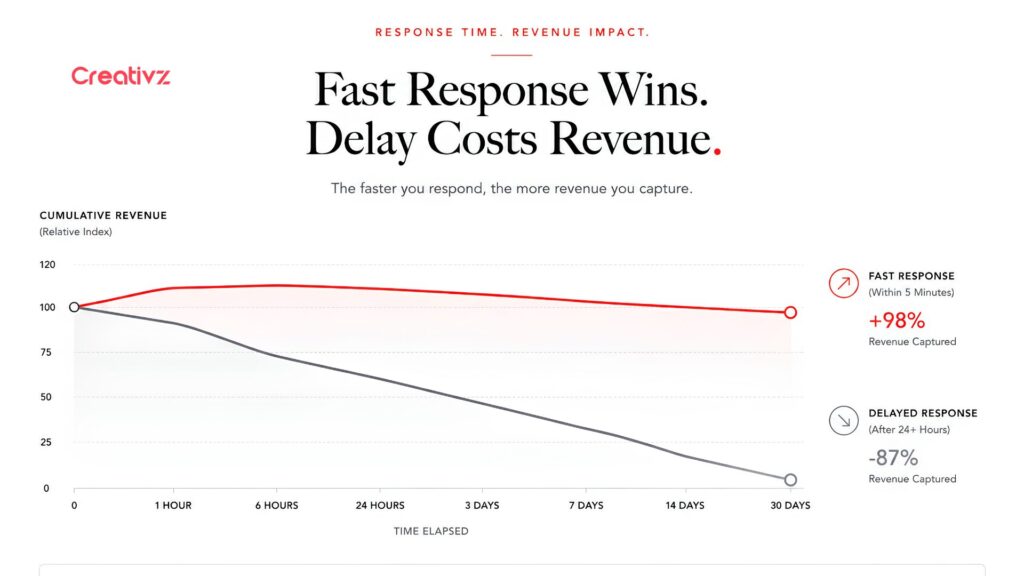
Third, the conversion window became much tighter. Research from Harvard Business Review shows that the odds of qualifying a lead drop by more than 80 percent after just five minutes without a response. If a landing page converts at 12 percent but the follow-up arrives three hours later, that conversion rate tells you very little about actual revenue performance.
This is why most businesses are not losing revenue on the page itself. They are losing it in the delay between the click and the first real conversation.
For more on this, see Why Your Business Does Not Have a Traffic Problem but a Conversion Problem.
The Real Problem Is Not Your Landing Page
Here is what we find in almost every revenue audit we run.
A founder may have a landing page converting at three to five percent, which sounds healthy at first glance. However, once you trace what happens after the form submission, the real problem becomes much easier to see.
In many cases, leads enter a CRM that no one reviews consistently, follow-up emails are sent manually one to three days after the initial inquiry, and there is no lead scoring in place to separate high-intent prospects from lower-priority contacts. Sales cycle length is often tracked informally rather than through a dashboard, while ad spend attribution is tied to clicks instead of closed revenue.
Each of these gaps creates friction in the revenue process. Taken together, they make the landing page conversion rate far less important than it appears. A business could double its conversion rate and still lose the same share of leads because the follow-up system remains unchanged.

HubSpot research shows that 44 percent of salespeople stop after a single follow-up, even though the average B2B sale requires eight touchpoints to close. Most businesses have not built the infrastructure needed to deliver those touchpoints automatically, so the burden falls on manual effort from teams that are already at capacity.
This is not primarily a marketing issue. It is a systems issue.
See also: Why Your Landing Page Is Not Converting (And Why Redesigns Do Not Fix It).
What a Revenue System Actually Looks Like
A revenue system is more than a funnel diagram. It is the operational infrastructure that moves a lead from first contact to closed deal through a consistent and repeatable process. Instead of relying on someone to remember each next step, the system handles follow-up, routing, and progression automatically.
That system typically includes four components that work together.
1. Lead Capture That Qualifies, Not Just Collects
Your landing page form should do more than collect an email address. It should classify the lead immediately based on the information they provide, so high-fit prospects receive a different response than lower-fit ones. That qualification process should begin before a human ever needs to step in.
2. Instant Automated Response
The moment a lead submits a form, the system should respond automatically rather than waiting for someone to check their inbox. An automated confirmation, a relevant resource, or a booking link should be delivered within 60 seconds of the submission. That single improvement can have a measurable effect on close rates.
For a deeper look at response time and revenue, read Why Fast Response Time Wins More Deals Than Better Marketing.
3. A Nurture Sequence That Runs Without You
Not every lead is ready to buy immediately, which is why a revenue system should keep those prospects engaged automatically over time. Timed emails and relevant content should be delivered based on lead behavior, so the relationship continues to build without requiring someone to remember each follow-up manually.
4. Reporting That Shows Revenue, Not Just Clicks
You need to know which channels generate closed revenue, not just which ones drive traffic. To do that, your ad platform, landing page, CRM, and sales data need to be connected in a single view that shows how leads move from click to closed deal. Without that level of visibility, optimization decisions are based more on assumption than evidence.
McKinsey describes this as a connected revenue operations model, in which commercial systems work together instead of operating in isolation. Businesses that integrate these systems grow revenue at twice the rate of those relying on disconnected processes.
For the full architecture, see How to Build Predictable Revenue with a Revenue Infrastructure Stack.
What This Looks Like in Practice
Consider a B2B service business generating around three million dollars in annual revenue. Its landing page converts at four percent, which looks acceptable on paper.
A full audit of the revenue system often reveals the following:
- average lead response time is 14 hours
- the follow-up sequence consists of only two emails, both sent manually
- CRM usage is inconsistent, with some leads logged and others tracked in spreadsheets
- ad spend attribution is measured by clicks instead of revenue
- the inbound lead close rate sits at 11 percent
After rebuilding the system behind the landing page, the performance profile changes significantly:
- lead response time drops to under four minutes through automated routing
- a six-email nurture sequence runs automatically based on form responses
- every lead enters the CRM immediately with tags that reflect fit score
- a live dashboard connects ad spend to pipeline and closed revenue
- the inbound lead close rate rises to 19 percent within 60 days
The landing page itself does not need to change for revenue to improve. What changes is the system behind the page, and that is where the real performance gain comes from.
This is the pattern we see repeatedly across B2B service businesses at this stage. In most cases, the constraint is not the page itself but the infrastructure responsible for receiving, routing, and converting the lead.

To understand how response time specifically drives this, read: The Lead Response System: How to Go from 3 Hours to 12 Minutes.
What to Stop Optimizing and What to Build Instead
This is not an argument against having a good landing page. Clarity matters, a strong headline matters, and a compelling offer matters.
The real question is where your next 30 days of effort should go.
Stop optimizing:
- button colors and CTA copy when your follow-up still takes more than an hour
- headline variations when leads are sitting untouched in your CRM for days
- ad creative when you still cannot connect spend to closed revenue
Start building:
- an automated lead response that triggers within 60 seconds of a form submission
- a nurture sequence that runs for 30 days without manual input
- a CRM setup that categorizes, scores, and assigns every lead automatically
- a reporting dashboard that shows revenue by channel rather than clicks alone
The businesses that grow past ten million dollars are not running smarter A/B tests. They are running better systems.
Want to Go Deeper?
These posts cover the components of a revenue system in more detail.
- How to Set Up a CRM That Actually Closes Deals If your CRM is a graveyard of untouched leads, this post shows exactly how to set it up so it works for your sales process, not against it.
- Founder-Led Sales to Scalable Revenue System: The 4-Stage Transition If you are still the one closing every deal, this post maps the exact four stages between founder-led sales and a system that closes without you.
- How Smart Automation Frees Founders and Boosts Predictable Revenue This post covers which automations actually move revenue and which ones just add complexity.
Final Thought
Growth hacking promised a shortcut. For a while, it delivered one. That era ended.
The founders winning in 2026 are not the ones running the cleverest tests. They are the ones who built the infrastructure to properly receive leads, automatically follow up, and consistently close.
Your landing page is not the problem. The system behind it is.
If you want to know exactly where your revenue system is leaking, the Digital Growth Audit walks you through six areas of your business in about 90 minutes. No pitch. Just a clear diagnostic.
Or start with the Revenue System Scorecard to benchmark where your infrastructure currently stands.

Creativz.io
Creativz.io is a digital growth consulting firm that builds revenue infrastructure for B2B founders scaling from $500K to $10M ARR. The team architects conversion systems, CRM pipelines, lead-nurture automation, and analytics infrastructure that turn website traffic into predictable revenue. Creativz has worked across construction, SaaS, fintech, B2B services, and logistics, with a focus on systems that scale without scaling headcount.
