
A deal closes lost. The CRM says price. Three months later, the buyer signs with a competitor who charged more. Price was never the reason. It was the easiest box to check on the way out the door, and almost nobody runs a real B2B win-loss analysis to catch it.
Your rep writes down what the buyer told them in the last polite email. The buyer writes nothing at all. They just move on.
So the reason on file is not a fact. It is a guess, dressed up as data.
B2B win-loss analysis is how you find the real answer. Not from the CRM. From the buyer, after the decision is already made and they have nothing left to lose by being honest.
That answer changes your roadmap. Your pricing. Your messaging. Get it wrong, and you spend a quarter fixing a problem you do not have.
Before you read another word of this, pull your last quarter’s closed-lost list and count how many deals say “price.” That number is your starting point. It is very likely wrong.

Why CRM Closed-Lost Reasons Are Unreliable for B2B Win-Loss Analysis
Every CRM has the same five reasons. Price. Timing. No budget. Went with a competitor. Went dark.
Sales teams treat these as data. In fact, they are the last thing a buyer said before disappearing, not a verified reason.
A buyer rarely tells a rep the truth on the way out. Not because they are dishonest. Because it is easier to blame budget than to explain that your demo felt scripted, or your proposal missed their actual problem.
Why this matters: if your reasons are wrong, your fixes target the wrong thing. A team that reads “price” as the top loss reason will discount harder next quarter. If the real reason was a weak proof point, the discount will not move the needle at all.
Reps also have an incentive to pick a reason that protects them. “Lost on price” sounds like a market problem. “Lost because I could not answer their security questions” sounds like a rep problem. Guess which one gets logged more often.
None of this means your sales team is doing anything wrong. It means the closed-lost reason field was never built to capture the truth. It was built to close the ticket.
If your reporting already feels disconnected from what is actually happening in your pipeline, that gap is worth a closer look on its own.
The Multi-Stakeholder Blind Spot in Your CRM Data
There is a second layer to this problem. Most B2B deals are not decided by one person. Notably, Gartner research puts the typical buying group at six to ten stakeholders, sometimes climbing past fifteen once legal, compliance, and finance get involved. Your rep talked to one or two of them. As a result, the reason in your CRM reflects one voice out of a room full of them.
Stop trusting single-stakeholder reasons on multi-stakeholder deals. If a deal over a certain size has only one contact logged in your CRM, that is a gap in your process, not in the data. Fix the process before you fix the data.
Which Deals to Include in Your B2B Win-Loss Analysis
You do not need every closed deal for a useful B2B win-loss analysis. You need the ones that teach you something.
Start with three categories.
Won deals. Pick your five best wins from the last quarter. Not the easiest closes. The ones where you beat a real competitor or replaced an incumbent tool.
Lost deals. Pick five losses where the buyer was genuinely evaluating you, not just collecting quotes to justify a decision they had already made.
No-decision deals. These are constantly skipped, and they are often the most useful. A no-decision means the buyer had a real problem, looked at solutions, and chose to do nothing. Find out why nothing beat you. If proposals tend to go quiet on your end, that pattern usually has a specific, fixable cause.
Handling Multi-Stakeholder Feedback in B2B Win-Loss Analysis
Watch for what happens when a deal has more than one voice in it. In multi-stakeholder deals, one person’s objection is often another person’s non-issue. For example, a champion tells you the deal died on budget. The economic buyer, in a separate conversation, tells you they never trusted the implementation timeline. Both are telling the truth. Neither is the full picture.
When this happens, do not force a single classification onto a single deal. Instead, classify the deal once per stakeholder voice. A single lost deal can carry a Risk tag from one interview and a Pricing tag from another, and that split is the finding. It tells you the deal was not lost on a single objection. It was lost because the buying group never reached internal agreement on what mattered most, which is a sales-process problem, not a product problem.
Do not average conflicting stakeholder feedback into one tidy reason. Log both. The disagreement between stakeholders is often more useful than either individual answer, because it tells you the deal was lost to internal misalignment, not to your product.
Finally, skip deals under a certain size. A five-thousand-dollar deal and a two-hundred-thousand-dollar deal rarely fail for the same reasons. Mixing them muddies the pattern you are trying to find.
When and How to Run B2B Win-Loss Interviews
Timing matters more than people expect.
Reach out two to four weeks after the deal closes. Too soon, and the buyer is still emotionally engaged in the sales process. Too late, and the details fade.
Do not have the rep who ran the deal conduct the interview. The buyer will soften their answers to avoid an awkward conversation with someone they just said no to. Use a founder, a colleague from another team, or a third party.
Keep the interview to fifteen minutes. Buyers agree to short calls. They do not agree to a thirty-minute debrief on their own decision-making process.
Frame the ask honestly. Tell them you are not selling anything. You want to understand their experience so you can improve it for the next company in their position. Most buyers, even the ones who rejected you, will take that call.
Book the first five interviews this week, not this quarter. A win-loss program that stays theoretical past week one usually never starts. Put five names on a calendar before you close this document.
Questions to Ask Without Leading the Buyer

The questions decide whether your B2B win-loss analysis produces real answers or polite ones.
Avoid closed questions that give the buyer an easy, socially acceptable exit. “Was price a factor?” invites a yes, whether or not it is true.
Ask open questions instead.
- Walk me through how your team made this decision.
- What almost made you choose us?
- What almost made you choose them?
- If you could redo one part of our process, what would it be?
- What would have needed to be true for us to win?
Let silence sit after each question. Buyers often add the real answer after a pause, once the rehearsed answer runs out.
Write these five questions on a card and use them verbatim for the first ten interviews. Do not improvise until you have a baseline. Improvised questions are how bias creeps back into a process built to remove it.
How to Classify B2B Win-Loss Interview Answers
Raw interview notes are not useful until you sort them. Build a simple B2B win-loss analysis system with seven categories.
Offer. The product or service did not fit the buyer’s actual need.
Pricing. The cost, structure, or packaging did not match their budget or expectations.
Proof. The buyer did not believe the results would hold up in their environment.
Risk. The buyer feared implementation failure, vendor instability, or internal pushback.
Sales experience. The process felt slow, scripted, or disconnected from their situation.
Competitor. A specific, named strength of the competitor won the deal.
Internal decision. The choice came down to politics, budget freezes, or a stakeholder outside the deal.
The Buyer Decision Matrix
Use this format to compare the recorded reason against the real one.
| What sales recorded | What the buyer actually said | The real problem | Who owns the fix |
| Price | Your competitor’s onboarding felt faster | Proof, not pricing | Product and Customer Success |
| Went dark | We never got a clear answer on security | Risk | Sales enablement |
| Timing | The proposal did not address our team structure | Offer fit | Sales process |
This table does the real work of a win-loss program. It shows you where the CRM lied, and it assigns the fix to the team that can actually make the change.
If three or more of your last ten losses land in the same category, you have found your highest-leverage fix. Stop reviewing more deals and go fix that one thing before you interview a single additional buyer.
The Confidence Tax: What B2B Win-Loss Analysis Usually Misses
Most win-loss frameworks stop at classification. Offer, pricing, proof, risk, sales experience, competitor, internal decision. Useful, but incomplete. It treats every lost deal as a single failure with a single cause.
Here is what that framework misses. In deals with more than one stakeholder, the deal is rarely lost on the objection itself. Instead, it is lost on how confident the buying group felt in their own answer to that objection.
Call this the Confidence Tax. A buyer who is 90 percent confident your product handles their security requirement will push the deal forward even with an open question. A buyer who is 60 percent confident will stall on the exact same open question, because the uncertainty itself becomes the risk, not the gap you left unanswered. This connects directly to why some buyers convert and others quietly stall out, the confidence gap shows up long before the deal ever reaches your pipeline.

How the Confidence Tax Changes Your Fix
This is why two deals can carry the identical CRM reason, “risk,” and require two completely different fixes. For example, one buyer needed one more proof point. The other buyer needed the internal political cover to defend the purchase to their own team. Your interview transcript will not say this directly. You have to listen for it.
The tell is in how the buyer describes their team’s reaction, not their own. “I was fine with it, but my CFO kept asking” is a Confidence Tax problem, not a Risk problem. The fix is not more proof. It is a document your champion can hand to their CFO without you present.
When you classify an interview, add a second tag next to the primary category: Confidence Tax present, yes or no. Deals with the tag need internal-facing assets, one-pagers, ROI calculators, security summaries a champion can forward alone. Deals without it need direct fixes to the objection itself. Mixing these two fix types is why some win-loss programs implement changes and see no movement in win rate.
No-Decision Deals: The Blind Spot in B2B Win-Loss Analysis
Most teams treat a no-decision the same way they treat a loss. Something was missing, so nothing happened. That is often wrong.
A meaningful share of no-decision outcomes are not rejections. Specifically, they are the buyer correctly identifying that the problem was not urgent enough to solve this quarter, regardless of who they might have chosen. If you interview a no-decision buyer using the same questions you use for a lost deal, you will get an answer shaped like a loss, “the proposal did not address X,” when the honest answer is “we decided not to fix this problem right now, at all.”
Ask a different first question for no-decision interviews. Not “what almost made you choose us.” Instead, “what changed that made this project stop being a priority.” If the answer points to a shift in the business, budget freeze, reorg, a different fire to put out, that is not a product or messaging problem. It belongs in a separate tracking category entirely: Deferred, not Lost. Treating deferred deals as losses inflates your loss classification counts and dilutes the real signal sitting in your Offer, Proof, and Risk categories.
Add a Deferred tag separate from your seven loss categories. A rising Deferred rate is a market-timing signal, not a product or sales signal, and it should never be blended into your loss classification counts.
How to Turn B2B Win-Loss Feedback Into Changes
Feedback that stays in a spreadsheet changes nothing. A B2B win-loss analysis only pays off once insights turn into shipped fixes.
Route each classified insight to the team that owns it. Pricing objections go to whoever sets packaging. Proof objections go to whoever builds case studies. Sales experience objections go to whoever runs onboarding for new reps. If the fixes keep pointing back to your pipeline setup itself, it may be time to rebuild the CRM around how deals actually close.
Set a review cadence. Monthly is enough for most companies. Quarterly works if deal volume is low.
Track whether the fix actually changed outcomes. If you rewrote your security messaging after three buyers cited risk, check whether risk shows up less often in the next round of interviews. If it does not, the fix did not work, and you need a different one.
A 30-Day B2B Win-Loss Review Process
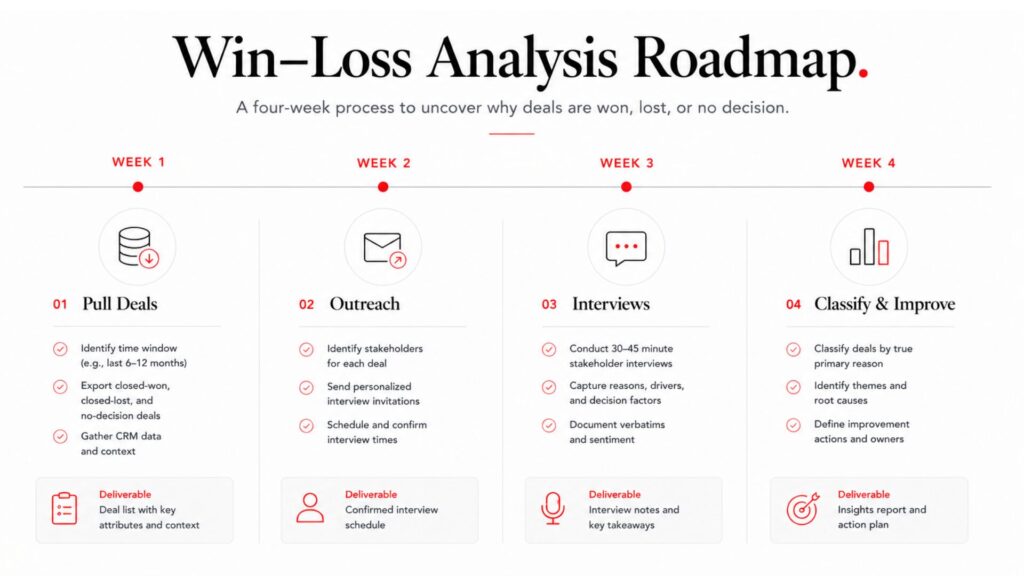
Week 1: Pull Your List
Five wins, five losses, three no-decisions. Confirm contact details are current.
The most common mistake here is pulling deals that closed too recently. A deal from three weeks ago still has an emotional charge for the buyer, win or lose. Instead, pull from the prior quarter, not the current one. Also check whether your original champion is still at the company. A departed champion means you are interviewing someone with half the context and none of the original motivation.
Week 2: Send Outreach
Schedule interviews. Aim for a fifty percent response rate. Anything above that is strong for a first attempt.
Send this from a founder or a research-specific address, never from the rep’s sales alias. A buyer who lost trust in your sales process will not open another email that looks like the same pitch with a new subject line.
Week 3: Conduct the Interviews
Fifteen minutes each. Record with permission, and take notes even if you record.
Here is the trap most first-time interviewers fall into. The buyer gives you their rehearsed reason in the first ninety seconds, because they thought about what they would say before the call. That answer is usually true, but it is rarely complete. Notably, the real detail tends to surface after you signal the interview is ending. Ask one more question once you have said “last thing” or “before we wrap up.” Buyers relax the moment they think the interview is over, and that is when the second, more specific answer comes out.
Week 4: Classify and Present Findings
Classify every answer into the seven categories. Build the Buyer Decision Matrix. Present findings to the teams who own each fix.
Assign one person as the final classifier. When multiple people classify the same interview, they tend to disagree on borderline cases, usually because each person hears the answer through the lens of their own department. So, a single arbiter keeps the categories consistent across every deal in the batch.
If you only do one week of this process, do Week 3. A single well-run round of interviews, even without the full classification system, will surface more truth than another quarter of CRM dropdown data.
Repeat the cycle every quarter. The value compounds. By the third round, you will see patterns that a single quarter cannot show you.
A 2025 industry survey found that companies running B2B win-loss analysis programs reported improved win rates, with the strongest gains among the most mature programs. In short, the lesson is not that win-loss analysis works instantly. It is that it compounds with repetition.
Metrics to Track After Your B2B Win-Loss Analysis
These five metrics tell you whether your B2B win-loss analysis program is actually working.
Interview response rate. Are buyers agreeing to talk to you. Below one in five is usually not a sign of weak buyer interest. It is a sign the outreach is coming from the wrong address, the wrong person, or too long after the deal closed.
Reason accuracy gap. How often does the buyer’s stated reason differ from the CRM’s recorded reason. If this happens in more than half your reviewed deals, treat every closed-lost reason in your CRM as unverified until you have interviewed your way back to a baseline you trust.
Fix implementation rate. How many identified issues actually get addressed by the owning team. A program that classifies feedback but implements fewer than half the fixes is a research exercise, not a revenue process. The classification work is the easy half.
Win rate trend. Track this quarterly, not monthly. Win-loss insights take a full sales cycle to show up in the numbers. Expect the first full cycle to look flat. The second cycle is where you find out if the fixes worked.
No-decision rate. A drop here often means your proof and risk messaging improved, even before win rate moves. If it has not moved after two full review cycles, the fixes you shipped were not the ones the no-decision buyers were actually waiting on.
Pick one metric, not five, to report to your team for the first two quarters. Programs that try to move five numbers at once usually move none of them. Reason accuracy gap is the one that most directly proves the program is working.
Want to Go Deeper?
A few Creativz resources connect directly to this B2B win-loss analysis framework.
Final Thought
Your CRM will always give you an answer. It will rarely give you the truth.
B2B win-loss analysis is not a research project. Instead, it is a habit. Talk to the buyers who said no. Talk to the ones who went quiet. Their answers are the clearest map you have of what to fix next.
This week, pick five lost deals and send five emails. That is the entire first step. Everything else in this post only matters once those five conversations happen.
A B2B win-loss analysis is one of the fastest ways to find where your revenue system is leaking. Book a Digital Growth Audit and get a clear look at what is actually costing you deals.
Or run a quick Revenue System Scorecard to see where your process stands before you commit to a full review.

Creativz.io
Creativz.io is a digital growth consulting firm that builds revenue infrastructure for B2B founders scaling from $500K to $10M ARR. The team architects conversion systems, CRM pipelines, lead-nurture automation, and analytics infrastructure that turn website traffic into predictable revenue. Creativz has worked across construction, SaaS, fintech, B2B services, and logistics, with a focus on systems that scale without scaling headcount.
