
Pull up your last ten closed-won deals. Which campaigns reached the people behind those deals before each deal entered your pipeline?
Most SaaS teams struggle to answer. The usual cause is missing links between records, not a weak attribution model.
B2B marketing attribution shows which marketing interactions sit behind your pipeline, deals, and revenue. For SaaS teams, this means linking activity from several decision-makers to CRM accounts, opportunities, and subscription outcomes.
Your ad platforms report conversions. Your CRM records opportunities and closed-won deals. Each system measures a different part of the journey, so the numbers rarely agree on their own.
In this guide, you will learn how to:
- Structure attribution at the account level.
- Pick a model to fit your reporting question.
- Connect marketing activity to CRM opportunities.
- Check the results before you move the budget.
You will also see a worked SaaS example showing how different models credit the same deal.

What Is B2B Marketing Attribution?
B2B marketing attribution gives credit to the marketing interactions linked to a sale. It shows which channels and campaigns appear from early research through opportunity creation and closed-won revenue.
B2B sales rarely happen through a simple online checkout. Several people may evaluate a product over weeks or months.
Your buying committee might include:
- A RevOps manager checking integration requirements.
- A finance director reviewing costs.
- A sales leader comparing workflow features.
- An executive approving the purchase.
Each person meets your marketing through different channels before anyone signs. If your reports track only the person who booked the demo, you miss what the other three saw first.
Keep one limit in mind: credit in a report does not prove an interaction caused the sale.
Use attribution as a reporting framework for decisions. Treat the output as evidence, not a full account of buyer behavior.
Why Does SaaS Marketing Attribution Need Account-Level Data?
Several people from one company shape a single purchase. Your attribution has to see them as one buyer.
Consider an illustrative buying journey:
- February: A RevOps manager finds your product through organic search.
- March: A finance director from the same company attends your webinar.
- April: The head of sales requests a demo.
- May: The company signs a subscription.
The customer sees one evaluation process. Your CRM sees separate contact records.
Without links to the correct company and opportunity, your attribution report shows only part of the journey.
Connect people to the right company
Every relevant contact record needs a reliable account association.
Email domains help you identify organizations, but domains alone fall short. Subsidiaries, consultants, personal email addresses, and shared domains complicate matching.
Connect the company to the sales opportunity
Each opportunity needs the right account relationship, deal information, and any available stakeholder associations.
Salesforce opportunity contact roles and HubSpot associations are two examples of CRM features supporting these relationships.
Linking a person to an account does not qualify every interaction from this person for a particular deal. You still need rules defining eligible interactions and reporting periods.
Before evaluating models, confirm your CRM identifies the buyer and every record in the purchase.
Which CRM Records Do You Need For B2B Marketing Attribution?
Your attribution setup connects four types of records: marketing interactions, contacts, accounts, and opportunities. Each record adds different information.
|
Record |
Information to capture |
What the record gives you |
|
Marketing interaction |
Date, channel, campaign, interaction type, relevant identifier |
Shows what activity was recorded |
|
Contact |
Contact ID, company association, source details |
Ties activity to a person |
|
Account |
Account ID, company details, related contacts |
Groups the relevant stakeholders |
|
Opportunity |
Deal ID, associated account, stage, value, dates, deal type |
Links activity to pipeline and sales outcomes |
Treat these as recommended fields for a practical reporting design. Not every analytics product requires all of them.
Where the connection usually breaks
Say a prospect clicks your LinkedIn campaign and requests a demo.
The campaign carries tracking parameters. Your form records the submission. Your CRM creates a contact.
Later, your sales team opens an opportunity under the company’s account.
Your reporting chain breaks at three points:
- The original campaign details get overwritten.
- The contact links to the wrong organization.
- The opportunity has no reliable association.
Another dashboard will not restore information your systems never kept.
This is why disconnected business systems create measurement problems even when each tool works.
Find which record or connection needs attention first.
Five Areas to Check Before Trusting Your B2B Marketing Attribution Data
Before you compare models or buy another platform, check whether your current data supports your decisions.
Start with five areas.
|
Check |
Question to ask |
Where to look if the check fails |
|
Campaign tracking |
Do you capture marketing sources consistently? |
UTM naming, form capture, source preservation |
|
Contact matching |
Are relevant contacts linked to the correct accounts? |
Duplicate records and account associations |
|
Opportunity records |
Do your deals connect to the buying organization and relevant activity? |
Deal ownership, associations, dates, and stages |
|
Revenue definitions |
Does everyone use the same meaning for pipeline, contract value, ARR, and MRR? |
Reporting definitions and finance alignment |
|
Attribution coverage |
How many deals lack enough recorded activity for attribution? |
Missing touches, unmatched contacts, and reporting rules |
These checks show you which problem to address first.
What should you fix first?
Say your campaigns use consistent tracking parameters, but contacts from one company sit under different accounts.
Switching from last-touch to linear attribution will not recover the missing relationships.
Each model calculates credit correctly from the available records. Those records still miss part of the buying journey.
Or say your contact and account data is reliable. Marketing reports annual recurring revenue, while finance compares the figures against total contract value.
Here the problem sits in the metric definition, not the model.
Fix the issue affecting the decision in front of you.
Your historical records do not need to be perfect. You need to know which information is reliable, which is missing, and whether those gaps change your conclusions.
Which Revenue Metrics Should B2B Marketing Attribution Report?
Before you credit any marketing activity, decide which revenue outcome matters to you. Keep pipeline, closed-won contract value, recurring revenue, and recognized revenue separate.
Each number answers a different question.
|
Metric |
What the metric tells you |
|
Created pipeline |
The value of opportunities created within a defined period |
|
Closed-won contract value |
The contract value of won deals |
|
ARR |
Annualized recurring subscription value under your reporting definition |
|
MRR |
Monthly recurring subscription value under your reporting definition |
|
Recognized revenue |
Revenue recorded under your accounting policies |
Say you sign a customer to a $24,000 annual subscription.
The contract might count as $24,000 in annualized recurring value under your calculation rules.
Your company has not yet recognized or collected $24,000.
If the contract includes implementation fees, report those apart from recurring subscription revenue.
Keep deal types separate
New business, renewals, and expansions follow different customer journeys.
A customer upgrading an existing subscription differs from a new customer buying for the first time. If you combine these deals without clear labels, your acquisition performance becomes hard to read.
Define marketing-sourced and marketing-influenced pipeline
Marketing-sourced pipeline: Opportunities meeting your organization’s defined marketing-origin rule.
Marketing-influenced pipeline: Opportunities with qualifying marketing activity during a defined reporting period.
The two categories overlap. Never add their totals together without checking.
Before you evaluate channels, align marketing, sales, RevOps, and finance around the same definitions.
A reliable revenue infrastructure depends on consistent processes and reporting rules, not only the software showing the numbers.
Which B2B Marketing Attribution Model Should a SaaS Team Use?
Pick your model based on your reporting question, your available data, and the sales cycle you want to understand.
Each model assigns credit differently.
|
Attribution model |
How credit is assigned |
What the model helps you examine |
|
First touch |
All credit to the first eligible interaction |
Where recorded journeys begin |
|
Last touch |
All credit to the last eligible interaction |
What happened closest to conversion |
|
Linear |
Equal credit across eligible interactions |
Recorded activity across the journey |
|
Time decay |
More credit to recent interactions |
Activity closer to conversion |
|
U-shaped |
More weight to two selected milestones |
Discovery and lead-creation activity |
|
W-shaped |
More weight to three selected milestones |
Discovery, lead creation, and opportunity creation |
|
Data-driven |
Platform-specific calculation based on observed patterns |
Relationships within available conversion-path data |
These are general approaches. Not every analytics platform offers every model, and milestone definitions vary.
Start with your decision
- Want to know how prospects first find you? Use first-touch reporting.
- Want to study activity close to conversion? Use last-touch or a milestone-based model.
- Selling through a long buying journey? Use a multi-touch model to spread credit across eligible interactions.
More complex does not mean more accurate.
A linear model with missing interactions still gives you incomplete results.
A data-driven model will not rebuild private conversations or unrecorded stakeholder interactions.
The model is one part of your measurement process.
Your next step: Before you choose a model, ask whether your records support the question you want answered.
How Do You Connect Marketing Touchpoints to CRM Opportunities?
Your attribution depends on collecting and keeping reliable information from every customer interaction. Campaign parameters, form submissions, and CRM associations need consistent rules.
Work through these six steps.
1. Standardize campaign naming
Define consistent source, medium, and campaign values for the links your team controls.
Use a naming sheet and check tagged links before campaigns launch.
Do not expect every legitimate referral to include UTM parameters.
2. Preserve original source data
Check your forms and integrations keep campaign information when a contact is created or updated.
Store first-touch and latest-touch information separately if your reporting needs both.
3. Review account matching
Confirm relevant contacts belong to the correct organizations.
Use verified identifiers, plus manual review where automated matching is unreliable.
4. Maintain opportunity associations
Record account relationships, relevant stakeholders, deal stages, creation dates, close dates, and values consistently.
5. Capture self-reported discovery
Ask prospects how they first heard about you.
Their answers reveal referrals, community discussions, podcasts, and other influences with no trackable click.
Treat these answers as added evidence, not verified touchpoints.
6. Document your attribution rules
Define which interactions qualify, which conversion event you measure, which reporting window applies, and how credit is assigned.
Write the rules clearly enough for a teammate to explain how the report was produced.
A documented first-party data strategy helps you decide which data to collect on your own properties. The strategy also covers upkeep.
A Worked SaaS Attribution Example: When Missing Data Changes the Answer
Picture a fictional SaaS company selling a customer operations platform.
Three stakeholders from one organization interact with its marketing before signing a $24,000 annual subscription.
The recorded journey
|
Month |
Stakeholder |
Interaction |
|
February |
RevOps manager |
Reads a technical guide from organic search |
|
March |
Finance director |
Attends a webinar |
|
April |
Head of sales |
Requests a demo |
|
May |
Organization |
Signs the subscription agreement |
Assume all three interactions are eligible, recorded, and connected to the correct opportunity.
In this example, your attribution report distributes $24,000 in closed-won contract-value credit.
This figure is not recognized revenue, and the credit does not prove marketing caused the sale.
How different models assign credit
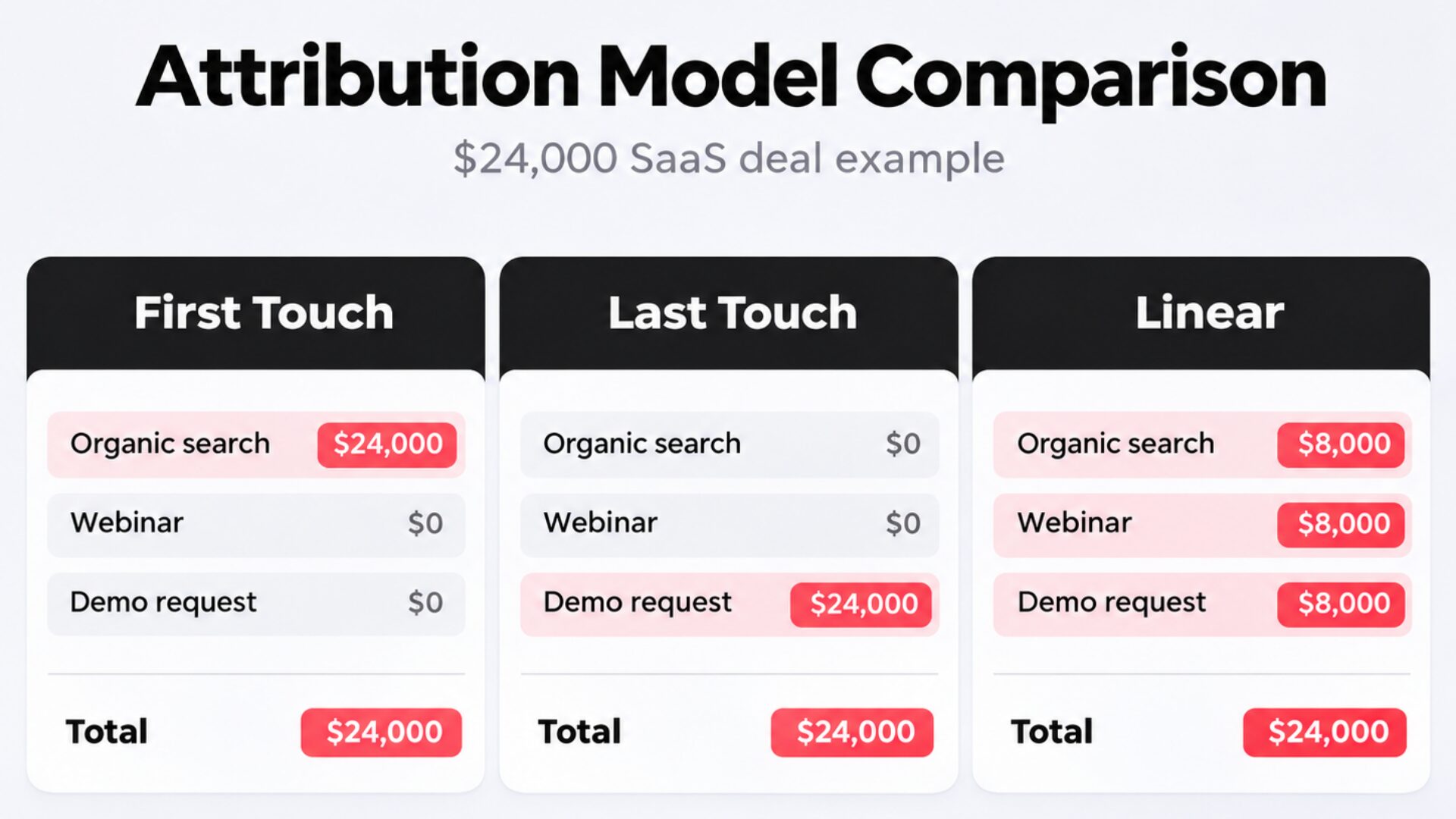
Illustrative example. These figures do not represent a Creativz customer or real campaign results.
Each model uses the same information and splits the credit differently.
- First touch gives all credit to organic search.
- Last touch gives all credit to the demo request.
- Linear splits credit equally.
None of these calculations creates extra revenue. Each is a different reporting view of the same deal.
Now remove one interaction
Say the finance director registered for the webinar with a personal email address.
Your system fails to connect this contact to the buying organization, so the webinar interaction drops out.
Under the same simplified linear rules, your report changes.
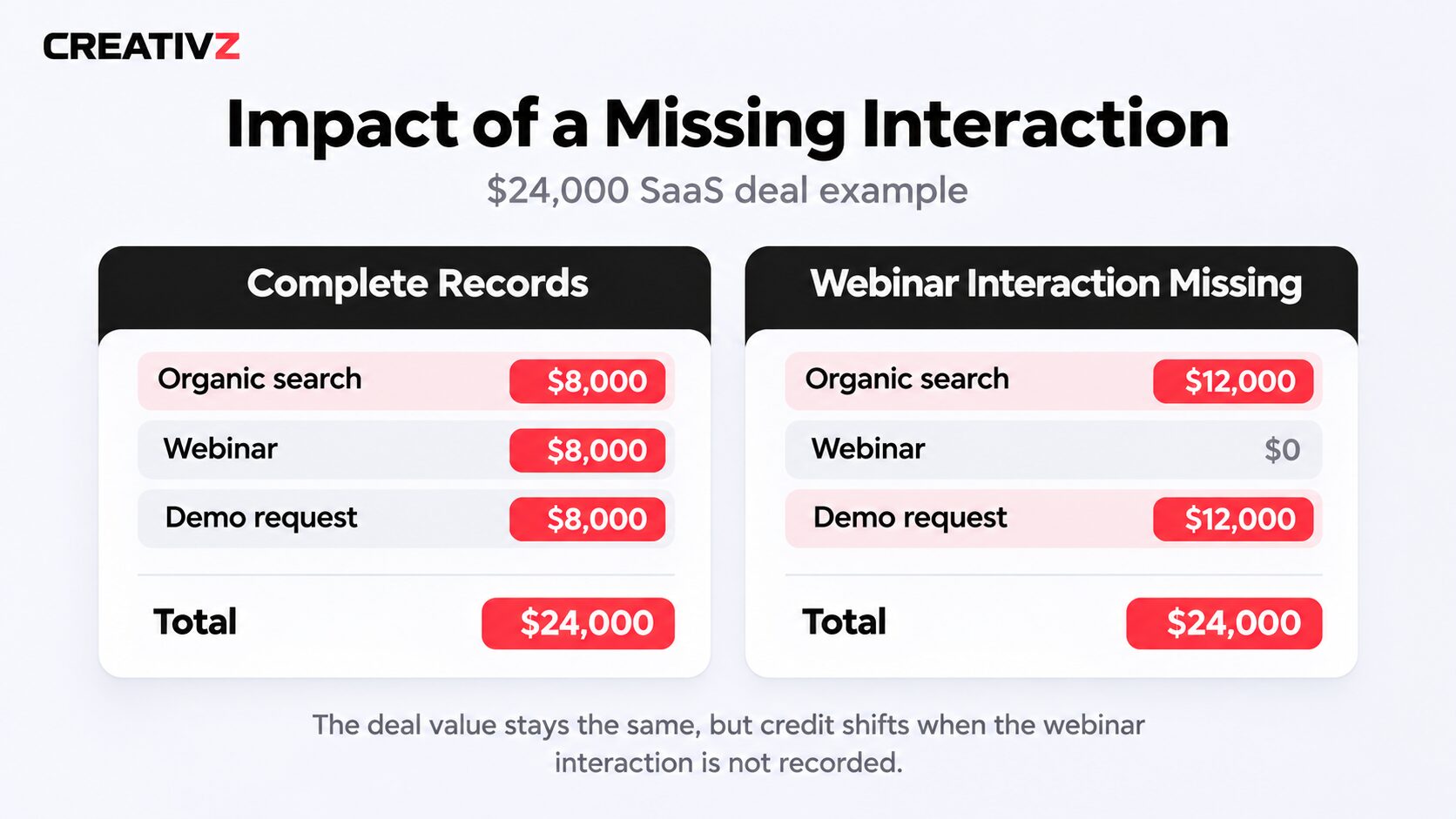
The attributed total still matches the $24,000 deal.
Organic search now gets more credit, and the webinar gets none.
If you only check whether credited totals reconcile, you miss the data problem underneath.
The calculation follows the selected rules correctly. The available journey is incomplete.
A report adding up correctly is different from a report showing the full recorded customer journey.
Before you change campaign budgets, check whether missing interactions, contact associations, or attribution rules change your channel comparison.
The Creativz 10-Deal Attribution Check
Before you invest in a more advanced attribution model, review ten recent closed-won SaaS opportunities.
This diagnostic comes from the business-first approach behind Creativz’s growth and revenue-system assessments.
Ten deals will not give you a statistically reliable measure of your whole attribution system. The check exposes obvious data-quality problems worth investigating.
Step 1: Select ten closed-won opportunities
Choose recent deals from the same reporting period.
Where possible, include deals from different marketing sources and sales cycles.
Step 2: Check six areas
|
Area |
What to verify |
|
Account |
Is the deal linked to the correct organization? |
|
Contacts |
Are relevant buying committee members tied to the account or opportunity? |
|
Source |
Do you see eligible recorded marketing interactions? |
|
Dates |
Do touchpoints fall within your attribution window? |
|
Value |
Does the report use your intended contract or revenue metric? |
|
Coverage |
Are missing sources and unattributed deals visible? |
Step 3: Find where records fail
Review your findings together and ask:
- Are campaign sources missing because forms drop tracking parameters?
- Are contacts assigned to duplicate accounts?
- Do opportunities lack the relationships needed to connect activities?
- Do finance and marketing use different revenue definitions?
Step 4: Decide what to investigate first
Rank problems by their effect on your reporting question.
- Measuring marketing-sourced pipeline? Start with missing original-source values.
- Measuring account-level influence? Start with missing contact associations.
- Comparing attributed recurring revenue? Start with inconsistent ARR definitions.
Step 5: Document what the report cannot tell you
Record which deals fall outside your current attribution rules and why.
An unattributed deal does not mean marketing had no influence. The available records do not support a reliable assignment.
This exercise gives you a starting point for fixing the system before you act on its outputs.
How Do You Validate B2B Marketing Attribution Reports?
Check your attribution reports against the CRM records and definitions behind them. A monthly review catches problems before they shape budget decisions.
Start with these checks:
- Confirm credit follows the model’s allocation rules and reconciles to the deal value where you expect full allocation.
- Review closed-won opportunities for missing accounts or contact associations.
- Check credited interactions that fall within your attribution period.
- Find duplicate contacts, companies, and opportunities.
- Review inconsistent campaign names and unknown sources.
- Compare ad-platform conversions with CRM opportunities, allowing for their different definitions.
- Manually inspect several won deals against sales notes and customer-reported information.
A gap between Google Ads conversions and CRM closed-won deals is not automatically an error.
Your ad platform counts form submissions or other conversion actions. Your CRM counts completed sales.
The question to ask is whether your reporting definitions and connections are correct.
If the figures keep disagreeing, review the underlying process before you change attribution rules.
Our article on why CRM reporting does not match business reality covers the wider reporting problem.
What Should You Do When Attribution Data Is Missing?
Show missing attribution data in your report. Never assign the gap to another channel without saying so.
Your response depends on what is missing and whether you recover the information reliably.
When the original source is unknown
Use an unattributed or unknown category, following your reporting definitions.
Do not classify the deal as direct traffic by default.
When contacts do not match
Review permitted account information, sales notes, and other reliable records.
If you fail to establish the relationship, leave the contact unmatched instead of guessing.
When platforms report different conversions
Review each platform’s conversion events, attribution windows, and counting rules.
Use platform reporting to understand campaign performance inside each platform.
Use reconciled CRM data to evaluate opportunity and sales outcomes.
When the buyer heard about you elsewhere
Referrals, private communities, podcasts, and colleague recommendations shape purchases without leaving a digital touchpoint.
Collect self-reported discovery information where appropriate.
When buyers use AI search
Some buyers find or research vendors through AI assistants before visiting your website.
GA4 includes an AI Assistant channel for recognized referral traffic. AI-assisted discovery does not always produce an identifiable visit.
Self-reported discovery gives you extra context.
The wider shift in B2B buyer behavior through AI search makes these limits worth understanding.
When historical records are incomplete
Never invent campaign sources for earlier deals.
Set a reliable reporting start date and explain which periods have incomplete data.
A transparent attribution report shows what you measure and where your evidence stops.
What Does Better B2B Attribution Look Like in Practice?
Better attribution starts with a business question, not a new dashboard.
Picture a SaaS leadership team deciding whether to raise its paid acquisition budget.
- Marketing reports rising conversions.
- Sales reports fewer qualified opportunities than expected.
- Finance wants to know whether the spend contributes to new recurring revenue.
A different attribution model is not the first fix.
First, the team needs each department’s metrics. Then the team checks whether the systems connect the same journey.
A practical improvement plan looks like this:
- Define the decision. Decide whether leadership needs to evaluate lead generation, opportunity creation, new-customer ARR, or another outcome.
- Review the records. Check campaign tracking, contact associations, opportunity data, and reporting definitions.
- Fix critical gaps. Improve the data capture, CRM relationships, or integrations blocking reliable analysis.
- Choose the reporting approach. Select attribution rules matching your available evidence and your business question.
- Maintain the system. Review data quality, discrepancies, and coverage on a regular schedule.
This approach reflects how Creativz thinks about growth.
Performance marketing helps you reach potential customers.
Software engineering and system integrations connect the tools behind your customer journey.
Automation keeps your processes repeatable.
Analytics and reporting make your outcomes easier to examine.
The value comes from making these capabilities work together around one business objective.
Want to Go Deeper?
These blogs give you the operational context behind what attribution data reveals:
- Why Your Business Does Not Have a Traffic Problem but a Conversion Problem. You are spending on ads and driving traffic, but revenue is not moving. This blog shows you exactly why your funnel is the problem, not your reach, and what to fix to stop losing leads you already paid for.
- The Cost of Disconnected Tech Stacks: How to Build an Integrated Growth Stack. Every tool you added was supposed to help. Instead, they created silos, duplicate data, and revenue leaks you cannot see. This blog exposes what that disconnection is actually costing you and how to build a stack that works as one system.
- Revenue Infrastructure: Build Predictable B2B Growth. If your revenue depends on who showed up this month, you do not have a growth engine. You have a guessing game. This blog breaks down the infrastructure that turns an unpredictable pipeline into consistent, scalable revenue.
Final Thought: Build Attribution Around the Business Decision
B2B marketing attribution is not about making every channel look measurable.
The goal is knowing which interactions sit behind your pipeline and revenue. You also learn where evidence stops and which decisions your data supports.
Choosing a model is only one part.
Your campaigns, CRM records, opportunity relationships, and reporting definitions need to work together.
Start with ten closed-won deals. Find out which records are reliable and where associations are missing. Then check whether the gaps change your view of performance.
Then decide what to improve.
If you want a second set of eyes on your attribution data flow, book a Digital Growth Audit. We will trace one closed-won deal from first touch to revenue with your team.
Prefer a self-check first? The Revenue System Scorecard benchmarks your revenue infrastructure in a few minutes.