
LinkedIn got credit for deal. Now you’re deciding whether to double the budget.
You can trace the demo request to the ad, and the contact is attached to a closed-won deal in your CRM. That’s enough to credit LinkedIn under your reporting rule. The budget decision raises a different question. Would that buyer have booked a demo without the ad?
Attribution assigns credit for a conversion to recorded marketing touchpoints. Incrementality estimates how many additional conversions a campaign generated compared with what would likely have happened without it. If you’re deciding whether to spend more, there’s a third question worth asking. How many more qualified opportunities would the extra budget bring in?
In this guide, you’ll learn how to:
- Read campaign credit in the context of the buyer’s journey.
- Use a holdout test to estimate whether retargeting adds qualified demo requests.
- Decide what evidence you need before increasing spend.
What’s the difference between attribution and incrementality?
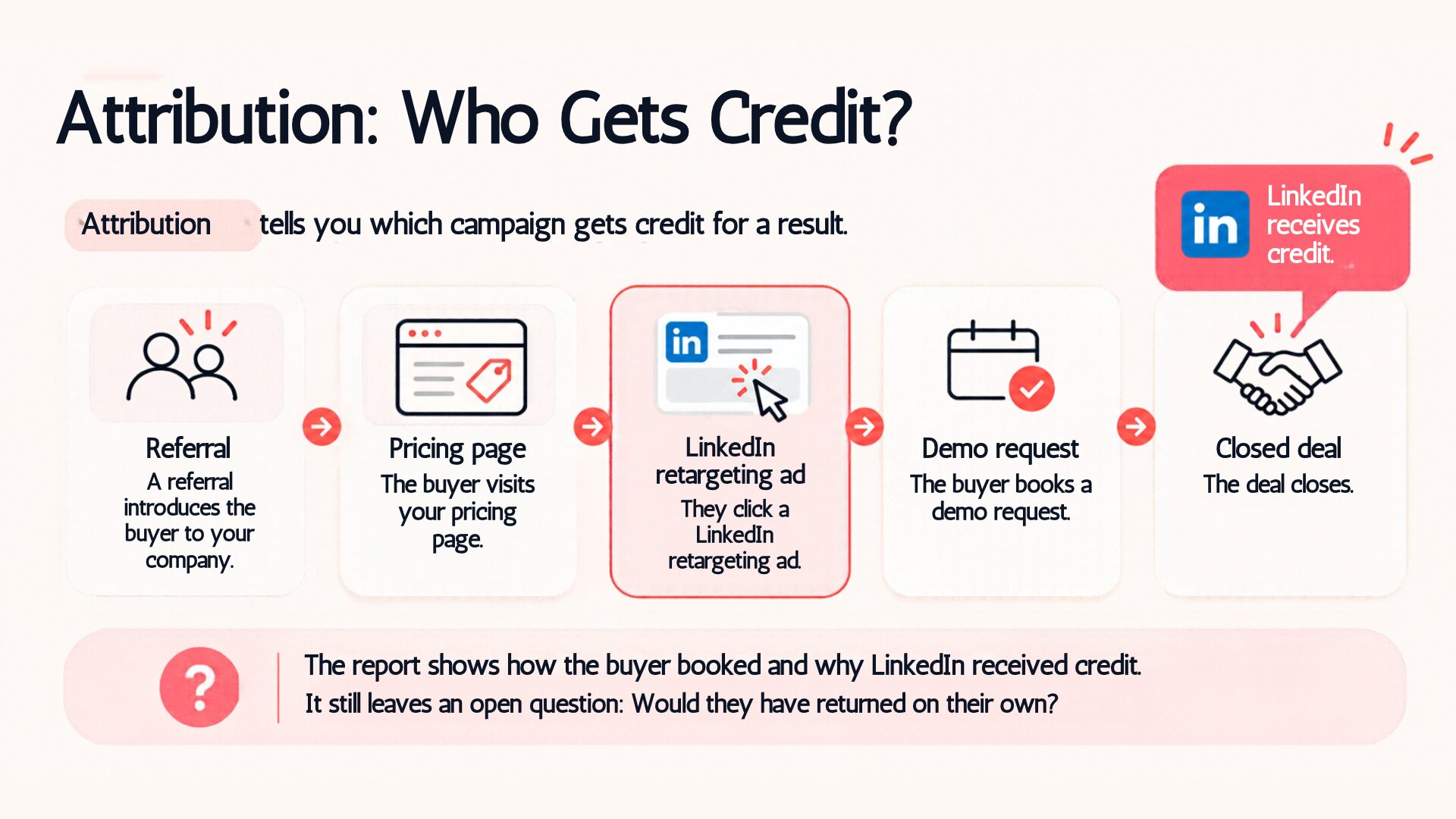
Attribution tells you which campaign gets credit for a result. Incrementality estimates how many additional results happened because of that campaign. Here’s how both apply to the same LinkedIn campaign.
Attribution asks who gets credit
A referral introduced the buyer to your company. They visited your pricing page then clicked a LinkedIn retargeting ad before booking a demo. Your team gives credit to the campaign that drove the demo request, so LinkedIn gets credit when the deal closes.
The report tells you how the buyer booked and why LinkedIn received credit. You still have an open question. Would they have come back on their own.
Incrementality asks what the campaign added
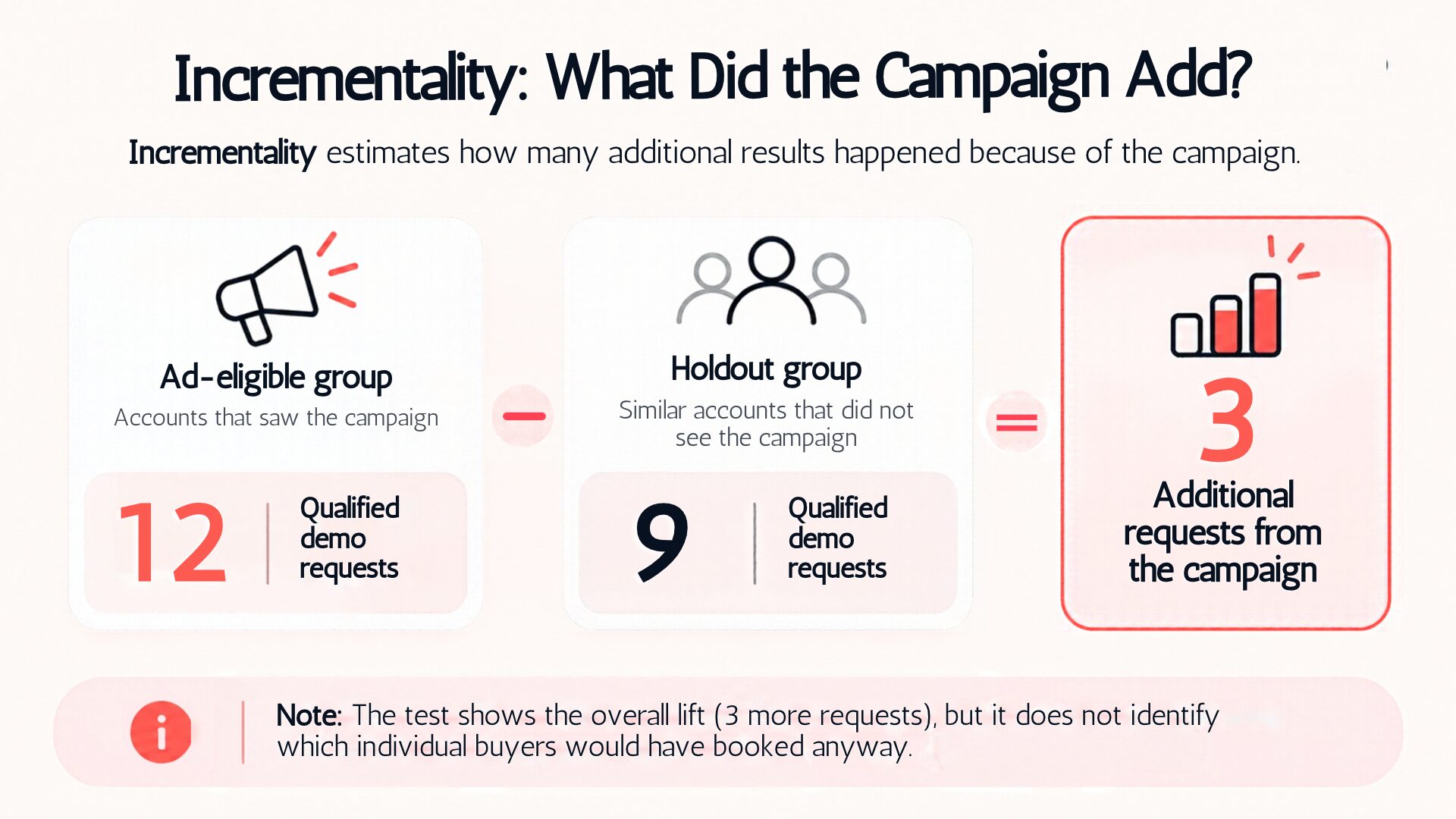
To estimate that look at a group of similar accounts. Imagine you randomly assign 200 out. During the same period, 12 accounts in the group eligible for ads request a qualified demo, compared with nine accounts in the holdout group.
Those nine requests show what accounts can book without the campaign. The difference of three requests in total, there’s still uncertainty. The test also leaves open which individual buyers would have booked anyway.
|
What you want to know |
What to use |
|
Why did LinkedIn get credit for this deal? |
Attribution. Check the recorded touchpoint and the rule that gave it credit. |
|
Did retargeting bring in more qualified demo requests? |
Incrementality. Compare the request rate for accounts eligible for ads with the rate for accounts held out. |
That brings you back to the budget meeting. You can explain why LinkedIn got credit for the deal. To decide whether to put more money into it, you need to estimate what the extra spend would add.
How do you test whether retargeting adds qualified demos?
Start with one campaign and one outcome your sales team can verify. For this example, count accounts that submit a qualified demo request. Agree on what qualifies before the test starts, such as a company that fits your target market and has a problem your team can solve.
Randomly assign eligible accounts to two groups. Keep one group eligible for retargeting and exclude the other from that campaign. The excluded group is your holdout. Use this design only if you can keep contacts from the same company together and reliably exclude the holdout. Keep other marketing activity comparable across the two groups. The principle is the same one Google describes in its media effectiveness guide.
Measure both groups over the same period. Count qualified requests in your CRM from every assigned account, including requests that came through a referral or direct visit. That’s how you pick up demos that happened without a campaign click.
Would three more demo request change your decision?
Imagine the test ends with these results:
|
Group |
Accounts assigned |
Accounts with a qualified demo request |
Request rate |
|
Eligible for retargeting |
200 |
12 |
6% |
|
Held out of retargeting |
200 |
9 |
4.5% |
The observed difference is 1.5 percentage points. With equal-sized groups, that’s three more accounts requesting a qualified demo in the group eligible for retargeting.
Here’s what I’d bring to the budget meeting: “We saw 12 qualified requests with the campaign and nine in the holdout. That’s 21 outcomes total, so the estimate is still uncertain. We’ll review whether those requests turned into sales opportunities before we commit to more spend.”
The result compares running the campaign at its current budget with holding it out. If your team wants to double the budget, it still needs to know how much the next round of spending could add.
How much would the extra budget need to produce?
Before you run a higher-budget test, give the team a number it can discuss. Suppose the proposed increase is $3,000, and your team sets a ceiling of $750 in extra ad spend per additional sales-accepted opportunity. You’d need four additional opportunities to meet that threshold.
Write that decision down before spending the money. If your setup supports a reliable comparison, test the current budget against the higher one. Use the same definition of a sales-accepted opportunity and give both groups enough time to reach that stage. If the result is too uncertain to tell whether you cleared the threshold, keep that uncertainty in the budget recommendation.
What if you see too few deals to run the test?
Use the earliest outcome that still tells you something about the quality of your pipeline. A qualified demo request may be practical when closed-won deals take months to come through. Follow those accounts in the CRM to see how many progress to opportunities and sales.
If qualified demos are scarce too, check whether the test can detect a difference large enough to change your decision. You might need a longer window or a larger eligible audience. If neither is practical, use the attribution report to review the campaign and keep the next budget change small enough to revisit. A month with two good deals can give you a reason to investigate. It’s a thin basis for a permanent increase.
Final Thought
Before the next budget meeting, pick one campaign someone wants to scale. Ask them to finish this sentence:
“We’d spend another $___ if we could reasonably expect ___ additional qualified opportunities.”
If the team can’t agree on what counts as a qualified opportunity or find it in the CRM, start there. If that’s where you’re stuck, talk to Creativz about your measurement setup and bring the budget decision you’re trying to make.