
Manual revenue operations create hidden costs that multiply over time; paying down this operational debt unlocks sustainable growth.
Operational debt is the compound cost of manual work, rework, and disconnected systems that slow down revenue and scale. Borrowed processes may seem harmless at first, but they accrue interest over time. Research on operational debt shows that it can cost companies 20–30 percent of their revenue and leaves teams with only a fraction of their day for high‑value work. This debt hides in every copy‑paste between systems and every follow‑up done by memory.
In this blog, you will learn what operational debt is, why it compounds as your business grows, how it impacts revenue and efficiency, and the practical systems you can build to eliminate it before it becomes a growth constraint.

Why Manual Revenue Processes Drag You Down
Founders often blame a non‑converting page or weak traffic when revenue stalls. In most cases, the real drain is buried in the way work happens after a click. For example, our audits of B2B service businesses found lead response times hovering around fourteen hours. During that window, prospects go cold.
External research backs this up: companies that respond to leads within five minutes are 21 times more likely to qualify them than those that wait 30 minutes. Waiting an hour makes it almost seven times harder to qualify a lead. Manual follow‑up causes those delays.
How Operational Debt Compounds as You Scale
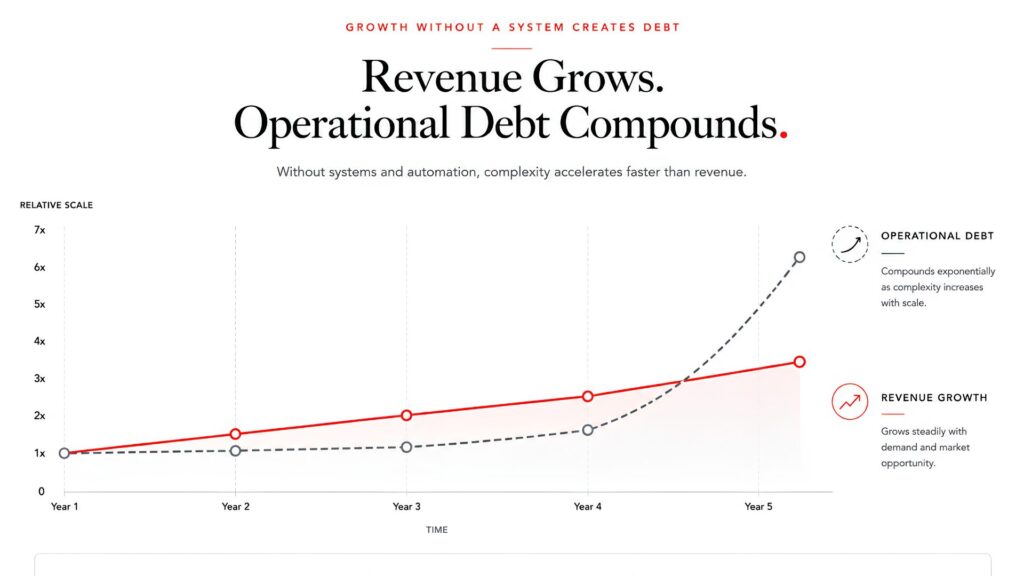
Operational debt grows with your business. A manual process that costs ten hours per month at five million dollars in revenue can consume forty hours at twenty million. Errors and rework multiply when tasks lack clear ownership and automation. Disconnected systems force teams to move data by hand, creating a ceiling on revenue per employee.
This compounding effect means what worked at an early stage becomes a bottleneck later. You are not just burning time; you are delaying deals and draining profit.
Pay Down the Debt: Build a Revenue System
Instead of tweaking button colors, focus on the system behind your funnel. Four components work together to reduce operational debt:
- Lead capture that qualifies, not just collects: Your form should gather enough information to route each inquiry based on fit. High‑value prospects receive a different response than low‑fit contacts.
- Instant automated response: The moment a lead arrives, the system sends a confirmation, a resource, or a booking link. This eliminates the gap between form submission and first contact.
- Nurture sequences that run without you: Prospects who are not ready to buy stay engaged through timed emails based on their behavior. The system handles these touches so you do not have to remember them.
- Reporting that shows revenue, not just clicks: Connect your ad spend, CRM, and sales data in one view. Decisions based on revenue rather than vanity metrics help you invest in what works.
Why this matters: Each element cuts hours of manual work and shortens the time between inquiry and closed deal. Together they reduce the hidden tax that slows growth.
What to Stop Optimizing and What to Start Building
Stop optimizing button colors and headline variations while leads sit untouched in your CRM. Stop rewriting copy when you still cannot trace spend to revenue.
Instead, build systems that respond in seconds, nurture automatically, score and route leads instantly, and report on revenue.
Real‑World Example
A mid‑market service business we audited had a landing page that converted at 5%.
The team thought the page needed a redesign. The real issues were hidden: a fourteen‑hour average response time, two manual follow‑up emails, inconsistent CRM usage, and disconnected ad reporting. After automating lead capture, routing, and nurturing, response time dropped to under four minutes, a six‑email sequence ran without intervention, and every lead entered the CRM with a fit score.
The close rate jumped from 12% to 19% in 60 days. The page stayed the same. The system changed.

Want to Go Deeper?
If this resonates, explore these posts to build your revenue system:
- How Smart Automation Frees Founders and Boosts Predictable Revenue: Learn which automations actually drive revenue and which ones just add complexity.
- Why Fast Response Time Wins More Deals Than Better Marketing: See the data on how response speed beats creative campaigns.
- How to Set Up a CRM That Actually Closes Deals: Turn your CRM from a contact graveyard into a deal‑closing machine.
Final Thought
Operational debt is not a theory. It is the drag you feel when manual handoffs and fragmented data slow your growth. Paying down that debt does more for revenue than another A/B test. The founders who scale past ten million dollars are not the ones with the cleverest headlines. They are the ones who build systems that handle the work, allowing their teams to focus on closing.
If you want a clear view of where your revenue system is leaking, our Digital Growth Audit will show you six areas to address.
No pitch. Just insight. Or start with the Revenue System Scorecard to benchmark your infrastructure.

Creativz.io
Creativz.io is a digital growth consulting firm that builds revenue infrastructure for B2B founders scaling from $500K to $10M ARR. The team architects conversion systems, CRM pipelines, lead-nurture automation, and analytics infrastructure that turn website traffic into predictable revenue. Creativz has worked across construction, SaaS, fintech, B2B services, and logistics, with a focus on systems that scale without scaling headcount
