
A winter storm crossed the United States in the days before Christmas 2022. Every major airline canceled flights. When the weather cleared, most carriers recovered within a day or two. Southwest Airlines did not. The Southwest Airlines 2022 meltdown stretched on for nearly a week, canceling 16,900 flights and stranding more than two million passengers.
Planes sat on the ground. Crew members waited for assignments. The airline had the aircraft and the staff it needed. What it lacked was a system that could match the two at scale once the normal schedule broke down.
The disruption cost Southwest more than a billion dollars and led to a record penalty from federal regulators. The Department of Transportation recorded 16,900 cancellations, more than two million affected passengers, and a 140 million dollar civil penalty.
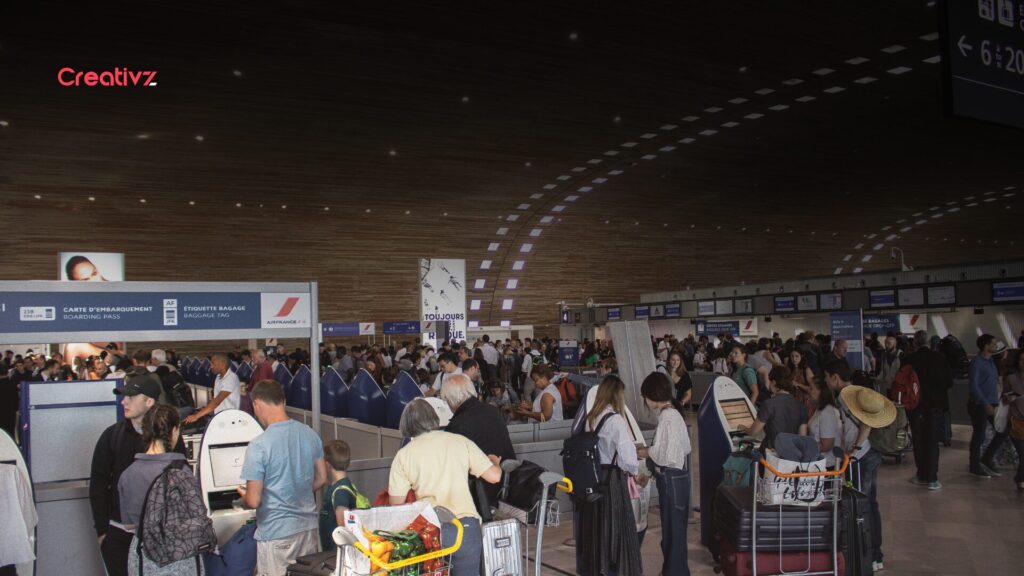
The Southwest Airlines 2022 Meltdown Started With Weather, Not Systems
The storm hit every airline the same week. Cancellations spiked across the industry as ice and wind shut down runways and delayed crews. For most carriers, this counted as a rough few days, not a crisis.
Southwest ran a point-to-point network instead of the hub-and-spoke model most large airlines use. The model gives passengers more direct routes on a normal day. During a large-scale disruption, the same model spreads crews and aircraft across more locations, making manual recovery harder to coordinate.
What Made Southwest Different From Other Airlines During the Storm?
Other major airlines run a hub-and-spoke network, concentrating operations in fewer locations. Southwest’s point-to-point network spread its aircraft and crews across more airports, and the scheduling system meant to track and reassign them at scale did not hold up once the volume of disruptions increased.
Why Other Airlines Recovered While Southwest Did Not
Airlines using hub-and-spoke networks reset operations from a smaller number of concentrated locations. Southwest needed to reset thousands of individual crew and aircraft pairings spread across the country, and the software built to automate the process broke under the volume.
Once the automated system stopped producing reliable schedules, Southwest employees turned to phone calls and manual spreadsheets to track crew assignments. A process built for exceptions became the primary method for running the entire airline, for days at a time.
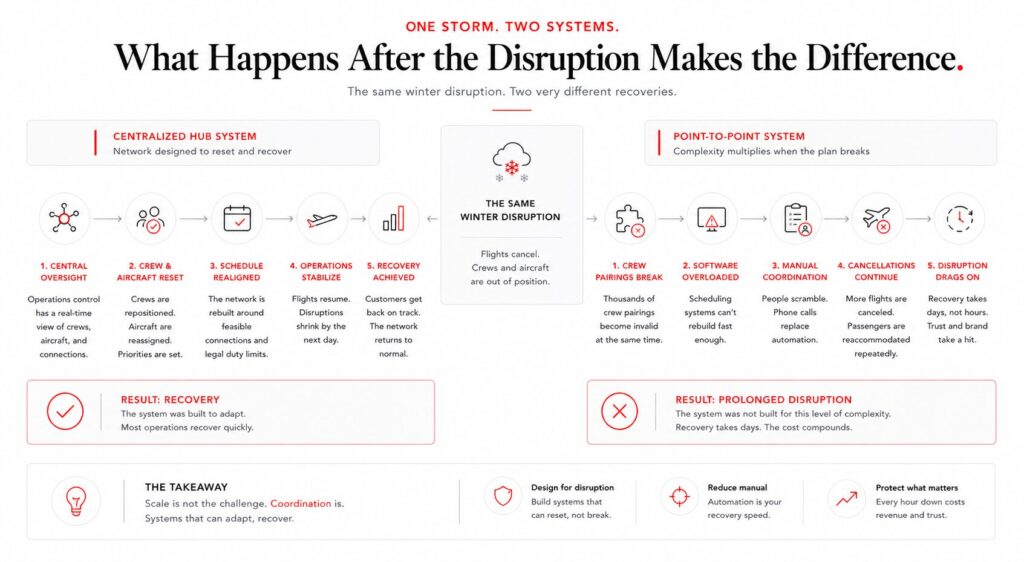
Inside the Scheduling System Behind the Southwest Airlines 2022 Meltdown
Southwest had used an aging crew-scheduling system for years, with warnings about its limitations raised internally before the storm. The system worked fine under normal disruption volume. It was never built to reassign the number of crews and aircraft the December 2022 storm required, all at once, across the entire network.
The gap between normal-day performance and crisis-day performance is where the meltdown lived. A system tested only under ordinary conditions gives a company no real information about how it behaves under stress.
Why Did Manual Coordination Replace the Scheduling System?
The scheduling software failed to process the volume of reassignments needed once cancellations passed a certain threshold, so staff shifted to manual phone calls and spreadsheets to track and reassign crews, a slower process falling further behind as cancellations kept growing.
The Real Cost of the Southwest Airlines 2022 Meltdown
The financial and regulatory cost of the meltdown surpassed a billion dollars, including refunds, reimbursements, and a 140 million dollar civil penalty from the Department of Transportation, the largest ever issued under the agency’s consumer protection authority. The reputational cost added weight beyond the balance sheet. Two million passengers experienced the failure directly, during one of the busiest travel weeks of the year.
The Hidden System Problem Behind the Southwest Airlines 2022 Meltdown
Southwest’s public explanation centered on the weather and the scale of the storm. The deeper problem sat in the scheduling infrastructure underneath daily operations, a system built for a smaller, calmer version of the airline Southwest had become.
Growth had added routes, aircraft, and daily flights for years. The scheduling system meant to coordinate all of it did not receive the same level of investment. The airline scaled the parts customers see, more destinations, more flights, while the operational core supporting those additions aged in place.

What Is Operational Resilience for a Growing Business?
Operational resilience means a company’s systems keep functioning, or recover quickly, when normal conditions break down. A business with strong resilience absorbs a disruption without collapsing into manual, ad-hoc processes across its entire operation.
What Growing Companies Should Learn From the Southwest Airlines 2022 Meltdown
Founders running businesses between one million and thirty million dollars in revenue rarely operate at Southwest’s scale, but the underlying pattern repeats at every size. A company adds customers, locations, or products faster than it upgrades the systems coordinating them. Everything holds together during normal weeks. The first real disruption exposes the gap.
Efficiency on a good day says little about a company’s resilience on a bad one. The meltdown proved this at the scale of a national airline. The same test applies to a ten-person operations team running on a spreadsheet nobody has rebuilt in three years.
The Creativz Operational Resilience Test
Before scaling operations further, a business should test what happens when the normal workflow stops.
- Single source of truth: The team works from one accurate, shared source of information, not competing spreadsheets or disconnected systems.
- Automatic reassignment: The system reassigns work or resources without a person manually rebuilding the schedule from scratch.
- Clear ownership during exceptions: One person or team owns the recovery process when something breaks, with no ambiguity about who acts first.
- Customer communication: Customers get answers during a disruption, not silence while the business works the problem internally.
- Recovery speed: Leadership knows, in advance, how long a full recovery from a major disruption should take, and tracks progress against the target.

What Should Founders Test Before Scaling Their Operations?
A founder runs a stress test on the current system, deliberately, before volume forces the test to happen in public. Cutting a data feed, delaying a shipment, or doubling lead volume for a day reveals where manual workarounds hide inside a process appearing automated on paper.
Want to Go Deeper?
Final Thought
Southwest did not fail because a storm hit during the holidays. Every airline faced the same weather. Southwest failed because the scheduling system underneath its growth never scaled with the rest of the business, and the gap stayed invisible until a real disruption forced it into view.
The pattern applies far below the scale of a national airline. Systems built for a smaller, calmer version of a business rarely announce their limits in advance. They wait for the week volume spikes, a process breaks, or a competitor moves faster, and the gap becomes public.
Start with a Digital Growth Audit to find where your operations would hold up under real pressure and where they would not.
Or take the Revenue System Scorecard for a faster, self-guided look at your current infrastructure.

Creativz.io
Creativz.io is a digital growth consulting firm that builds revenue infrastructure for B2B founders scaling from $500K to $10M ARR. The team architects conversion systems, CRM pipelines, lead-nurture automation, and analytics infrastructure that turn website traffic into predictable revenue. Creativz has worked across construction, SaaS, fintech, B2B services, and logistics, with a focus on systems that scale without scaling headcount.
