
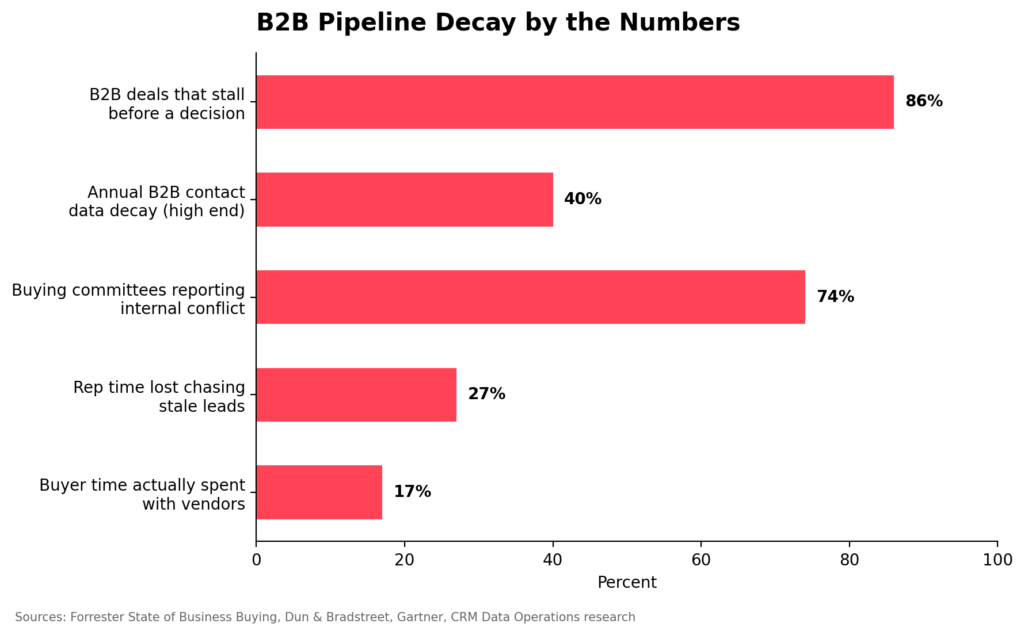
Eighty-six (86%) percent of B2B deals stall before a decision gets made. Most founders call that slow sales. The data points to something else entirely: pipeline decay.
Pipeline decay does not look like a lost deal. It looks like a normal CRM report: deals sitting in stage, close dates sliding forward, nothing on the dashboard flagging a problem.
So the pattern hides in plain sight. Pipeline decay is measurable; it compounds fast, and most founders scaling past a million in revenue are absorbing the cost without ever seeing it named.
Where This Data Comes From
The six data points below come from published research on B2B buying behavior and CRM data quality. We cite each source at first use.
On top of that, we layered in patterns Creativz has observed while running Digital Growth Audits across active client pipelines. Client-specific figures stay generalized, since we protect confidentiality above all else.
Key Findings at a Glance
- 86 percent of B2B purchases stall at some point before a decision gets made (Forrester’s State of Business Buying research).
- B2B contact data decays 22.5 to 40 percent a year, depending on the benchmark and industry (Dun and Bradstreet research).
- Buyers spend only 17 percent of their total purchase time actually meeting with vendors. The rest happens internally, out of sight of the seller.
- Deals with six or more stakeholders stall at roughly double the rate of deals with three or fewer.
- Sales reps lose an estimated 27 percent of their time, over 500 hours a year, chasing invalid or outdated leads.
- 74 percent of buying committees report internal conflict, and aligned committees are 2.5 times more likely to reach a high-quality decision.
Why Deals Stall Before Pipeline Decay Sets In
A stalled deal and a lost deal are not the same problem. A lost deal gets evaluated and declined. A stalled deal simply stops moving, often for reasons that have nothing to do with your offer.
Forrester’s stall-rate research puts the figure at 86 percent of B2B purchases. That is not a rejection rate. It is a stall rate, and it is the starting point for pipeline decay. Most of that pipeline never receives a formal close-lost. Instead, it sits quietly in whatever stage it occupied when momentum stopped.
The reason usually traces back to the buying committee rather than the product. Because Gartner’s research on buying groups found that 74 percent of committees experience real internal conflict, and the ones that resolve it are 2.5 times more likely to land on a high-quality decision. Every additional stakeholder adds a veto point.
As a result, deals with six or more stakeholders stall at close to double the rate of simpler deals with three or fewer, which is exactly the setup that lets pipeline decay take hold.
The Pipeline Decay Clock Nobody Is Watching
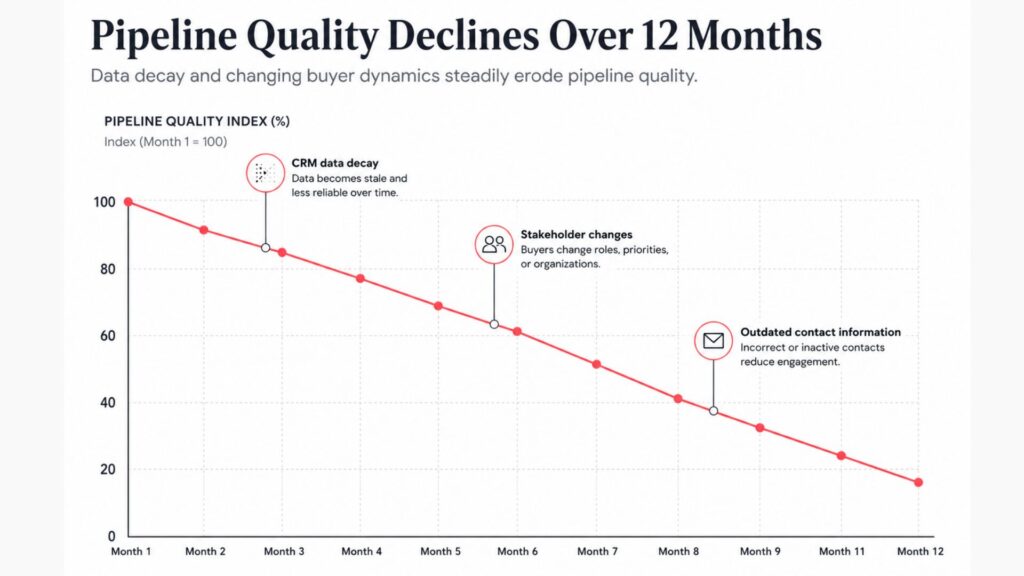
Speed is the variable most founders ignore, and the data explains why that matters. B2B contact information decays fast. Depending on the benchmark, data decay runs between 22.5 and 40 percent a year, with technology and financial services sitting at the higher end of that range.
A stalled deal is not the same deal six months later. The champion may have changed roles. The budget owner may have left the company. The email address that worked in January may bounce in July. So every month a deal sits untouched, the odds of the underlying facts still holding true go down.
This is not just a pipeline hygiene issue either, since it costs real time too. Research on CRM data operations estimates sales reps lose roughly 27 percent of their week, over 500 hours a year, chasing leads and contacts that pipeline decay has already made stale.
What Pipeline Decay Actually Costs a Scaling Founder
| Pipeline State | Typical Pattern | Founder Impact |
|---|---|---|
| Ungoverned pipeline | Deals age with no owner, no decay tracking, no reactivation trigger | Reps waste time chasing invalid contacts, forecasts drift from reality |
| Governed pipeline | Stalled deals get flagged, verified, and either reactivated or archived on a schedule | Rep time redirects to live opportunities, forecast reflects actual pipeline health |
The gap between these two states is not a tooling problem. Most CRMs already carry the fields needed to track deal age and last activity. Instead, the gap is a process nobody assigned to anyone, which is exactly the kind of leak a proper CRM setup and a Digital Growth Audit are built to find.
A Framework for Prioritizing Stalled Deals
Not every stalled deal deserves a reactivation attempt. So run a simple scoring pass before you spend rep time on outreach.
- Confirm the problem still exists. If the pain point the buyer originally described is gone, archive the deal.
- Verify the contact is still active. Check whether the champion still works at the company and still holds influence over the decision.
- Check deal age against the decay clock. Treat pipeline older than 12 months with no verified activity as high-risk, not high-priority.
- Weigh stakeholder count. Deals that stalled with six or more people involved need a different reactivation approach than a single-stakeholder deal.
- Assign an owner before you reach out. Otherwise, a reactivated deal without a named owner decays again within a quarter.
How do you know if a stalled deal is worth reactivating?
Check whether the original problem still exists and whether the contact remains active and influential. If both hold true, the deal deserves a real attempt.
What is the fastest way to reopen a cold B2B deal?
Lead with new information relevant to the buyer’s original problem instead of a status question. A generic check-in rarely earns a reply.
How often should a company audit its pipeline for decay?
Quarterly, at minimum. Given a 22.5 to 40 percent annual decay rate, a pipeline reviewed once a year has already lost a meaningful share of its accuracy before anyone looks at it.
Why Pipeline Decay Matters for Founders Scaling Past $1M
Reactivating existing pipeline is almost always cheaper than generating new leads, since the contact already understands the problem you solve. What is missing is not awareness. Instead, what is missing is a system that catches decay before it becomes permanent.
So founders who build that system into their revenue engine recover pipeline value that would otherwise disappear quietly, quarter after quarter.
Want to Go Deeper?
- How to Set Up a CRM That Actually Closes Deals (For Founders Scaling Past $1M) — the ownership and routing structure that keeps a reactivated deal from decaying again.
- The Post-Proposal Problem: Why Your B2B Proposal Follow-Up Is Losing You Deals — what happens to a deal in the gap between proposal and decision.
- Why Fast Response Time Wins More Deals Than Better Marketing — why speed compounds across the whole pipeline, not only reactivation.
Final Thought
The data points in this piece describe the same problem from six different angles. Deals stall for structural reasons, the data underneath them decays fast, and most revenue teams have no system built to catch either one. So the founders who recover that lost value are not the ones with better closing scripts. Instead, they are the ones who build a process to catch pipeline decay before six months of silence becomes permanent.
If you want a clear picture of where your own pipeline is leaking, start with a Digital Growth Audit. It maps exactly where deals stall and why.
You can also run your own numbers first with the Revenue System Scorecard to see how your current pipeline process holds up.

Creativz.io
Creativz.io is a digital growth consulting firm that builds revenue infrastructure for B2B founders scaling from $500K to $10M ARR. The team architects conversion systems, CRM pipelines, lead-nurture automation, and analytics infrastructure that turn website traffic into predictable revenue. Creativz has worked across construction, SaaS, fintech, B2B services, and logistics, with a focus on systems that scale without scaling headcount.
